J.M.W. Turner: Sketchbooks, Drawings and Watercolours

ISBN 978-1-84976-386-8

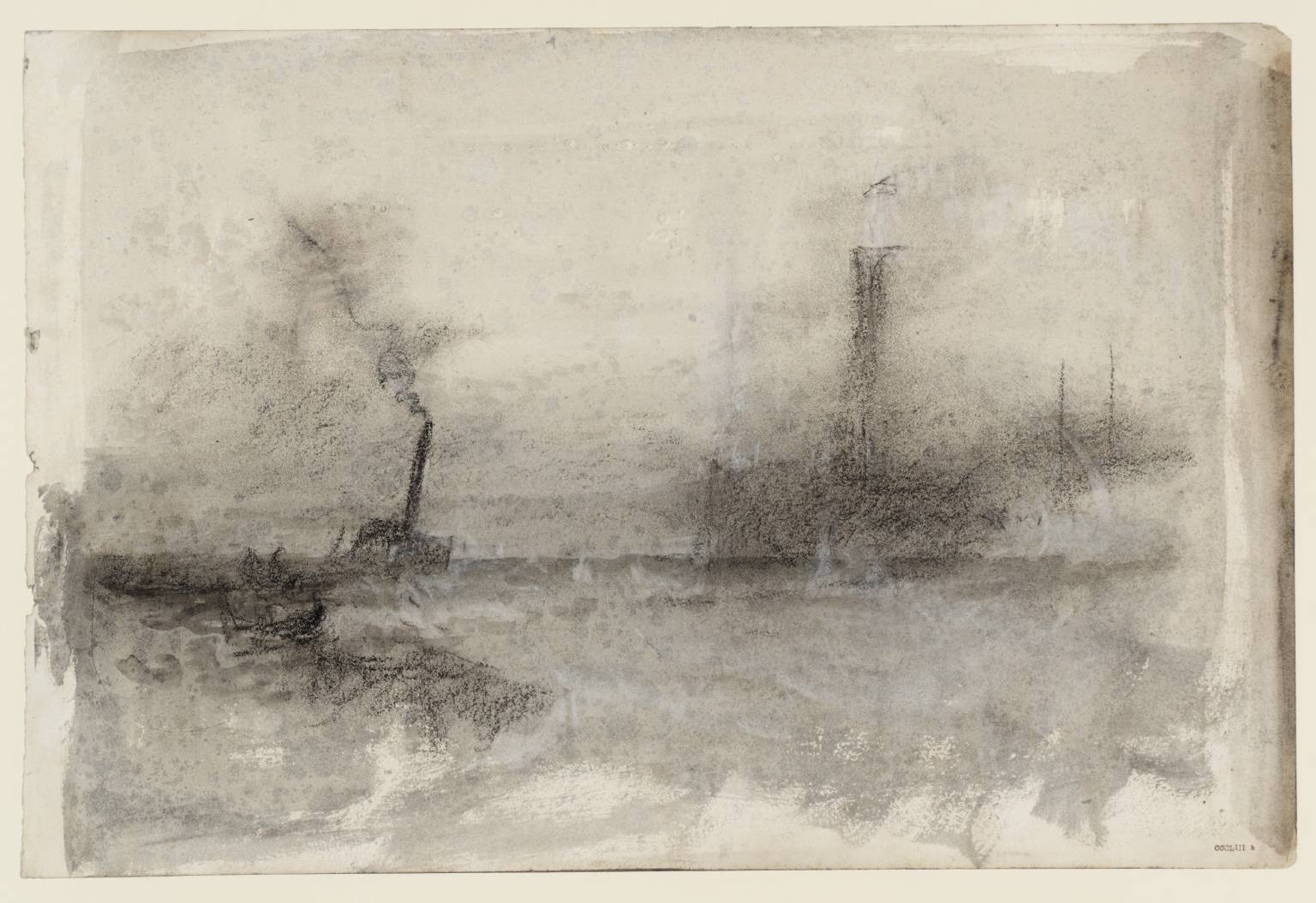
Joseph Mallord William Turner A Steamer Leaving Harbour c.1845

A Steamer Leaving Harbour c.1845
D35244
Turner Bequest CCCLIII 5
Chalk and watercolour on white wove paper prepared with a grey wash, 221 x 333 mm
Watermark ‘J Whatman | Turkey Mills | 1823
Blind-stamped with Turner Bequest monogram bottom right
Inscribed in red ink ‘5’ bottom right (now very faint)
Stamped in black ‘CCCLIII 5’ bottom right
Accepted by the nation as part of the Turner Bequest 1856
A steam ship, its plume of smoke rising to the left, is seen departing from the mouth of a harbour. In its wake lies a stream of foam. The angle of the ship, vigorously drawn black waves and white sea-spray suggest the violent motion of a choppy sea. A vertical cliff and a lighthouse, its light rendered in white chalk, rises above the sea to the right. Two vertical lines at the far right indicate the masts of other ships in the harbour. Luke Herrmann has suggested that Turner sketched this scene on-the-spot from the shore or from another boat, as he was often known to do.1
Attempts have been made to identify the harbour in this sketch. David Blayney Brown believes that the harbour strongly resembles that of Dieppe.2 Turner did visit Dieppe in the autumn of 1845, using the Dieppe sketchbook (see Tate D35460; Turner Bequest CCCLX 2, and numerous subsequent pages) and the Dieppe and Kent sketchbook (see under Tate D35541; Turner Bequest CCCLXI 31), although no identified view of the town in his other work appears to exactly match that seen here. Compositionally, it does indeed correspond with a drawing of the same title (as given by Finberg) in the Dieppe and Kent book (D35648; CCCLXI 90).
Robert Upstone subsequently proposed Ramsgate as the location, based on the similarity between the beacon here and that in Turner’s watercolour of Ramsgate made around 1824 for the Ports of England series (Tate D18150; Turner Bequest CCVIII Q).3 Given the relative obscurity of topographical detail here, however, it is difficult to ascertain a specific locale. It is entirely possible that this scene is one of Turner’s own invention, rooted in his observations of the harbours of the Dieppe and Kent coasts.
1
Herrmann 1980, p.15.
2
Brown 1987, p.18.
3
Andrew Wilton, J.M.W. Turner: His Life and Work, Fribourg 1979, p.387 no.754; see Upstone 1993, p.61 under no.55.
Technical Notes:
There is a fingerprint in black watercolour half-way along the right-hand edge. The edges of the leaf are discoloured, particularly so down the right-hand edge, probably as a result of damage in the Tate Gallery flood of 1928. This leaf is mounted.
The ‘technical integrity’ of this drawing has been highlighted by Brown, who suggests that, contrary to the majority of the other coastal scenes in the Whalers sketchbook, it was likely to have been produced by Turner in one session, as opposed to having been returned to at a later stage.1
1
Brown 1987, p.18.
Verso:
Blank, bearing patches of discolouration and offsetting in yellow, brown and black chalk.

Amy Concannon
May 2025

How to cite

Amy Concannon, ‘A Steamer Leaving Harbour c.1845’, catalogue entry, May 2025, in David Blayney Brown (ed.), J.M.W. Turner: Sketchbooks, Drawings and Watercolours, Tate Research Publication, July 2026, https://www.tate.org.uk/art/research-publications/jmw-turner/a-steamer-leaving-harbour-r1214152, accessed 11 July 2026.