
J.M.W. Turner
>
1830-35 Annual tourist
>
Byroniana c.1831-4
>
Artwork
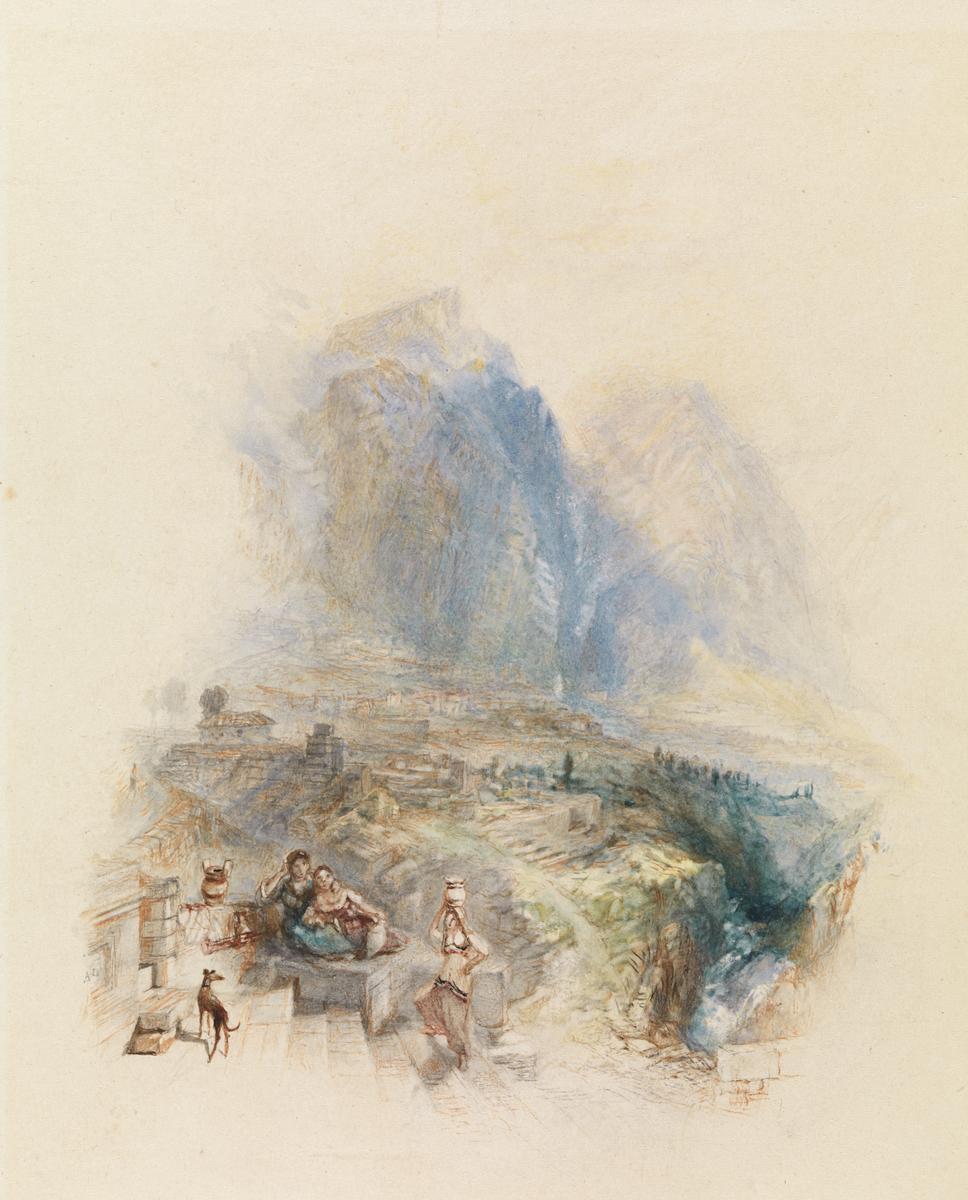
Joseph Mallord William Turner Parnassus and Castalian Spring (Delphi) 1832
Joseph Mallord William Turner,
Parnassus and Castalian Spring (Delphi)
1832
Parnassus and Castalian Spring (Delphi) 1832
N05238
Watercolour and gouache on white laid paper, 184 x 140 mm
Bequeathed by Beresford Rimington Heaton 1940
Provenance:
...; art dealer and publisher David Thomas White (operating 1834–1860), London; bought in spring 1855 by Ellen Heaton (1816–1894), Leeds, though John Ruskin, for around 55 guineas; bequeathed to her nephew Beresford Rimington Heaton (1863–1940)
...; art dealer and publisher David Thomas White (operating 1834–1860), London; bought in spring 1855 by Ellen Heaton (1816–1894), Leeds, though John Ruskin, for around 55 guineas; bequeathed to her nephew Beresford Rimington Heaton (1863–1940)
Exhibition history
1992
Turner and Byron, Tate Gallery, London, June–September 1992 (73).
1997
Joseph Mallord William Turner, Bank Austria Kunstforum, Vienna, March–June 1997 (74).
1997
J.M.W. Turner 1775–1851: A Tate Gallery Collection Exhibition, Yokohama Museum of Art, June–August 1997, Fukuoka Art Museum, September–October; Nagoya City Art Museum, October– December 1997 (65).
2021
J.M.W. Turner: Sun is God, ARoS Kunstmuseum, Aarhus, October 2021–March 2022 (52).
2022
Turner: La luz es color, Museu Nacional d’Art de Catalunya, Barcelona, May‒September 2022 (no catalogue).
2022
J.M.W. Turner: The Sun is God, National Gallery of Ireland, Dublin, October 2022‒February 2023 (no catalogue).
2023
Turner: The Sun is God: En collaboration avec la Tate, Fondation Pierre Gianadda, Martigny, March–June 2023 (26).
References
1975
Mordechai Omer, Turner and the Poets, exhibition catalogue. Marble Hill House, London 1975, p.[27].
1972
Virginia Surtees (ed.), Sublime & Instructive; Letters from John Ruskin to Louisa, Marchioness of Waterford, Anna Blunden and Ellen Heaton, London 1972, pp.152, 153, 154, 162, 163, 164, 165, 173, 194, 195, 216.
1979
Andrew Wilton, The Life and Work of J.M.W. Turner, Fribourg 1979, pp.446–7 no.1228, reproduced.
1992
David Blayney Brown, Turner and Byron, exhibition catalogue, Tate Gallery, London 1992, pp.52, 53, 113, reproduced.
1993
Jan Piggott, Turner’s Vignettes, exhibition catalogue, Tate Gallery, London 1993, pp.48, 99.
1997
David Blayney Brown and Klaus Albrecht Schröder, Joseph Mallord William Turner, exhibition catalogue, Bank Austria Kunstforum, Vienna 1997, pp.36, 259, reproduced in colour, p.260.
1997
David Blayney Brown, Turner 1775–1851, exhibition catalogue, Yokohama Museum of Art, Yokohama 1997, pp.37, 124 reproduced in colour.
2001
Martin Butlin, ‘Greece’, in Evelyn Joll, Martin Butlin and Luke Herrmann eds., The Oxford Companion to J.M.W. Turner, Oxford 2001, p.131.
2021
Amy Concannon in Maria Kappel Blegvad (ed.), David Blayney Brown and Concannon, Sun is God: Joseph Mallord William Turner, exhibition catalogue, ARoS Aarhus Kunstmuseum, Aarhus 2021, p.52 reproduced in colour, p.176.
2023
Amy Concannon in David Blayney Brown and Concannon, Turner: The Sun is God, exhibition catalogue, Fondation Pierre Gianadda, Martigny 2023, pp.33, 63, reproduced in colour, p.149.
This vignette depicts a scene in Greece, the slopes of Mount Parnassus and the Castalian stream with women from the village of Kastri collecting pitchers of its sacred waters for drinking or laundry. Engraved by Edward Finden (1791‒1857) in 1833, it appeared as the frontispiece to volume XIV of John Murray’s edition of The Works of Lord Byron, with his Letters and Journals, and his Life, by Thomas Moore, Esq. (Tate impression: T06652), and in part XIV of Finden’s Landscape and Portrait Illustrations to the Life and Works of Lord Byron. Murray paid £28 7 shillings for Turner’s drawing and one by William Page (1794‒1872) for Turner to use as his source, having never been to Greece himself, and £37 5 shillings and sixpence for Finden’s engraving.
The illustrations Turner supplied to Murray were designed to evoke the countries and landscapes Byron (1788‒1824) had seen and written about. They seem not to have been intended to illustrate particular passages in Byron’s poems, at least not exclusively, and were deployed somewhat arbitrarily throughout Murray’s seventeen volumes to build a cumulative impression of the Byronic world, its history, associations and current condition. As the frontispiece to volume XIV this subject was associated with lines from The Island (II, xii) describing the narrator’s rovings across time and place, North and South:
Long have I roamed through lands which are not mine,
Adored the Alps, and loved the Apennine,
Revered Parnassus...
Mixed Celtic memories with the Phrygian mount,
And Highland’s linns with Castalie’s clear fount
Adored the Alps, and loved the Apennine,
Revered Parnassus...
Mixed Celtic memories with the Phrygian mount,
And Highland’s linns with Castalie’s clear fount
Turner has not attempted any such mingling, and his vignette is entirely Greek in content. He was probably more inspired by the direct tribute to Delphi and address to its ancient ‘Muse’ at the beginning of Childe Harold’s Pilgrimage where Byron assures ‘thou in Hellas deemed of heavenly birth’ that he will not ‘call thee from thy sacred hill’:
Yet there I’ve wandered by thy vaunted rill,
Yes! Sighed o’er Delphi’s long deserted shrine,
Where, save that feeble fountain, all is still.
Yes! Sighed o’er Delphi’s long deserted shrine,
Where, save that feeble fountain, all is still.
This passage and Byron’s footnote describing Kastri on the slopes of Parnassus, with its deep Pythian cave, Greek monastery and descending Castalian stream, could have contributed as much to Turner’s design as Page’s working sketch. Byron had visited the site in 1809 with his friend John Cam Hobhouse (1786‒1869), leaving his name on a column from the ancient gymnasium where the painter Charles Eastlake (1793‒1865) found it in 1818. As Jan Piggott observed, Byron habitually used Delphi and Parnassus as symbols of poetic inspiration, and ‘Parnassus’ and ‘Castalian’ loosely for ‘poetry’ in his poems and letters.1
Believed by the ancient Greeks to be the centre of the world, where Apollo killed the serpent Python as painted by Turner in Apollo and Python (1811; Tate N00488)2 and the site of the Pythian oracle and the stream or fount in which the Pythoness bathed to prepare herself for prophecy, Delphi was a place of pilgrimage in spectacular mountain scenery. Its ancient buildings largely invisible to Byron’s generation and Kastri impoverished and down-at-heel, it prompted melancholy reflections on past splendour and present decline. Travels in Sicily, Greece and Albania by Thomas Smart Hughes (London 1820), of which Turner owned a copy (private collection),3 contains a long account of Delphi’s history and scenery, such as must inspire ‘the painter who could raise his ideas to the sublime associations with which it is connected’.4 Kastri however was ‘a wretched village ... whose low mud cottages, joint tenements of man and beast, occupy the site of that gorgeous city’ and the ‘sacred stream’ was ‘miserably degraded’ by Albanian women doing their washing.5 Kastri would be abandoned altogether in 1890 and its population moved elsewhere, to allow excavations of ancient Delphi to begin in 1892.
The initial history of this work after it was engraved for John Murray is yet to be established.6 It was left to the Tate Gallery in 1940 by Beresford Rimington Heaton, a solicitor born in Leeds in 1863;7 he was the nephew of Ellen Heaton (1816–1894), a patron of the Pre-Raphaelites and friend of the writer John Ruskin, Turner’s patron and critical champion. In Virginia Surtees’s study of Miss Heaton’s association and correspondence with Ruskin, there are extensive references to the present work. Ruskin was evidently closely involved in her acquiring it from the London dealer David Thomas White.8 On 3 February 1855 Ruskin wrote to Miss Heaton to advise her of five Turner vignettes available from White, including this one and (apparently) Tate N05242, The Walls of Rome (another Byron subject) initially at 65 guineas each.9 After further negotiations in the spring of 1855, with Ruskin suggesting a 55 guinea price for the present subject10 to Miss Heaton, in another letter to her (likely in May), he wrote that he was ‘very glad you have the Parnassus – which is a firstrater – (Note how Turner has given the boiling up in globular fountains of the spring – how different from a common torrent. The exquisite grace of the figures is almost unique)’.11 He continued to comment in passing on the design over the next couple of years.12
In 1894 Miss Heaton ‘left her estate to her nephew’,13 and in 1940 he bequeathed eight Turner watercolours to the Tate Gallery (Tate N05236–N05243), along with works by D.G. Rossetti and Arthur Hughes (N05228–N05235, N05244–N05245).14 Of the Turners, this one, N05242 and N05243 are Byron subjects, all acquired by Ellen Heaton at around the same time.
Martin Butlin and Evelyn Joll, The Paintings of J.M.W. Turner, revised ed., New Haven and London 1984, p.82 no.115, pl.119.
Extended provenance information has been provided by Matthew Imms while preparing this entry for publication.
See ‘David Thomas White’, The British Museum, accessed 3 April 2025, https://www.britishmuseum.org/collection/term/BIOG119182 .
Dianne Sachko Macleod, ‘Heaton, Ellen (1816–1894), art collector and philanthropist’, 24 May 2007, Oxford Dictionary of National Biography, accessed 3 April 2025, https://www.oxforddnb.com/view/10.1093/ref:odnb/9780198614128.001.0001/odnb-9780198614128-e-62814 .
See The Tate Gallery: Report of the Trustees for the Year 1 April 1953 to 31 March 1954 with a Brief Survey of the Period 1 January 1938 to 31 March 1953, London 1954, p.44, pp.44–5, and Robert Upstone, The Pre-Raphaelite Dream: Paintings and Drawings from the Tate Collection, exhibition catalogue, Art Gallery of Western Australia, Perth 2003, pp.27–8.
Verso:
Blank
David Blayney Brown and Matthew Imms
April 2025
How to cite
David Blayney Brown and Matthew Imms, ‘Parnassus and Castalian Spring (Delphi) 1832’, catalogue entry, April 2025, in David Blayney Brown (ed.), J.M.W. Turner: Sketchbooks, Drawings and Watercolours, Tate Research Publication, July 2026, https://www