
J.M.W. Turner
>
1830-35 Annual tourist
>
Byroniana c.1831-4
>
Artwork
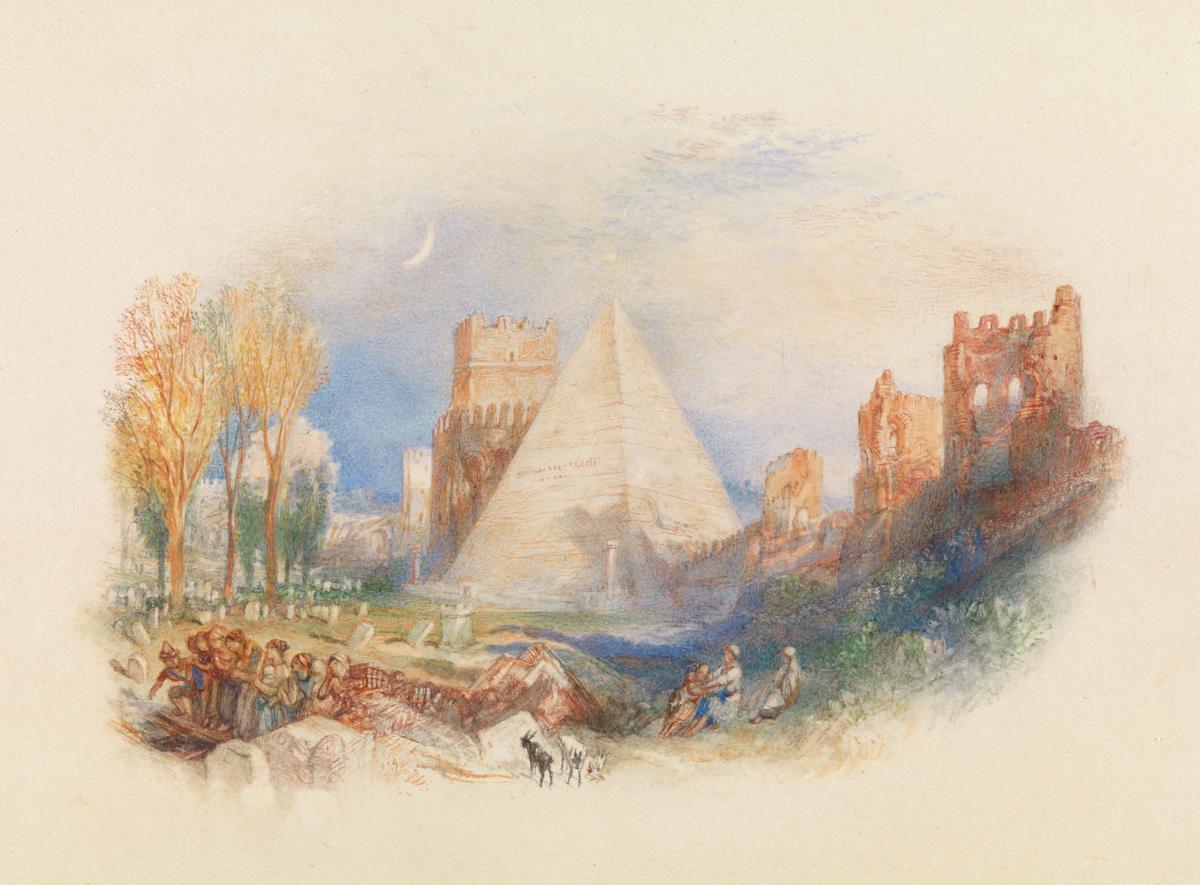
Joseph Mallord William Turner The Walls of Rome, with the Tomb of Caius Sestus 1832
Joseph Mallord William Turner,
The Walls of Rome, with the Tomb of Caius Sestus
1832
The Walls of Rome, with the Tomb of Caius Sestus 1832
N05242
Watercolour and gouache on white laid paper, 146 x 197 mm
...; art dealer and publisher David Thomas White (operating 1834–1860), London; bought in spring 1855 by Ellen Heaton (1816–1894), Leeds, though John Ruskin, likely for around 55 guineas; bequeathed to her nephew Beresford Rimington Heaton (1863–1940)
Bequeathed by Beresford Rimington Heaton 1940
Exhibition history
1974
Turner 1775–1851, Royal Academy of Arts, London, November 1974– March 1975 (286).
1992
Turner and Byron, Tate Gallery, London, June–September 1992 (73).
2013
J.M.W. Turner: The Making of a Master, Art Gallery of South Australia, Adelaide, February–May 2013; National Gallery of Australia, Canberra, June–September 2013 (66).
2014
Turner from the Tate: The Making of a Master, Metropolitan Art Museum, Tokyo, October‒December 2013; City Museum, Kobe, January‒April 2014 (48).
2021
J.M.W. Turner: Sun is God, ARoS Kunstmuseum, Aarhus, October 2021–March 2022 (no number).
2022
Turner/ La luz es color, Museu Nacional d’Art de Catalunya, Barcelona, May‒September 2022 (no catalogue).
2022
J.M.W. Turner: The Sun is God, National Gallery of Ireland, Dublin, October 2022‒February 2023 (no catalogue).
2023
Turner: The Sun is God: En collaboration avec la Tate, Fondation Pierre Gianadda, Martigny, March–June 2023 (25).
References
1972
Virginia Surtees (ed.), Sublime & Instructive; Letters from John Ruskin to Louisa, Marchioness of Waterford, Anna Blunden and Ellen Heaton, London 1972, pp.152, 153, 154, 155, 156, 157, 159, 160, 162, 194, 216, 241, 250, 253, pl.16, as ‘The Walls of Rome, Tomb of Caius Sestius [sic]’ (roughly cropped to image).
1974
Martin Butlin, Andrew Wilton and John Gage, Turner 1775–1851, exhibition catalogue, Royal Academy of Arts, London 1974, p.100.
1975
Mordechai Omer, Turner and the Poets, exhibition catalogue. Marble Hill House, London 1975, p.[27].
1979
Andrew Wilton, The Life and Work of J.M.W. Turner, Fribourg 1979, p.446 no.1227, reproduced.
1992
David Blayney Brown, Turner and Byron, exhibition catalogue, Tate Gallery, London 1992, pp.52, 112, reproduced.
1993
Jan Piggott, Turner’s Vignettes, exhibition catalogue, Tate Gallery, London 1993, pp.48, 99.
2001
Cecilia Powell, ‘Rome’, in Evelyn Joll, Martin Butlin and Luke Herrmann eds., The Oxford Companion to J.M.W. Turner, Oxford 2001, p.269.
2013
Ian Warrell ed., J.M.W. Turner: The Making of a Master, exhibition catalogue, Art Gallery of SouthAustralia, Adelaide 2013, pp.59, 149, 153, reproduced in colour.
2013
Ian Warrell ed., Turner from the Tate: The Making of a Master, exhibition catalogue, Metropolitan Art Museum, Tokyo 2013, p.106, reproduced in colour.
2021
Amy Concannon in Maria Kappel Blegvad (ed.), David Blayney Brown and Concannon, Sun is God: Joseph Mallord William Turner, exhibition catalogue, ARoS Kunstmuseum, Aarhus 2021, p.53, reproduced in colour, p.176.
2023
Amy Concannon in David Blayney Brown and Concannon, Turner: The Sun is God, exhibition catalogue, Fondation Pierre Gianadda, Martigny 2023, pp.33, 62, reproduced in colour, p.148.
Lord Byron (1788‒1824) set scenes in his verse drama The Deformed Transformed beside the walls of Rome. Accordingly this vignette, engraved by Edward Finden (1791‒1857), appeared in January 1833 on the title page of volume XIII of The Works of Lord Byron, with his Letters and Journals, and his Life, by Thomas Moore, Esq. containing the play (Tate impression: T06651). It was also included in Finden’s Landscape and Portrait Illustrations to the Life and Works of Lord Byron, in part XIII. The publisher John Murray’s accounts cite £31 10 shillings for the watercolour and a working sketch, and £54 for the engraving.
Instead of the sixteenth-century siege of Rome envisioned in Part II of Byron’s play, Turner’s vignette is a graveyard scene in the Protestant (now the non-Catholic) cemetery beneath the city walls, with the pyramidal tomb of Cestius and the Porta San Paolo. Mourners beside a freshly dug grave and a modest wood coffin provide a poignant modern counterpoint to the grandiose ancient tomb. It is evening, doubly lit by setting sun and rising moon, an effect loved by Byron and adopted by Turner in many of his Byronic subjects. Rather than prompted by Byron’s stage directions, Turner’s reflections on transience and the passage of time seem to echo those of Bourbon in the previous scene of the play, on the ‘past earth and present phantom of Imperial Rome’ and the ghosts that ‘flit along the eternal city’s rampart | And stretch their glorious, gory, shadowy hands | And beckon me away’. Nevertheless, Jan Piggott found these connections tenuous beside the ‘eloquent meditations on the fragile world and the fall of civilisation’ in the fourth canto of Childe Harold’s Pilgrimage.1
The tomb of the still-mysterious Cestius probably dates from between 18 and 12 BC and reflects the Egyptomania current in Rome after Egypt became subsumed into its empire. Byron did not mention the pyramid in his play and in Childe Harold referred instead to the tower containing the tomb of Cecilia Metella near another section of the walls. He and his friend John Cam Hobhouse (1786‒1869) knew both these monuments from their rides around the Roman walls in 1810 and in his prose Historical Illustrations to the Fourth Canto of Childe Harold (London 1818) Hobhouse dryly observed that ‘Cestius is as little famous as Metella, and his pyramid is no less conspicuous than her tower. Oblivion, however, has been kind perhaps to one who has left no other present to posterity than this ambitious sepulchre.’2
The initial history of this work after it was engraved for John Murray is yet to be established.3 It was left to the Tate Gallery in 1940 by Beresford Rimington Heaton, a solicitor born in Leeds in 1863.4 In Andrew Wilton’s standard catalogue of Turner’s watercolours, he noted one intervening transaction: ‘H.A.J. Munro of Novar, sale 6 April 1878 (77), bt. Makins’.5 Turner’s friend and patron Munro (1797‒1864) had built up a collection of around 130 drawings by Turner included ‘illustrations to the poets’.6 The Wilton entry concurs with the relevant entry in a posthumous Christie’s sale catalogue: ‘The Walls of Rome: Tomb of Caius Sextus [sic]. Engraved in Finden’s illustrations to Lord Byron’s Works | 5 ½ x 8 ½ in[ches]’.7 If reliable, these dimensions equate to 140 x 216 mm, varying somewhat from the 146 x 197 mm given here for this sheet.
However, this conflicts with another well-documented narrative. B.R. Heaton was the nephew of Ellen Heaton (1816–1894), a patron of the Pre-Raphaelites and friend of the writer John Ruskin, Turner’s patron and critical champion. In Virginia Surtees’s study of Miss Heaton’s association and correspondence with Ruskin, there are extensive apparent references to the present work. Ruskin was evidently closely involved in her acquiring it from the London dealer David Thomas White.8 On 3 February 1855 Ruskin wrote to Miss Heaton to advise her of five Turner vignettes available from White, including a ‘Walls of Rome’ subject along with ‘Mount Parnassus’, evidently Tate N05238, Parnassus and Castalian Spring (Delphi) (another Byron subject), initially at 65 guineas each.9 Ruskin wrote again on 9 February:
Mr White undertook yesterday to send you the Walls of Rome, which I had no hesitation in choosing for you in fulfilment of the authority with which you had entrusted me. The vignette of Berne [likely the Byron vignette now called View of Berne and the Bernese Alps (The Frances Lehman Loeb Art Center, Vassar College, Poughkeepsie)10] – subject and all being considered – was the most pleasurable I thought as a possession but the walls of Rome are far greater as a work of art. I have no hesitation in ranking this as among the nine or ten best vignettes which Turner ever executed – None are better and it contains his utmost refinement of execution and preciousness of colour – & tenderness of heart.11
Assuming that the present sheet is the one so admired by Ruskin and acquired in 1855, it seems unlikely that Ellen Heaton would have sold it to Munro in the last year of his life before repurchasing it at a much higher price in or after 1878. Perhaps the Christie’s catalogue of that year is mistaken in identifying Munro’s work as the engraved ‘Walls of Rome’ design, or (less likely) it might have been another version or variant, otherwise unrecorded. At any event, in 1894 Miss Heaton ‘left her estate to her nephew’,14 and in 1940 B.R. Heaton bequeathed eight Turner watercolours to the Tate Gallery (Tate N05236–N05243), along with works by D.G. Rossetti and Arthur Hughes (N05228–N05235, N05244–N05245).15 Of the Turners, this one, N05238 and N05243 are Byron subjects.
Extended provenance information has been provided by Matthew Imms while preparing this entry for publication.
John Gage (ed.), Collected Correspondence of J.M.W. Turner, with an Early Diary and a Memoir by George Jones, Oxford 1980, p.273.
Catalogue of the Modern Portion of the Celebrated Collection of Pictures Known as the Novar Collection, Formed by that distinguished Amateur, the late Hugh A.J. Munro, Esq., The intimate friend and Executor of J.M.W. Turner, R.A., auction catalogue, Christie’s, London, 6 April 1878, p.13; copies held by the RKD, The Hague, have variant MS price notes 205 and 215 guineas.
See ‘David Thomas White’, The British Museum, accessed 3 April 2025, https://www.britishmuseum.org/collection/term/BIOG119182 .
Dianne Sachko Macleod, ‘Heaton, Ellen (1816–1894), art collector and philanthropist’, 24 May 2007, Oxford Dictionary of National Biography, accessed 3 April 2025, https://www.oxforddnb.com/view/10.1093/ref:odnb/9780198614128.001.0001/odnb-9780198614128-e-62814 .
See The Tate Gallery: Report of the Trustees for the Year 1 April 1953 to 31 March 1954 with a Brief Survey of the Period 1 January 1938 to 31 March 1953, London 1954, p.44, pp.44–5, and Robert Upstone, The Pre-Raphaelite Dream: Paintings and Drawings from the Tate Collection, exhibition catalogue, Art Gallery of Western Australia, Perth 2003, pp.27–8.
Verso:
Blank
David Blayney Brown and Matthew Imms
April 2025
How to cite
David Blayney Brown and Matthew Imms, ‘The Walls of Rome, with the Tomb of Caius Sestus 1832’, catalogue entry, April 2025, in David Blayney Brown (ed.), J.M.W. Turner: Sketchbooks, Drawings and Watercolours, Tate Research Publication, July 2026, https://www