
J.M.W. Turner
>
1830-35 Annual tourist
>
Byroniana c.1831-4
>
Artwork
Joseph Mallord William Turner The Castle of St Angelo, Rome 1832
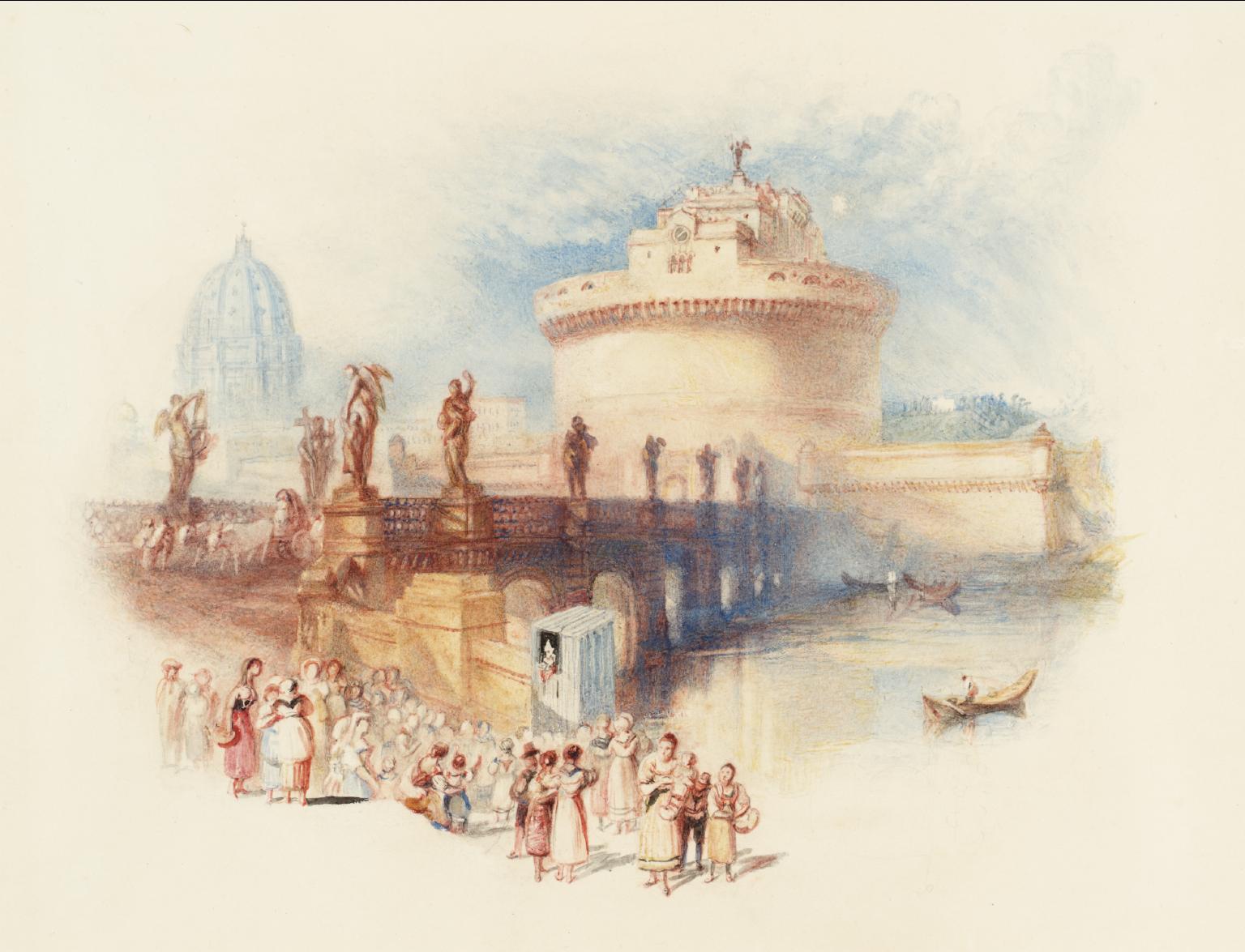
Joseph Mallord William Turner,
The Castle of St Angelo, Rome
1832
The Castle of St Angelo, Rome 1832
N05243
Watercolour and gouache on white laid paper, 171 x 210 mm
Bequeathed by Beresford Rimington Heaton 1940
Provenance:
...; art dealer and publisher David Thomas White (operating 1834–1860), London; bought between spring 1855 and autumn 1856 by Ellen Heaton (1816–1894), Leeds, though John Ruskin, likely for around £52 10 shillings; bequeathed to her nephew Beresford Rimington Heaton (1863–1940)
...; art dealer and publisher David Thomas White (operating 1834–1860), London; bought between spring 1855 and autumn 1856 by Ellen Heaton (1816–1894), Leeds, though John Ruskin, likely for around £52 10 shillings; bequeathed to her nephew Beresford Rimington Heaton (1863–1940)
Exhibition history
1974
Turner 1775–1851, Royal Academy of Arts, London, November 1974–March 1975 (285).
1992
Turner and Byron, Tate Gallery, London, June–September 1992 (65).
2018
Turner: Opere della Tate, Chiostro del Bramante, Rome, March–August 2018 (66).
2018
J.M.W. Turner: Acuarelas: Tate Collection, Museo Nacional de Bellas Artes, Buenos Aires, September 2018–February 2019 (no number).
2019
J.M.W. Turner: acuarelas / watercolours, Centro Cultural Palacio La Moneda, Santiago de Chile, March–July 2019 (no number).
2020
J.M.W. Turner: Watercolors from Tate, Mystic Seaport Museum, October‒February 2020 (no number).
2020
Turner peintures et aquarelles. Collection de la Tate, Musée Jacquemart André, Paris, May 2020–January 2021 (no number).
References
1972
Virginia Surtees (ed.), Sublime & Instructive; Letters from John Ruskin to Louisa, Marchioness of Waterford, Anna Blunden and Ellen Heaton, London 1972, pp.162, 163, 164, 188, 194, 212, 213, pl.17, as ‘Castle and Bridge of St Angelo’ (roughly cropped to image).
1974
Martin Butlin, Andrew Wilton and John Gage, Turner 1775–1851, exhibition catalogue, Royal Academy of Arts, London 1974, p.100.
1975
Mordechai Omer, Turner and the Poets, exhibition catalogue. Marble Hill House, London 1975, p.[26].
1979
Andrew Wilton, The Life and Work of J.M.W. Turner, Fribourg 1979, p.446 no.1223, reproduced.
1988
Nicholas Alfrey, ‘A Voyage Pittoresque: Byron, Turner and Childe Harold’, Renaissance and Modern Studies, vol.32, 1988, pp.108, 115, 126, reproduced.
1992
David Blayney Brown, Turner and Byron, exhibition catalogue, Tate Gallery, London 1992, pp.52, 109, reproduced.
1993
Jan Piggott, Turner’s Vignettes, exhibition catalogue, Tate Gallery, London 1993, pp.45, 47, 99.
2007
David Blayney Brown, Turner Watercolours, London 2007, pp.14, 101, reproduced in colour.
2001
Cecilia Powell, ‘Rome’, in Evelyn Joll, Martin Butlin and Luke Herrmann (eds.), The Oxford Companion to J.M.W. Turner, Oxford 2001, p.269.
2018
David Blayney Brown and Valter Curzi, Turner: Opere della Tate, exhibition catalogue, Chiostro del Bramante, Rome 2018, pp.25, 115, reproduced in colour.
2018
David Blayney Brown, J.M.W. Turner: Acuarelas: Tate Collection, exhibition catalogue, Museo Nacional de Bellas Artes, Buenos Aires 2018, pp.21, 103, reproduced in colour, pp.130, 140.
2019
David Blayney Brown, J.M.W. Turner: Acuarelas / watercolours, exhibition catalogue, Centro Cultural Palacio de La Moneda, Santiago 2019, pp.26, 113, reproduced in colour, p.155.
2019
Nicholas R. Bell (ed.), Conversations with Turner: The Watercolours, exhibition catalogue, Mystic Seaport Museum 2019, p.138, reproduced in colour.
2020
Pierre Curry, Barthélémy Jobert and David Blayney Brown, Turner peintures et aquarelles: Collection de la Tate, exhibition catalogue, Musée Jacquemart-André, Paris 2020, pp.122, 133, reproduced in colour.
Engraved by Edward Finden (1791‒1857) in 1832 (Tate impression: T06183), this vignette appeared on the title page of volume VIII of The Works of Lord Byron, with his Letters and Journals, and his Life, by Thomas Moore, Esq. Representing Rome, the subject of a long section of the fourth canto of the poem Childe Harold’s Pilgrimage by Lord Byron (1788‒1824) contained within, it answers Byron’s invitation to his readers to ‘Turn to the mole which Hadrian rear’d on high’ and ‘the dome ‒ the vast and wondrous dome’ in which ‘Power, Glory, Strength and Beauty are all aisled’. The publisher John Murray paid Turner £31 10 shillings for his watercolour and £27 for the engraving which was also included in Finden’s Landscape and Portrait Illustrations to the Life and Works of Lord Byron.
Spanning millennia in its architectural content and animated by the picturesque street life of the modern city, the view takes in the dome of St Peter’s in the left distance and the Castel Sant’ Angelo to its right, reached across the Tiber by the Ponte Sant’ Angelo. The former Pons Aurelius built by the Emperor Hadrian to provide access to his mausoleum, the bridge was rebuilt in 1667 by Gian Lorenzo Bernini (1598‒1680) for Pope Clemens IX, to provide a ceremonial entrance to the Vatican. Bernini designed ten statues for the bridge, which were finished by 1672. Hadrian’s mausoleum was completed in 139 AD, used as such for sixty years and later incorporated into the Aurelian Walls as a fortress. It was renamed Castel Sant’ Angelo following Pope Gregory the Great’s supposed vision in 590 of an angel on the top of the fortress, lowering a sword to answer his prayers for an end to plague in the city. During the Napoleonic occupation of Rome the castle was used as a prison.
Turner first depicted this view before he went to Rome in 1819, in a finished watercolour (private collection)1 based on a camera obscura outline in pencil by James Hakewill (1778‒1843) for the latter’s Picturesque Tour of Italy, published by John Murray in 1820. Hakewill’s drawing showed the bridge head-on, St Peter’s centred in the distance and the castle on the right and not much else. Working from pure imagination Turner added boats on the Tiber, people on its bank and a magnificent sky, all present in the engraving (Tate impression: T06015) by George Hollis (1793‒1842). For a vignette illustration to the poem Italy by Samuel Rogers (1763‒1855), Turner reduced and simplified the same view while greatly enlarging the dome of St Peter’s and somewhat emphasising Bernini’s statues on the bridge. The watercolour (Tate D27677; Turner Bequest CCLXXX 160) was engraved (Tate impression: T04652) by Robert Wallis (1794‒1878). In the Byron vignette the bridge is set at an angle, as seen from what was then the Lungotevere della porta, further exaggerating the size of the statues and providing road space for a Punch and Judy show and its audience of modern Romans whose gestures seem to mimic theirs.
For Jan Piggott this was ‘one of Turner’s guignols’ but overall a ‘sinister design, in keeping with the history of the fortress and prison and its associations with plague and deliverance’2 related at length by John Cam Hobhouse (1786‒1869), Byron’s friend and companion in Rome in 1810, in Historical Illustrations of the Fourth Canto of Childe Harold (London 1818).3 Having seen the published vignette, the critic of Arnold’s Magazine of the Fine Arts found Turner’s design ‘rather too artificial’ with the castle parapet top-heavy and out of proportion. However, the statues, seen from the dark side of the bridge silhouetted against misty vapour enveloping St Peter’s, were ‘angeli delle tenebre, a fitting threshold to the shades of Hades’.4
The initial history of this work after it was engraved for John Murray is yet to be established.5 It was left to the Tate Gallery in 1940 by Beresford Rimington Heaton, a solicitor born in Leeds in 1863;6 he was the nephew of Ellen Heaton (1816–1894), a patron of the Pre-Raphaelites and friend of the writer John Ruskin, Turner’s patron and critical champion. In Virginia Surtees’s study of Miss Heaton’s association and correspondence with Ruskin, there are various references to the present work. Ruskin was evidently closely involved in her acquiring it from the London dealer David Thomas White.7 In May 1855, Ruskin wrote to Miss Heaton to advise her to offer £52 10 shillings.8 After further negotiations in the spring of 1855,9 by October 1856 the work was evidently in Miss Heaton’s collection,10 but in May 1857 Ruskin was turning against the design, and suggested it could be exchanged with another work for two others available from White: ‘I am going to let you charge me with inconstancy to some purpose. I don’t like the St Angelo, now I have it by me [on loan]. – I think nature of some sort is pleasanter though there is magnificent work in the St Angelo.’11
Evidently, Miss Heaton did not act on the latter suggestion, and in 1894 she ‘left her estate to her nephew’;12 in 1940 he bequeathed eight Turner watercolours to the Tate Gallery (Tate N05236–N05243), along with works by D.G. Rossetti and Arthur Hughes (N05228–N05235, N05244–N05245).13 Of the Turners, this one, N05238 and N05242 are Byron subjects, all acquired by Ellen Heaton at around the same time.
Extended provenance information has been provided by Matthew Imms while preparing this entry for publication.
See ‘David Thomas White’, The British Museum, accessed 3 April 2025, https://www.britishmuseum.org/collection/term/BIOG119182 .
Dianne Sachko Macleod, ‘Heaton, Ellen (1816–1894), art collector and philanthropist’, 24 May 2007, Oxford Dictionary of National Biography, accessed 3 April 2025, https://www.oxforddnb.com/view/10.1093/ref:odnb/9780198614128.001.0001/odnb-9780198614128-e-62814 .
See The Tate Gallery: Report of the Trustees for the Year 1 April 1953 to 31 March 1954 with a Brief Survey of the Period 1 January 1938 to 31 March 1953, London 1954, p.44, pp.44–5, and Robert Upstone, The Pre-Raphaelite Dream: Paintings and Drawings from the Tate Collection, exhibition catalogue, Art Gallery of Western Australia, Perth 2003, pp.27–8.
Verso:
Blank
David Blayney Brown and Matthew Imms
May 2025
How to cite
David Blayney Brown and Matthew Imms, ‘The Castle of St Angelo, Rome 1832’, catalogue entry, May 2025, in David Blayney Brown (ed.), J.M.W. Turner: Sketchbooks, Drawings and Watercolours, Tate Research Publication, July 2026, https://www