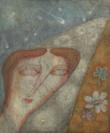
Cecil Collins, The Cells of Night 1934
© Tate
Display caption
'The Cells of Night' is one of the earliest paintings in which Collins expressed his ideas about the life of the human spirit. The human head in the foreground represents the psyche while the landscape behind, seen in dramatic recession, represents infinity. The distortion of the head symbolises the human psyche's yearning for infinity. The 'Cells' of the title refer to the multitude of organisms and natural phenomena that make up the cosmos. The breaking of dawn signifies the promise of a new world and the possibility of re-birth, important themes in Collins's work of this period.
September 2004
Find similar artworks
Artist
Cecil Collins
(75)
Category
Painting
(5,294)
Decade
1930-9
(979)
Style or ‘-ism’
20th century 1900-1945
(1,052)
British Surrealism
(75)
Subject
abstraction
(8,371)
from recognisable sources
(3,325)
landscape
(955)
emotions, concepts and ideas
(7,969)
emotions and human qualities
(1,745)
psyche
(4)
literature and fiction
(2,343)
nature
(37,446)
animals: insects & lower animals
(173)
chrysalis
(5)
plants and flowers
(1,741)
flower
(495)
times of the day
(1,555)
people
(21,185)
actions: postures and motions
(6,763)
looking up
(104)
body
(2,881)
head / face
(1,696)
symbols & personifications
(4,830)
birth to death
(96)