Summary
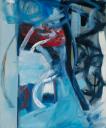
Typically for Lanyon's work, Lost Mine combines an apparently abstract idiom with a precise external source. The broad, gestural style reflects the respect Lanyon had for American Abstract Expressionist painters. He had first seen the work of Jackson Pollock and Willem de Kooning in Venice in 1950, but the broad black marks also recall the work of Franz Kline, who may have been among the many artists he met in New York in 1957. Unlike the work of the Americans, Lanyon avoided an all-over even treatment, however. Employing a favourite device, he juxtaposes a quiet area on the left with the larger confusion of rapid, twisting and interweaving marks on the right.
As the title indicates, this painting refers to a tin mine that was inundated by the sea and abandoned. Colour operates figuratively and symbolically. The black represents the mine shaft and signifies death, the blues are the sea and sky, the red signals life and danger… (read more)