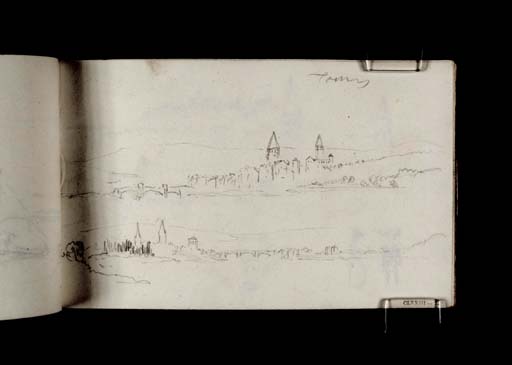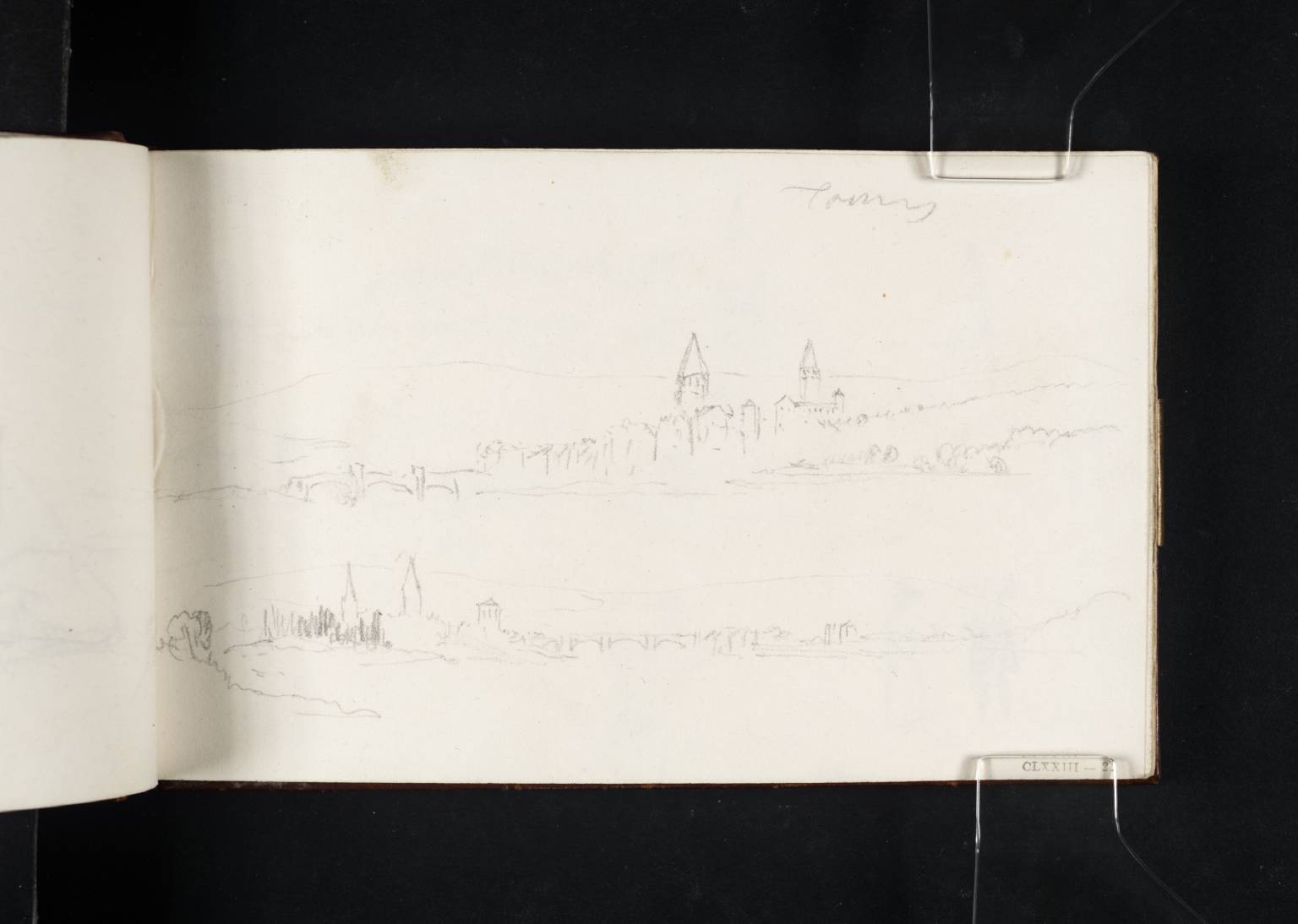
Joseph Mallord William Turner Two Views of Tournus from the River Saône 1819
Image 1 of 2
Joseph Mallord William Turner,
Two Views of Tournus from the River Saône
1819
Joseph Mallord William Turner 1775–1851
Folio 22 Recto:
Two Views of Tournus from the River Saône 1819
D14024
Turner Bequest CLXXIII 22
Pencil on white wove paper, 114 x 185 mm
Stamped in black ‘CLXXIII 22’ bottom right
Accepted by the nation as part of the Turner Bequest 1856
References
1909
A.J. Finberg, A Complete Inventory of the Drawings of the Turner Bequest, London 1909, vol.I, p.504, as ‘ “Tournus” (?)’.
1997
James Hamilton, Turner: A Life, London 1997, pp.197, 325 note 9.
1981
Maurice Guillaud, Nicholas Alfrey, Andrew Wilton and others, Turner en France: aquarelles, peintures, dessins, gravures, carnets de croquis / Turner in France: Watercolours, Paintings, Drawings, Engravings, Sketchbooks, exhibition catalogue, Centre Culturel du Marais, Paris 1981, p.108, reproduced fig.179, as ‘ “Tournus” ’.
As Turner’s inscription indicates, the subject of these two sketches is Tournus, a town on the Saône river in the Burgundy region of France. The artist had first visited the town in 1802 during his first trip to France and the Swiss Alps and several relevant sketches can be found within the France, Savoy, Piedmont sketchbook (see Tate D04411, D04418–D04419; Turner Bequest LXXIII 19, 26–27). Indeed, one study of the town from the north had provided the compositional basis for the later oil painting, The Festival upon the Opening of the Vintage of Macon, exhibited 1803 (Sheffield Galleries and Museum Trust), although Turner seems to have been confused over the actual location.1 He passed through Tournus again in 1819 en route between Auxerre and Lyon, probably travelling by boat from Chalon-sur-Saône, and this time he made a series of sketches recording the river topography and the bridge, see folios 21–24 (D14022–D14026).
This page contains two variant views of the town seen from the river. The upper vista depicts the approach from the north, whilst for the lower Turner must have looked behind him as the boat in which he was travelling sailed south in the direction of Mâcon. Aside from the bridge, the most recognisable landmark in both studies is the Benedictine Abbey of St Philibert with its two Romanesque towers (a third tower flanking the entrance to the building was never completed).
Verso:
Blank
Blank
Nicola Moorby
February 2013
How to cite
Nicola Moorby, ‘Two Views of Tournus from the River Saône 1819 by Joseph Mallord William Turner’, catalogue entry, February 2013, in David Blayney Brown (ed.), J.M.W. Turner: Sketchbooks, Drawings and Watercolours, Tate Research Publication, August 2013, https://www