
Turner Bequest CXXXVI 1–182
Sketchbook bound in boards, covered in brown leather; blind–tooled floral borders to covers and double gilt bands to spine; one brass clasp
182 leaves and paste–downs of white wove paper; page size 119 x 82 mm
Made at Ivy Mill, Maidstone; various pages watermarked ‘Ivy Mill | 1811’
Inscribed in ink by Turner ‘Review at Portsmouth’ on back cover (D30833)
Numbered 376 as part of the Turner Schedule in 1854 and endorsed by the Executors of the Turner Bequest towards back, on folio 175 recto (D10197)
Blind–stamped with Turner Bequest monogram on back cover (D30833)
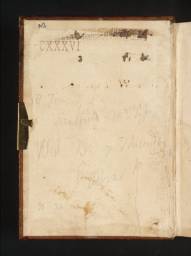
Inscribed in pencil ‘CXXXVI’ inside front cover (D40829)
Stamped in black ‘CXXXVI’ inside front cover
182 leaves and paste–downs of white wove paper; page size 119 x 82 mm
Made at Ivy Mill, Maidstone; various pages watermarked ‘Ivy Mill | 1811’
Inscribed in ink by Turner ‘Review at Portsmouth’ on back cover (D30833)
Numbered 376 as part of the Turner Schedule in 1854 and endorsed by the Executors of the Turner Bequest towards back, on folio 175 recto (D10197)
Blind–stamped with Turner Bequest monogram on back cover (D30833)
Inscribed in pencil ‘CXXXVI’ inside front cover (D40829)
Stamped in black ‘CXXXVI’ inside front cover
Accepted by the nation as part of the Turner Bequest 1856
References
In this sketchbook, Turner recorded his travels through Devon and Cornwall, South–West England, along the Tamar Valley (where the counties meet) and at Plymouth, as well as marine subjects at Portsmouth. He sketched on 101 pages, the bulk of which show the Naval Review in the Solent, off Portsmouth, in June 1814, after which this sketchbook was named by Finberg in his 1909 Turner Bequest Inventory, adopting the wording of Turner’s ink note on the back cover: ‘Review at Portsmouth’.1
Turner closed his London gallery on Monday 20 June, and on Thursday 23rd ‘he was at Portsmouth making sketches of the review of the Fleet which was being held to gratify the wishes of their Majesties, the Emperor of Russia and the King of Prussia.’2 This was a short visit for Turner, as Finberg’s Life states that he ‘must have returned to London soon after the review, for he was one of the ten members who dined at the Academicians’ Club on July 6.’3
Although he did not mention the present sketchbook by name, Eric Shanes stated that for Turner, the naval review ‘was unprecedented in his lifetime’ as it ‘comprised fifteen battleships and about the same number of frigates in “a line of seven or eight miles in extent in front of the Isle of Wight”’.4 This was the conclusion of the Allied sovereigns of Austria, Prussia, Russia and Sweden’s visit to Britain, their partner in celebration of the defeat and exile of Napoleon in April 1814 (albeit his return to France the following year ended in final defeat at Waterloo).
King George IV, then the Prince Regent, attended the review with Tsar Alexander of Russia, King Frederick William III of Prussia, and dignitaries from the other allied states. It can be assumed that Turner made numerous sketches as ‘possibly he had entertained the notion of producing a large painting of the Allied sovereigns and the Prince Regent undertaking their duties, but if so, nothing would come of it.’5 However, Thomas Phillips commemorated an episode during the state visit in his 1817 oil painting The Allied Sovereigns at Petworth, 24 June, 1814 (National Trust, Petworth House, Sussex), in which Turner’s great patron, the third Earl of Egremont, features prominently as host at his opulent country house.
Turner made an extensive tour of the West Country in 1811, largely along the coast, and had returned in 1813, focusing on Plymouth and the Tamar Valley, as addressed in Matthew Imms’s ‘West Country 1811’ and ‘1813’ sections of the present catalogue.6 On a further visit during what was likely the late summer of 1814, Turner used several other sketchbooks that pertain to views of the region, as discussed in Imms’s overall Introduction to the present ‘West Country and Yorkshire 1814–17’ section. The artist revisited the countryside vistas and coastline landscapes of the 1813 tour; as Eric Shanes summarised in 2016:
The sketchbooks used solely in 1814 were the pocket Review at Portsmouth sketchbook, T[urner]. B[equest]. CXXXVI; the Devon Rivers No.1 sketchbook, T.B. CXXXII; the Devon Rivers No.2 sketchbook, T.B. CXXXIII; and the Devonshire Rivers No.3 and Wharfedale sketchbook, T.B. CXXXIV. The pocket sketchbook taken on both tours was the Chemistry and Apuleia sketchbook, T.B. CXXXV.7
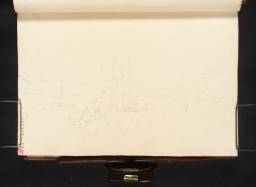
(The latter book is dated in the present catalogue to c.1813 only.) The present Review at Portsmouth sketchbook had not previously been associated with the West Country visit of 1814, although Shanes did not elaborate in print on its contents; he did go into selective detail in the lengthier unpublished draft he kindly shared, which has informed some of the entries here.8 Finberg had not recognised any of the rural Devon scenes, and indeed actively misidentified one view of Plymouth Harbour (folio 17 recto; D10003) as Portsmouth.
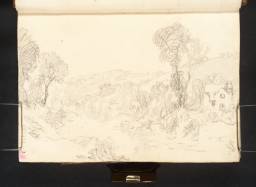
From the drawings of the Tamar Valley on folios 3 to 16 recto (D09989–D10002), it can be assumed that Turner may have used this sketchbook during his travels around the South–West in either 1813 or 1814, working at each end, also using the central section when he travelled to Portsmouth to attend the Naval Review in June 1814. This illustrates his practice of maintaining a sketchbook for extended periods, utilising it for a diverse range of interests and projects, although it remains a moot point as to which of the dual subjects was covered first. For clarity, pending conclusive evidence, all the drawings and the sketchbook as a whole are here dated to 1814.
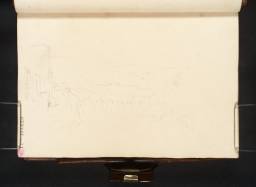
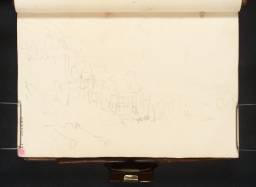
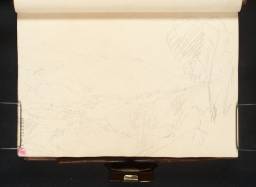
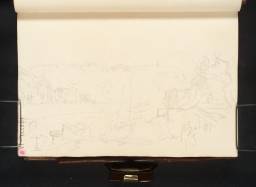
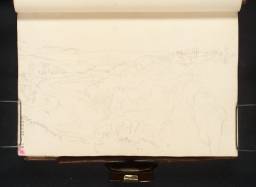
Turner predominantly sketched the meandering River Tamar flowing through the rolling hills enclosing its valley. This section includes views of the medieval New Bridge in Gunnislake on folios 9, 11, 12 recto and 171 verso (D09995, D09997, D09998, D10190), which Turner also drew in the 1814 Devon Rivers, No.1 sketchbook (Tate D09611, D09622, D09626, D09637; Turner Bequest CXXXII 117a, 123, 125, 131). Following the early sequence here, there are eight sketches of the coastal landscape of Plymouth Sound, starting with a drawing of the Great Mew Stone on folio 17 recto (D10003) and ending with a depiction of Drake’s Island on folio 23 recto (D10009).
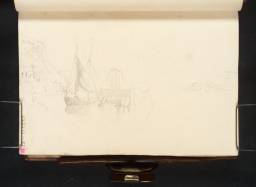
From the verso of the latter page onwards (D10010), the middle of the sketchbook is taken up with studies of shipping, likely all at Portsmouth, although its forts and other waterfront buildings are only depicted occasionally and in little detail. Most of the sketches are quick impressions of vessels under sail, or annotated details of hulls and figureheads, occasionally with the ships’ names included, some of which correspond with those listed with their captains on folio 2 recto (D09988). There are extended runs of blank pages (notably folios 80–99, 105–123, 125–142; D10080–D10099, D10109–D10127, D10129–D10146), perhaps suggesting that Turner was distracted and moving between vantage points or possibly being rowed about; the sequence ends on folio 168 verso (D10184), after which there are a few more Tamar subjects towards the end of the book, with possibly a last Portsmouth shipping sketch on folio 173 recto (D10193).
Turner had visited Portsmouth in 1807, using the Spithead sketchbook (Tate; Turner Bequest C), as addressed in David Blayney Brown’s ‘Marine Subjects c.1803–14’ section. He returned in the 1820s, as covered in Matthew Imms’s ‘London, Thames and South of England 1821–7’ section, where the Introduction to the London Bridge and Portsmouth sketchbook of about 1824 (Tate; Turner Bequest CCVI) provides comprehensive coverage of the setting of the important naval base and Turner’s work in relation to it. His final visit, just over thirty years after the great review covered here, was on 8 October 1844, to witness the pageantry of the arrival of Louis–Philippe, King of the French, on his visit to Queen Victoria; see Imms’s ‘Louis–Philippe at Portsmouth 1844’ section.
The ink number ‘55’ was recorded by Finberg on a parchment label on the spine of the present book9 (since lost, like many others, perhaps in the 1928 Tate Gallery flood). Turner scholar David Hill initially suggested that Turner probably added his sequence of numbered and annotated paper spine labels during a general review of his sketchbooks in about 1821 or 1822,10 later revising this to the second half of 1824 on the dating evidence of some of the relevant books.11 Ian Warrell has subsequently reasoned that the process began in 1823, ending in the summer of 1824.12
Shanes 2016, p.443, quoting a Times report of 27 June; see also Finberg 1909, I, pp.387–8, with notes supplied ‘by the Admiralty and Public Record Offices’, and lengthy extracts from the London Gazette, 28 June 1814, pp.1319– 20.
For the area’s history, mining industry and topography, see also Diana Cook and Dorothy Kirk, Turner in the Tamar Valley: Following in Turner’s Footsteps along the River Tamar, Drakewalls 2009.
Eric Shanes, extended draft of ‘The West Country, 1814’ section for Young Mr Turner: The First Forty Years 1775–1815, New Haven and London 2016, email to Matthew Imms, 20 December 2012, Tate catalogue files, unpaginated; Imms has contributed suggestions for some of the specific identifications for the present entries (Tate catalogue files, March 2024).
See David Hill, ‘The Landscape of Imagination and the Sense of Place: Turner’s Sketching Practice’ in Maurice Guillaud, Nicholas Alfrey, Andrew Wilton and others, Turner en France, exhibition catalogue, Centre Culturel du Marais, Paris 1981, pp.143, 147 note 34.
See David Hill, Turner on the Thames: River Journeys in the Year 1805, New Haven and London 1993, p.176 note 79.
Technical notes
-
 Joseph Mallord William TurnerReview at Portsmouth SketchbookD40829
 -
-
 Joseph Mallord William TurnerReview at Portsmouth SketchbookD09988
 -
 Joseph Mallord William TurnerReview at Portsmouth SketchbookD09989
 -
-
-
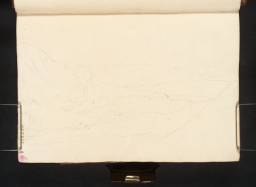 Joseph Mallord William TurnerReview at Portsmouth SketchbookD09992
 -
 Joseph Mallord William TurnerReview at Portsmouth SketchbookD40830
 -
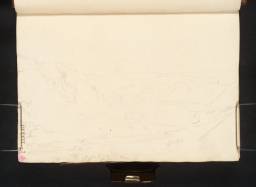
-
-
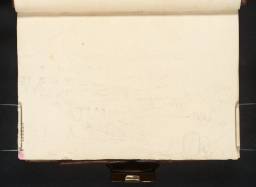 Joseph Mallord William TurnerReview at Portsmouth SketchbookD09995
 -
-
 Joseph Mallord William TurnerReview at Portsmouth SketchbookD09997
 -
 Joseph Mallord William TurnerReview at Portsmouth SketchbookD09998
 -
-
-
 Joseph Mallord William TurnerReview at Portsmouth SketchbookD10001
 -
 Joseph Mallord William TurnerReview at Portsmouth SketchbookD40831
 -
 Joseph Mallord William TurnerReview at Portsmouth SketchbookD10002
 -
 Joseph Mallord William TurnerReview at Portsmouth SketchbookD10003
 -
-
-
 Joseph Mallord William TurnerReview at Portsmouth SketchbookD40832
 -
-
-
 Joseph Mallord William TurnerReview at Portsmouth SketchbookD10008
 -
 Joseph Mallord William TurnerReview at Portsmouth SketchbookD10009
 -
 Joseph Mallord William TurnerReview at Portsmouth SketchbookD10010
 -
 Joseph Mallord William TurnerReview at Portsmouth SketchbookD10011
 -
How to cite
Vanessa Otim, ‘Review at Portsmouth Sketchbook 1814’, sketchbook, March 2025, in David Blayney Brown (ed.), J.M.W. Turner: Sketchbooks, Drawings and Watercolours, Tate Research Publication, July 2026, https://www