Joseph Mallord William Turner Three Views, Including ?the Bay of Fréjus and Saint-Raphaël 1838
Image 1 of 2
Joseph Mallord William Turner,
Three Views, Including ?the Bay of Fréjus and Saint-Raphaël
1838
Folio 3 Recto:
Three Views, Including ?the Bay of Fréjus and Saint-Raphaël 1838
D21275
Turner Bequest CCXXXII 3
Pencil on white wove paper, 98 x 157 mm
Inscribed in pencil by Turner ‘[?Nice]’ within sketch, top left
Inscribed in red ink ‘3’ bottom left, descending vertically
Stamped in black ‘CCXXXII 3’ bottom left, descending vertically
Inscribed in pencil by Turner ‘[?Nice]’ within sketch, top left
Inscribed in red ink ‘3’ bottom left, descending vertically
Stamped in black ‘CCXXXII 3’ bottom left, descending vertically
Accepted by the nation as part of the Turner Bequest 1856
References
1909
A.J. Finberg, A Complete Inventory of the Drawings of the Turner Bequest, London 1909, vol.II, p.711, CCXXXII 3, as ‘Views on coast near “Nice.”’.
1981
Maurice Guillaud, Nicholas Alfrey, Andrew Wilton and others, Turner en France: aquarelles, peintures, dessins, gravures, carnets de croquis / Turner in France: Watercolours, Paintings, Drawings, Engravings, Sketchbooks, exhibition catalogue, Centre Culturel du Marais, Paris 1981, pp.293, 295, 296, fig.571, as ‘Fréjus’.
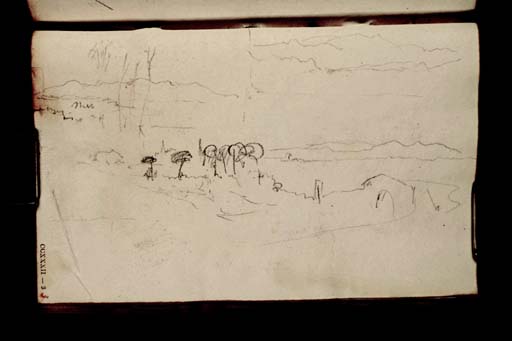
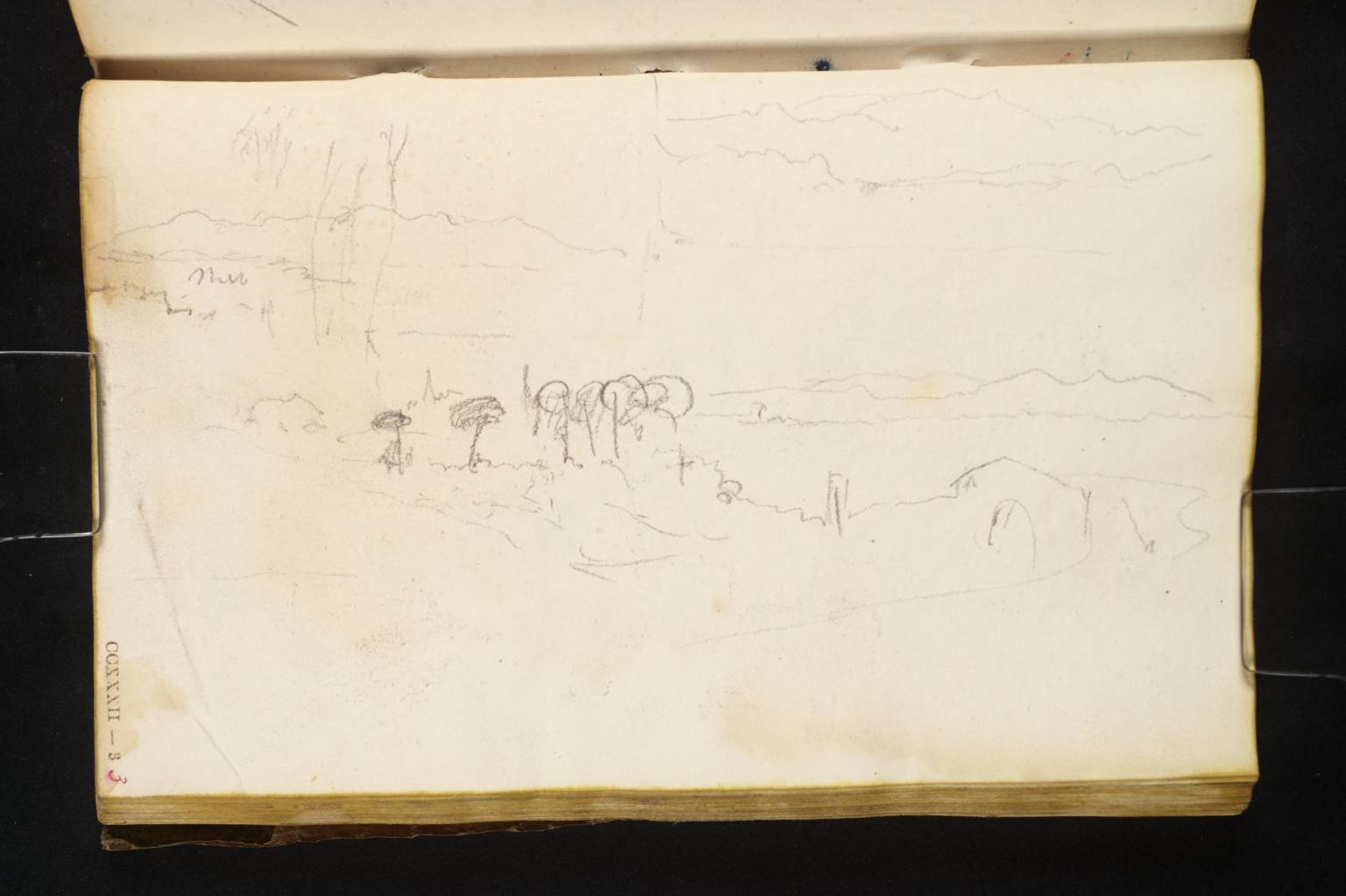
This page contains three landscape sketches, executed with the book turned horizontally.
In his 1909 Inventory of the Turner Bequest, A.J. Finberg, inspired by his interpretation of Turner’s inscription in the top left corner, identified the subject of the drawings as ‘Views on [the] coast near “Nice”’.1 More recently, the art historian Maurice Guillaud has alternatively proposed that the principal design, occupying the majority of the picture space, represents a distant view of Fréjus.2 Geographer and Turner researcher has expanded on this tentative identification, suggesting the view depicts the bay of Fréjus and Saint-Raphaël, as seen from the west.3 The distinctive trees, at the centre of the composition, are said to be reminiscent of the sea pines which are a common feature of the landscape in this area.4
The Roman port town of Fréjus is situated on France’s Mediterranean coastline, approximately fifty miles north-east of Toulon, the starting point of the journey described in this sketchbook. Turner appears to have taken an inland route to Fréjus from Toulon, before continuing on to the city of Cannes, approximately twenty-five miles away. For a more detailed overview of Turner’s itinerary through this region, see the Introduction to this sketchbook. For additional views of Fréjus and Saint-Raphaël see folios 3 verso, 4 recto and 66 verso–74 recto (D21276, D21277, D21391–D21406).
Courtot describes the subject of the drawing in the top right corner of this page as an unidentified mountainous coast.5 Guided by Turner’s inscription, he presumes the sketch in the top left corner to be a distant view of Nice, which, owing to the respective location and geographical distance between Fréjus and Nice, would suggest that this particular design (and possibly the other drawing on the right) was executed on a different occasion to the central composition. This is quite feasible, although it is also possible that Turner’s inscription has been misinterpreted and the sketches represent views of a location closer to Fréjus.
Roland Courtot, ‘Carnet de voyage de Turner: 9. Notebook CCXXXII “Côte de Génès” (1838?)’, Hypotheses, 24 August 2018, accessed 24 June 2024, https://carnetswt.hypotheses.org/949 .
Technical notes:
Yellow staining along the edges of the page is most likely the result of 1928 Tate Gallery flood (see under sketchbook introduction).
Nicola Moorby
May 2017
Revised by Hayley Flynn
June 2025
How to cite
Nicola Moorby, ‘Three Views, Including ?the Bay of Fréjus and Saint-Raphaël 1838’, catalogue entry, May 2017, revised by Hayley Flynn, June 2025, in David Blayney Brown (ed.), J.M.W. Turner: Sketchbooks, Drawings and Watercolours, Tate Research Publication, July 2026, https://www