
Turner Bequest CCCLV 1–14
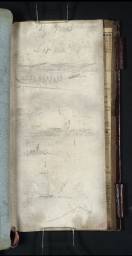
Pocket book of dark brown leather with a loose label inside the spine of back cover printed ‘Bought at | Middleton’s | 7, King William Street: | City.’; one leather loop on front cover and two leather loops on back cover for holding a pencil or fastening
Blind-stamped with Turner Bequest monogram towards top left of front leather cover, and stamped with ‘CCCLV’ top right
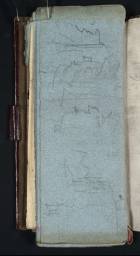
13 leaves of predominantly blue wove paper with a folder piece of white paper inserted at the centre of the sketchbook
Approximate page size varies between 186 x 70 mm and 170 x 70 mm
Stamped in black ‘CCCLV’ top left inside front cover
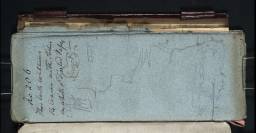
Folio 2 recto (D35336) numbered ‘206’ and inscribed in ink ‘This book contains 14 leaves with sketches on white and tinted paper’, as part of the Turner Schedule in 1854
Blind-stamped with Turner Bequest monogram towards top left of front leather cover, and stamped with ‘CCCLV’ top right
13 leaves of predominantly blue wove paper with a folder piece of white paper inserted at the centre of the sketchbook
Approximate page size varies between 186 x 70 mm and 170 x 70 mm
Stamped in black ‘CCCLV’ top left inside front cover
Folio 2 recto (D35336) numbered ‘206’ and inscribed in ink ‘This book contains 14 leaves with sketches on white and tinted paper’, as part of the Turner Schedule in 1854
Accepted by the nation as part of the Turner Bequest 1856
References
The Hythe and Walmer sketchbook is perhaps better described as a gentleman’s pocketbook within which sketches are contained; the leather covers holding together loose folded leaves as a wallet might (see technical notes below). This narrow almanac format was ‘favoured by Turner as a supplement to larger sheets of paper from the last years of the 1830s’, according to the art historian Ian Warrell.1 That the drawings are loose and folded into the pocketbook and that the dimensions of the leaves are taller than the leather casing, indicates that the pocketbook may originally have served a different purpose, perhaps as a diary or notebook.
In the same article, Ian Warrell contends that this sketchbook and one other sharing the same dimensions (Life Class sketchbook, c.1835–40; Tate; Turner Bequest CCCXXIX) probably belonged to a parcel of sketchbooks which were circumscribed by a paper wrapper and sealed with red wax by John Ruskin during the art critic’s organisation of the Turner Bequest drawings. The wrapper was numbered ‘AB.72.P/B’ by Ruskin and inscribed with ‘Life Class’ and ‘Kept as evidence of the failure of mind only’ because of the erotic drawings contained in the Life Class sketchbook.2 That the Hythe and Walmer sketchbook does not contain any erotic material nor any life class studies, however, has lead Warrell to conclude that ‘it is to some extent purely coincidental’ that the sketchbook was contained in Ruskin’s censured parcel in this way.3
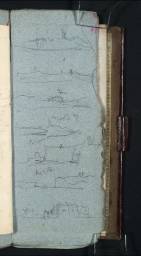
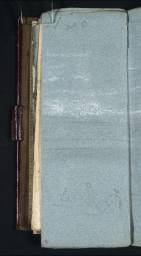
Turner probably produced the drawings in the Hythe and Walmer sketchbook on the spot, as he was roaming the coastline on foot or perhaps also by boat, pencil in hand. The sketchbook begins and ends with miniature sketches of boats, ships, and coastline drawn on white laid paper which had been affixed to the grey card endpapers. They are clearly summary jottings which caught Turner’s eye: vessels moored at shore or in transit, fishing boats or ships journeying to the continent, a shallow stretch of coastline extending into the sea.
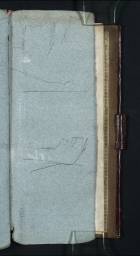
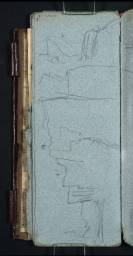
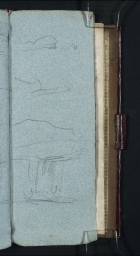
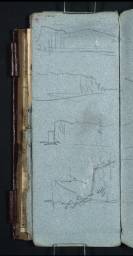
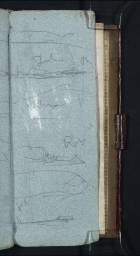
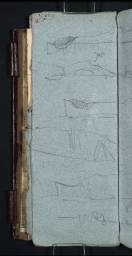
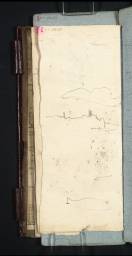
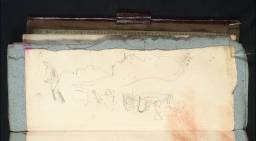
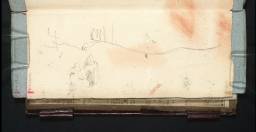
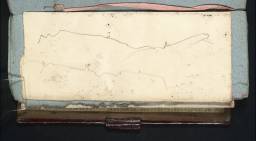
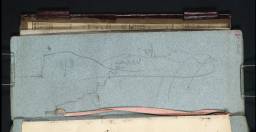
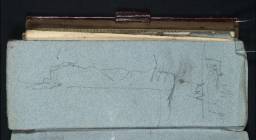
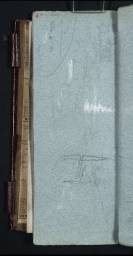
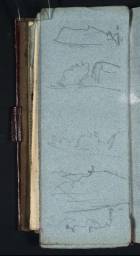
The majority of drawings in this sketchbook, however, depict the profiles of cliffs: craggy headlands with striking weather-eroded formations and topographies. In some cases Turner turned the sketchbook horizontally relative to the foliation for a wider view of a headland; in others he drew a sequence of smaller sketches of cliffs with the sketchbook positioned in line with the foliation, the sketches often continuing onto the opposite folio. Further examples of Turner arranging small sketches of cliff profiles sequentially on a page can be found in his Folkestone sketchbook of c.1821 (Tate D17297–D17300, D17338, D17340, D17344; Turner Bequest CXCVII 55a–57, CXCVII 77a, CXCVII 78a, CXCVII 80a). On a number of the folios of the Hythe and Walmer sketchbook Turner drew cliff profiles with the sketchbook turned upside down relative to the other drawings. In sum, one is left with the impression that when Turner saw a view or headland worth recording this sketchbook was used with little attention paid to consistent page orientation.
The effect of this array and arrangement attests to both Turner’s curious eye and his prolific, continuous draughtsmanship: a day ‘never...without a line’.4 This sentiment is expressed by Cyrus Redding who writes that Turner’s ‘glance commanded in an instant all that was novel in scenery, a few outlines on paper’.5 These pictorial jottings, though often ‘unintelligib[le] to others’, ‘bore much away in memory... [as] a kind of shorthand, which he [Turner] deciphered in his studio’.6
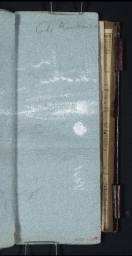
Figures rarely appear in the Hythe and Walmer sketchbook, though there are a few exceptions. On folios 7 verso and 8 recto (D35347, D35348) Turner has produced summary sketches of figures within a rather indecipherable topography, perhaps a beach. Figures have also been roughly sketched into a chalk and pencil sunset scene on folios 9 verso and 10 recto (D35351, D35352).
Another variation to the majority cliff sketches are two small drawings of what is taken to be Walmer Castle on folio 6 recto (D35344), given that Turner inscribed the name of that monument immediately below the sketches. Walmer Castle is one of a series of ‘Device Forts’ or ‘Henrician Castles’ constructed along the south-east coast of England in the reign of King Henry VIII as a part of a chain of coastal artillery defences to counter the threat of French and Spanish invasion. In 1708 the castle became the official residence of the Lord Warden of the Cinque Ports.7 A further pencil inscription which appears to read ‘Hythe’ is located beneath a cliff sketch on folio 6 verso (D35345). These inscriptions presumably led A.J. Finberg to believe that the sketchbook contained drawings of the Hythe and Walmer areas on the south coast of Kent. Indeed, Hythe is approximately twenty miles south of the town of Walmer (with Dover and Folkestone between them), so the townships would have been accessible to Turner by carriage or boat. Hythe and Walmer were familiar to Turner; he had sketched in and around these towns between 1816–19 and again in the mid-1820s, producing pencil drawings and individual watercolours from which engravings were taken (see list below).
For other of Turner’s views of Walmer Castle and the Walmer area, see his watercolour drawing Walmer Castle, near Deal, Kent of about 1825 (Tate D25477; Turner Bequest CCLXIII 354); see also the pencil drawings in the Walmer Ferry sketchbook (Tate D10648–D10650, D10767; Turner Bequest CXLII 1a–2a, 95), the Richmond Hill; Hastings to Margate sketchbook (Tate D10466; Turner Bequest CXL 30) and the Holland sketchbook (Tate D19392–D19396; Turner Bequest CCXIV 278a–280a).
For Turner’s earlier views of Hythe and the coast surrounding it, see his watercolour drawing Hythe, Kent of 1824 (Guildhall Art Gallery, London)8 engraved in 1824 for the Southern Coast project (Tate impressions: T05257–T05264, T04414–T04415, T05992). A preliminary sketch for this work appears in the Hastings sketchbook of 1816 (Turner Bequest CXXXIX).
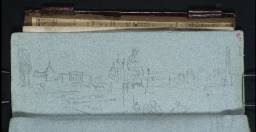
There is one puzzling and significant anomaly among the sketches of coastal scenery. Folios 11 verso and 12 recto (D35355, D35356) show classical façades and statuary; what appears to be a statue of a seated crowned figure atop a pedestal is visible on D35356. Not long after the present sketchbook was originally catalogued for online publication, Ian Warrell reproduced the latter page as ‘The Place de la Concorde, with the Luxor Obelisk; the Assemblé Nationale and the dome of Les Invalides on the left’, dating it to c.1838–44 and suggesting it was ‘Turner’s last view of Paris’.9 D35355 likely shows another aspect of the square; see the individual entries for further discussion. Pending detailed research as to the occasion of the drawings, they remain dated to c.1845, so as not to disrupt the sketchbook’s chronological place within the present catalogue.
Note: The last paragraph above replaces a speculative passage elsewhere in Alice Rylance-Watson’s original text as to possible Kent locations for the two subjects. The rest of the main Introduction remains effectively unchanged. Some additional technical notes on Turner’s other ‘Almanack’ sketchbooks have been added below.
A reference to Pliny’s dictum nulla dies sine linea, ‘never a day without a line’; see Deanna Petherbridge, The Primacy of Drawing: Histories and Theories of Practice, New Haven and London 2010, p.212.
Cyrus Redding quoted in Walter Thornbury, The Life of J.M.W. Turner, R.A. Founded on Letters and Papers Furnished by his Friends and Fellow-Academicians: A New Edition, Revised with 8 Coloured Illustrations after Turner’s Originals and 2 Woodcuts, London 1897, p.143.
See ‘Walmer Castle’, PastScape, accessed on 28 January 2013, http://www.pastscape.org.uk/hob.aspx?hob_id=468409&sort=2&type=&typeselect=c&rational=a&class1=None&period=None&county=None&district=None&parish=None&place=&recordsperpage=10&source=text&rtype=monument&rnumber=468409 .
Technical notes
-
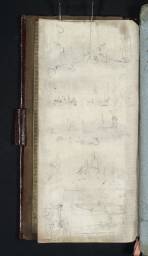 Joseph Mallord William TurnerHythe and Walmer SketchbookD35335
 -
-
-
-
-
-
-
-
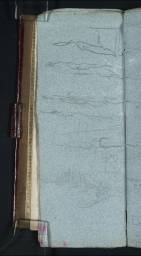 Joseph Mallord William TurnerHythe and Walmer SketchbookD35343
 -
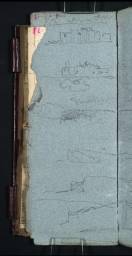 Joseph Mallord William TurnerHythe and Walmer SketchbookD35344
 -
-
-
-
-
-
-
-
-
-
 Joseph Mallord William TurnerHythe and Walmer SketchbookD35354
 -
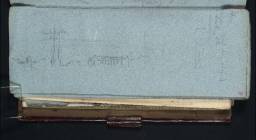 Joseph Mallord William TurnerHythe and Walmer SketchbookD35355
 -
-
-
-
-
How to cite
Alice Rylance-Watson, ‘Hythe and Walmer sketchbook 1845’, sketchbook, February 2013, revised by Matthew Imms, September 2025, in David Blayney Brown (ed.), J.M.W. Turner: Sketchbooks, Drawings and Watercolours, Tate Research Publication, June 2013, https://www