
Turner Bequest CCCLIII 1–22
21 leaves from a disbound sketchbook with buff brown card covers, laminated over endpapers
Endpapers and separated leaves of white wove paper; approximate page size 220 x 328 mm
Various leaves watermarked ‘J Whatman | Turkey Mills | 1823’
Stamped in black ‘CCCLIII’ top right of front cover
Stamped in black ‘CCCLIII’ and inscribed in pencil ‘CCCLIII’ and ‘H’ inside front cover (D40442)
Endpapers and separated leaves of white wove paper; approximate page size 220 x 328 mm
Various leaves watermarked ‘J Whatman | Turkey Mills | 1823’
Stamped in black ‘CCCLIII’ top right of front cover
Stamped in black ‘CCCLIII’ and inscribed in pencil ‘CCCLIII’ and ‘H’ inside front cover (D40442)
Accepted by the nation as part of the Turner Bequest 1856
A.J. Finberg, A Complete Inventory of the Drawings of the Turner Bequest, London 1909, vol.II, p.1162, CCCLIII 1–22, as ‘The Whalers Sketch Book’, c.1844–5
C[harles] Lewis Hind, Turner’s Golden Visions, London and Edinburgh 1910 and 1925, p.219
Luke Herrmann, Turner: Paintings, Watercolours, Prints & Drawings, London 1975, p.234 under no.176, as containing studies for whaling paintings
Luke Herrmann, ‘Turner and the Sea’, Turner Studies, vol.1, no.1, Summer 1981, p.15
Martin Butlin and Evelyn Joll, The Paintings of J.M.W. Turner, revised ed., New Haven and London 1984, pp.261 under no.414, 268 under no.423, 271 under no.426, 289 under no.473
Barry Venning, ‘Turner’s Whaling Subjects’, The Burlington Magazine, vol.127, February 1985, p.75
David Blayney Brown, Turner and the Channel: Themes and Variations c.1845, exhibition catalogue, Tate Gallery, London 1987, pp.18, 23
Andrew Wilton, Turner in his Time, London 1987, p.244, as 1845
Robert K. Wallace, ‘Chasing Turner’s Whales in London’, NKU [Northern Kentucky University] Alumni Magazine, Spring 1988, p.15, as 1844–5 (Wallace 1988a)
Robert K. Wallace, ‘The Antarctic Sources for Turner’s 1846 Whaling Oils’, Turner Studies, vol.8, no.1, Summer 1988, pp.25–6 (Wallace 1988b)
Robert Upstone, Turner: The Final Years: Watercolours 1840–1851, exhibition catalogue, Tate Gallery, London 1993, pp.20–1, 59, 60, 61
Robert K. Wallace, ‘Whaling’ in Evelyn Joll, Martin Butlin and Luke Herrmann (eds.), The Oxford Companion to J.M.W. Turner, Oxford 2001, p.378
Ian Warrell, ‘Exploring the “Dark Side”: Ruskin and the Problem of Turner’s Erotica’, with ‘A Checklist of Erotic Sketches in the Turner Bequest’, British Art Journal, vol.4, no.1, Spring 2003, p.45, as c.1845
Andrew Wilton, Turner in his Time, revised ed., London 2006, p.243, as 1845
Ian Warrell, Turner’s Secret Sketches, London 2012, p.136, as c.1845
Richard Johns in Christine Riding and Johns, Turner & the Sea, exhibition catalogue, National Maritime Museum, London 2013, pp.211, 228
Amy Concannon in David Blayney Brown, Concannon and Sam Smiles (eds.), Late Turner: Painting Set Free, exhibition catalogue, Tate Britain, London 2014, pp.41, 170–1, 212
Ian Warrell, Turner’s Sketchbooks, London 2014, p.214
Alison Hokanson in Thomas P. Campbell and Hokanson, Turner’s Whaling Pictures, exhibition catalogue (reprinted from The Metropolitan Museum of Art Bulletin, vol.73, no.4, Spring 2016), Metropolitan Museum of Art, New York 2016, p.19, as c.1844–5
C[harles] Lewis Hind, Turner’s Golden Visions, London and Edinburgh 1910 and 1925, p.219
Luke Herrmann, Turner: Paintings, Watercolours, Prints & Drawings, London 1975, p.234 under no.176, as containing studies for whaling paintings
Luke Herrmann, ‘Turner and the Sea’, Turner Studies, vol.1, no.1, Summer 1981, p.15
Martin Butlin and Evelyn Joll, The Paintings of J.M.W. Turner, revised ed., New Haven and London 1984, pp.261 under no.414, 268 under no.423, 271 under no.426, 289 under no.473
Barry Venning, ‘Turner’s Whaling Subjects’, The Burlington Magazine, vol.127, February 1985, p.75
David Blayney Brown, Turner and the Channel: Themes and Variations c.1845, exhibition catalogue, Tate Gallery, London 1987, pp.18, 23
Andrew Wilton, Turner in his Time, London 1987, p.244, as 1845
Robert K. Wallace, ‘Chasing Turner’s Whales in London’, NKU [Northern Kentucky University] Alumni Magazine, Spring 1988, p.15, as 1844–5 (Wallace 1988a)
Robert K. Wallace, ‘The Antarctic Sources for Turner’s 1846 Whaling Oils’, Turner Studies, vol.8, no.1, Summer 1988, pp.25–6 (Wallace 1988b)
Robert Upstone, Turner: The Final Years: Watercolours 1840–1851, exhibition catalogue, Tate Gallery, London 1993, pp.20–1, 59, 60, 61
Robert K. Wallace, ‘Whaling’ in Evelyn Joll, Martin Butlin and Luke Herrmann (eds.), The Oxford Companion to J.M.W. Turner, Oxford 2001, p.378
Ian Warrell, ‘Exploring the “Dark Side”: Ruskin and the Problem of Turner’s Erotica’, with ‘A Checklist of Erotic Sketches in the Turner Bequest’, British Art Journal, vol.4, no.1, Spring 2003, p.45, as c.1845
Andrew Wilton, Turner in his Time, revised ed., London 2006, p.243, as 1845
Ian Warrell, Turner’s Secret Sketches, London 2012, p.136, as c.1845
Richard Johns in Christine Riding and Johns, Turner & the Sea, exhibition catalogue, National Maritime Museum, London 2013, pp.211, 228
Amy Concannon in David Blayney Brown, Concannon and Sam Smiles (eds.), Late Turner: Painting Set Free, exhibition catalogue, Tate Britain, London 2014, pp.41, 170–1, 212
Ian Warrell, Turner’s Sketchbooks, London 2014, p.214
Alison Hokanson in Thomas P. Campbell and Hokanson, Turner’s Whaling Pictures, exhibition catalogue (reprinted from The Metropolitan Museum of Art Bulletin, vol.73, no.4, Spring 2016), Metropolitan Museum of Art, New York 2016, p.19, as c.1844–5
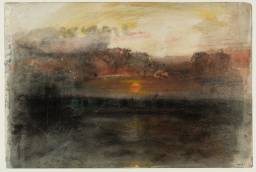
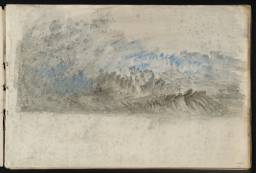
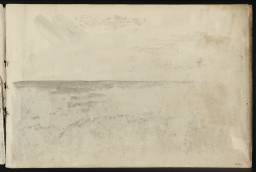
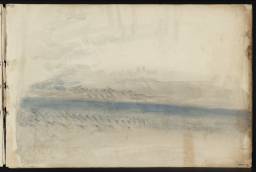
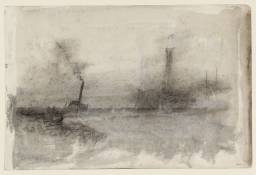
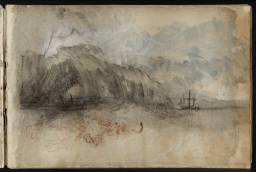
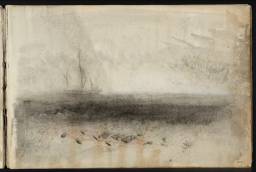
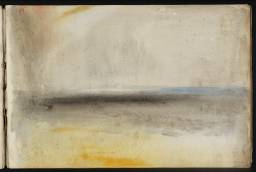
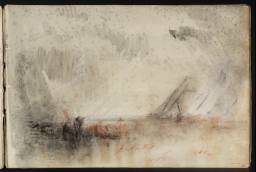
Named by A.J. Finberg because of its predominant focus on whale hunting scenes, the Whalers sketchbook was dated to about 1844–5 in his 1909 Turner Bequest Inventory.1 Dark and stormy seascapes dominate the sketchbook, many of which appear to be observations from the shore. During the 1840s Turner spent extended periods in the coastal town of Margate, Kent, and it was presumably from here that he worked on this sketchbook, with sketches from a vantage point at sea perhaps inspired by the Channel crossings to the Continent he made in 1844, for his last visit to Switzerland, and 1845, when he travelled to the Boulogne area of France, and later that year to Dieppe and the coast of Picardy (see the corresponding sections of the present catalogue).
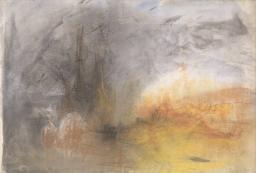
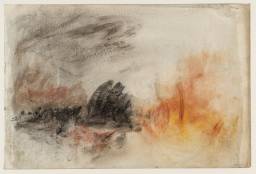
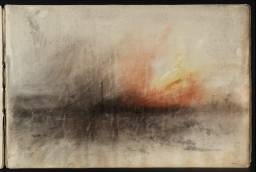
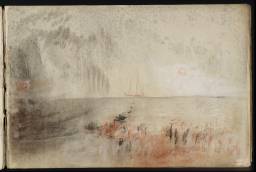
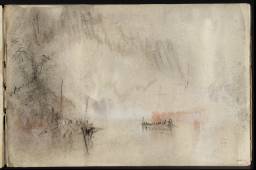
Set within many of these dark seascapes are scenes of whaling ships and the practices of the whaling industry. Andrew Wilton and Robert K. Wallace have noted the presence of studies of whales in the sketchbook, but these are not readily apparent.2 In particular, the works reveal a preoccupation with the processing of the whale carcass, and specifically the drama of the stark contrast between dark sea and luminous fire during the burning of blubber. This is depicted on several of the leaves (D35245, D35246 and possibly D35250; Turner Bequest CCCLIII 6, 7, 11); Wallace has interpreted the fire as an erupting volcano.3 Notational, energetic and apparently swiftly made, the drawings in the Whalers sketchbook differ greatly to four other whaling themed drawings by Turner – one highly finished watercolour (Taft Museum, Cincinnati) and three less worked-up vignettes (private collections) – that have been tentatively dated by Wilton to 1839, thus likely pre-dating this sketchbook.4
Visually, the energy and restlessness of sketches in the Whalers sketchbook may, as has been argued by Richard Johns, transcend their historical context.5 Its majority subject matter, however, anchors the sketchbook firmly to the times in which Turner lived, a period of increased polar exploration, advances in sea transportation and marine industry at large. The sketches depicting whaling subjects represent the development of another tenet within Turner’s longstanding enthusiasm for marine subject matter, yet the timing of their production lends a heightened topicality: in 1844 a discussion on the state of the British whaling industry was initiated by Parliament, revealing it to be faltering in the face of increased competition.6 This is one of several potential stimuli of Turner’s whaling imagery, the sources for which have been widely speculated upon by art historians.
Refraining from identifying any outside source, Luke Herrmann has suggested the drawings in the Whalers sketchbook are entirely imagined scenes.7 Charles Lewis Hind, meanwhile, supposed that Turner had talked with sailors in one of the several public houses he frequented in Wapping, London, and ‘learnt from them of the wonders of the deep waters related by Arctic voyagers’.8 Jack Lindsay has suggested that a sighting of a whale in October 1842 off Deptford, which was subsequently put on public display, may have been the stimulus of his interest.9 As Martin Butlin and Evelyn Joll note, however, Turner was most probably inspired by a combination of factors: by the whale sighting; by his association with the collector and patron Elhanan Bicknell, who had business interests in whale fishery; and also through his reading of various texts such as Thomas Beale’s 1839 re-issue of The Natural History of the Sperm Whale...to which is added, a Sketch of a South-Sea Whaling Voyage, the text he cited as a source for three of his whaling paintings.10 (Several other literary sources have been suggested.11)
Such a publication offered the artist a wealth of scientific information and imagery concerning whales and the intricacies of chasing and capturing them in the Pacific, while first-hand experience of the Arctic may have been relayed to Turner by his acquaintance, the inventor George William Manby (1765–1854), who published an account of his voyage there in 1822.121840 saw the publication of F.D. Bennet’s A Narrative of a Whaling Voyage round the Globe as well as the exhibition at the Royal Academy of The Swan and the Isabella (Hull Trinity House Collection), showing the two whaling ships frozen in ice, by marine painter John Ward (1798–1849).13 Turner would himself develop a painting on this same theme, his Whalers sketchbook becoming a repository of initial ideas inspired by an increasing range of stimulating material on the subject of whaling and marine exploration more generally.
A handful of sketches from the Whalers book relate directly to the series of four whaling oil paintings Turner made and exhibited in pairs in 1845 and 1846. D35244, D35245 and D35246 (CCCLIII 5, 6, 7) relate to Whalers (Boiling Blubber) Entangled in Flaw Ice, Endeavouring to Extricate Themselves, exhibited in 1846 (Tate N00547),14 while D35245 has also been linked by Barry Venning15 to Whalers, exhibited in 1845(Metropolitan Museum, New York).16 The second exhibit of that year, also titled Whalers, is Tate N00545.17 D35252 and D35253 (CCCLIII 13, 14) have been linked to the painting Hurrah! for the Whaler Erebus! Another Fish! (Tate N00546),18 exhibited in 1846.19
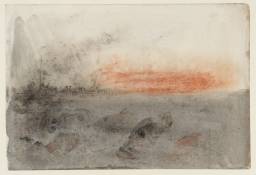
The large majority of the remaining leaves explore variations on this subject matter. Other whaling themed drawings in the Turner Bequest include one in the 1845 Ambleteuse and Wimereux sketchbook (Tate D35391; Turner Bequest CCCLVII 6), while there is a drawing at Cambridge’s Fitzwilliam Museum, The Whaler: ‘He Breaks Away’ 20 and another, The Whaler: ‘Hurrah boys’ (untraced),21 both of which Wilton suggests may have once been part of the Whalers sketchbook.22 Another drawing in the present book, here called ‘Sea Monsters and Vessels at Sunset’ (D35260; CCCLIII 21), features monstrous fish. This leaf might be viewed as a fantastical counterpart to the imagined yet highly informed whaling scenes and an extension of Turner’s conception of the sublime at sea, revealing as much danger in its depths as was played out by the elements on its surface.
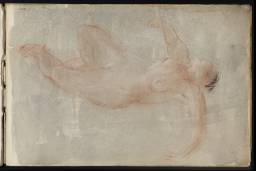
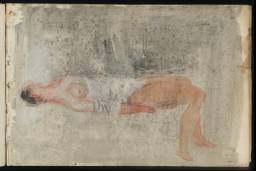
Another notable grouping in the Whalers sketchbook consists of three figure studies. Since the early 1830s, when his visits to Margate became increasingly regular, Turner would routinely stay in the harbour-side lodging house of Mrs Sophia Booth. By 1844, she had become his companion and may have modelled for the figure drawings in this sketchbook (except possibly D35257 and D35258; CCCLIII 18, 19).23 As Ian Warrell has suggested, the presence of these figure drawings potentially depicting Mrs Booth, along with studies of the sea, strengthens the possibility that the sketchbook was worked on during one of Turner’s excursions to Margate or the Kent coast.24
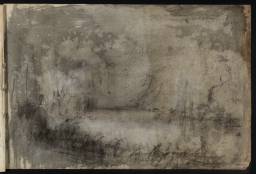
Turner’s choice of medium for the drawings in the Whalers sketchbook was unusual for this late period in his life. The preparation of the leaves with a grey wash along with the varying combinations of watercolour, gouache and chalk was more typical of his drawings of the 1830s. As David Blayney Brown suggests, many of the drawings may have started out as sketches in watercolour, receiving additions in chalk at a later stage.25 However, it is unfortunate that the interrogation of Turner’s mixed-media approach in these drawings is hampered by their condition: the sketchbook was a particularly conspicuous victim of the Tate Gallery flood in January 1928. The effects of submersion are most evident in Turner’s grey wash ground, but the overall sinking of chalk and gouache into the surface of the paper renders some marks difficult to read.
John Ruskin commented on the book when he was working on the Bequest at the National Gallery in January and February in 1862,26 in his customary notes on its white paper wrapper, since trimmed to 175 x 160 mm and kept separately with other archival Turner material at Tate. Finberg gave his reading of the extensive notes, with minor variations, omitting other’s initials;27 they are transcribed in full here.
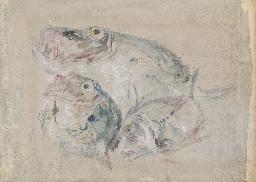
First, Ruskin noted in ink, beginning with the sketchbook’s original Turner Bequest schedule number: ‘15. Book of 20 sketches in colours, with crayon. ; (16 studies for Whalers, 1 of fish, and 3 of human body.)’. Below, again in ink, are the initials of the Turner Bequest Executors Henry Scott Trimmer, George Jones and Charles Turner: ‘stamped H.S T’, ‘G.J.’, and ‘CT.’ At the bottom right of the overall sheet are the pencil initials, ‘C.L.E.’ and ‘JPK’, of the Bequest’s Assessors, Sir Charles Lock Eastlake and John Prescott Knight. In the space between the two sets of initials, Ruskin added somewhat haphazardly in pencil, with the associated totals in a column to the right:
The one of fish is taken out | separated for future mounting 1
14. whaler studies put in parcel | with paper between. 14
The leaf of book and | one of the dirty leaves here | were counted in the 16 above, 2
3 figures here. 3
14. whaler studies put in parcel | with paper between. 14
The leaf of book and | one of the dirty leaves here | were counted in the 16 above, 2
3 figures here. 3
Ruskin underlined the last ‘3’ and added ‘20’ below it. Again in pencil, he added ‘JR. 1862’ and lastly, opposite the Assessor’s initials, ‘This not signed | by Sir C. only the ink.’
As Finberg tersely observed: ‘This book was broken up, and distributed as above.’28
Note: This sketchbook’s entries, initially drafted in 2012, have been brought up to date for publication by the Turner Bequest project’s editor Matthew Imms, incorporating recent exhibition and literature references.29
See: John Gage in Martin Butlin, Andrew Wilton and Gage, Turner 1775–1851, exhibition catalogue, Royal Academy, London 1974, p.189 under catalogue B117; Peter Bicknell, ‘Turner’s The Whale Ship: A Missing Link?’, Turner Studies, vol.5, no.2, Winter 1985, pp.20–3; Robert K. Wallace, ‘The “sultry creator of Captain Ahab”: Herman Melville and J.M.W. Turner’, Turner Studies, vol.5, no.2, Winter 1985, pp.2–23; Wallace 1988b, pp.20–31; Robert K. Wallace, ‘The Antarctic Sources Vignettes’, Turner Studies, vol.9, no.1, Summer 1989, pp.48–55.
Malcolm Cormack, J.M.W. Turner, R.A. 1775–1851: A Catalogue of Drawings and Watercolours in the Fitzwilliam Museum, Cambridge, Cambridge 1975, p.74 no.52, reproduced; Wilton 1979, p.469 no.1411, reproduced.
Including Hokanson 2016; another recent publication, albeit with no direct reference to the Whalers sketchbook, is Jason Edwards (ed.), Martha Cattell, and Meg Boulton, Turner and the Whale, exhibition catalogue, Hull Maritime Museum 2018, particularly Edwards’s ‘Chapter 3: Turner and the Whale/rs, c.1845–46’, pp.55–92.
Technical Notes:
The unaccessioned front and back outside covers are abraded in places and bear adventitious marks in black paint. The blank inside of the front cover (D40442) has some offsetting of black media, while the inside of the back cover, used for a watercolour, has been foliated with the numbered leaves (D35259; CCCLIII 20). Twelve leaves are kept loose in the sketchbook covers, while nine (D35240, D35244–D35246, D35250, D35256–D35257, D35260–D35261; CCCLIII 1, 5–7, 11, 17, 18, 21, 22) are mounted.
Most pages are very roughly prepared with grey wash, and worked on the recto, that is, using only the right-hand pages in the book; offsetting is therefore to be found on the versos of most.
-
 Joseph Mallord William TurnerThe Whalers SketchbookD35240
 -
-
-
-
-
-
-
-
-
-
-
-
-
-
-
-
-
-
-
-
 Joseph Mallord William TurnerThe Whalers SketchbookD35260
 -
 Joseph Mallord William TurnerThe Whalers SketchbookD35261
 -
How to cite
Amy Concannon, ‘The Whalers Sketchbook c.1845’, sketchbook, May 2025, in David Blayney Brown (ed.), J.M.W. Turner: Sketchbooks, Drawings and Watercolours, Tate Research Publication, July 2026, https://www