

L.S. Lowry
Learn from Lowry and make the most of your everyday experiences to inspire a collaborative artwork

Artwork
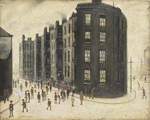
Dwelling, Ordsall Lane, Salford
L.S. Lowry
1927

Your students don’t need to know anything about an artwork or artist to start exploring it.
Use these quick group activities to build their confidence and curiosity in sharing their first responses to the artwork. Some artworks they might like straight away, some they might not.
Discovering art can be new, exciting and sometimes confusing. There are no right or wrong ways to respond!
In pairs or as a group, take it in turns to imagine the artwork answering these questions and telling their story.
- What are you made from?
- When were you made?
- What has happened here?
- Do you want me to feel sad or joyful, or something else?
- What else would you like to say?
In pairs or as a group, use your body to respond to the artwork.
- Mirror movements or shapes in the artwork
- Imagine sounds the artwork might make
- Trace the artwork in the air with your hands
- Move like the artwork
- What else could you do?
About the artwork
"A street is not a street without people, it is as dead as mutton"
L.S. Lowry
In Dwelling, Ordsall Lane, Salford 1927 Lowry shows a busy street scene in front of an imposing, castle-like, block of flats. In the background we can see a hazy glimpse of industrial buildings. Lowry used oil paint on a wooden board. He worked with a limited range of colours, mostly greys and browns. Repeated flecks of red stand out, adding vibrancy to this lively street scene. We can see lots of people on the street. Through tiny changes in colour and brush stroke, each is given their own personality.
Lawrence Stephen Lowry was an English painter who lived and worked in the northwest of England. He is best known for his paintings capturing everyday scenes from the urban, industrial North of England in the mid 20th Century. His distinctive way of painting human figures in these scenes see them regularly referred to as ‘matchstick men’.
Make
Lowry found inspiration for his paintings in the everyday scenes he saw all around him. He would often capture these scenes by quickly sketching on whatever scrap of paper he had to hand, before making the finished paintings in his studio. In this activity, draw inspiration for your art from the everyday scenes around you.
- Start by thinking about your journey to school. What do you pass on the way? Do you pass any notable buildings? Do any of the people you see stick in your mind? Do you see any memorable animals, vehicles or objects? Share with a partner your journey and the things you see.
- On a piece of paper quickly sketch the most memorable building from your journey. Make your sketch simple and bold.
- On another piece of paper, quickly sketch a memorable person, animal or object from your journey. Again, you don’t need to add lots of detail.
Adapt
Different people get to school in different ways, and some journeys (on a bus or in a car) might be too fast-moving to remember many details! Instead, as a class, take a mindful walk around your school. What did you notice that you've never noticed before? Can you sketch what you see?
You could tape a piece of clear acetate on a window and trace the outline of the buildings, people and objects you see through it. Bring these sketches together into a larger, single image.
Cut out simple buildings, people and object shapes from different coloured papers and collage a scene.
4. Place your drawings on a large sheet of paper and work with your partner to create one picture.
How could the buildings, people and objects from your sketches best fit to make an interesting visual story?
5. Now, use crayons, chunky pencils or paint sticks to add colour to your picture. Using these materials will mean that you won’t be able to capture lots of fine detail so, instead, think about how you can show personality with simple mark marking, just like Lowry.
You might choose a limited palette like Lowry, choosing mostly greys and browns with small touches of a brighter colour. How does that change your image?
6. Stand back and look at your collaborative artwork. With a partner consider the following questions:
How much do you pay attention to the people, places and things around you?
How does your artwork capture a sense of your journey and your everyday surroundings?
How did it feel to use the materials that make it difficult to capture fine detail? How did you manage to give your artwork personality?
Will you change anything about how you pay attention to your surroundings when you walk/travel home today?
7. Share your work with the class to see how others have experienced their surroundings and celebrate how we can capture beauty and meaning in the everyday.
Extend
Other people might think about the same everyday experiences differently. Rather than sketching out things from your own journey, sketch out your partner’s description of the things they remembered. Imagine how their journey may have felt for them.
Lowry often used very similar repeated figures in his work, changing them just slightly through use of colour or shape. Can you repeat the objects and figures in your picture to create a busier scene where each character still has their own personality?
Lowry rarely painted interior scenes. Thinking about one of the people in your image or in Lowry's painting, can you sketch a scene from their homelife using your imagination? Perhaps in the kitchen, at the dining table, in the living room? What does their home look like? Who is there and what are they doing?
How to use Art Makes
Making art is a powerful way to learn new skills, explore ideas and express ourselves creatively. Encourage your students to discover new materials, techniques and methods inspired by great artists at Tate.
- Prepare
- Project the artwork in your classroom and/or print off copies for your students to have in front of them
- Explore (10 minutes)
- Invite your students to respond to the artwork through the group activity
- Read the background information on the artwork and the artist
- Make (30 minutes)
- Follow the step-by-step instructions
- Use the Adapt section for accessible alternatives to this activity
- Use the Extend activity within the same lesson or in a future session


