
You will need:
- Scissors
- Glue sticks
- Printed material – these could be free newspapers, news magazines, printed off images from social media, or anything that feels relevant to you. Cut out some images, shapes, and text in advance as starting points.

You will need:


Your students don’t need to know anything about an artwork or artist to start exploring it.
Use these quick group activities to build their confidence and curiosity in sharing their first responses to the artwork. Some artworks they might like straight away, some they might not.
Discovering art can be new, exciting and sometimes confusing. There are no right or wrong ways to respond!
In pairs or as a group, take it in turns to imagine the artwork answering these questions and telling their story.
In pairs or as a group, use your body to respond to the artwork.
"There is no need for wishful thinking nor to build castles in the sky by dreaming of the day when there will be tranquillity and peace in the world. We have to live with the evil of war."
Uzo Egonu
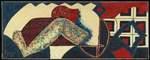
Much of Egonu’s work from this period relates to the Biafran War, also known as the Nigerian Civil War (1967–70). Woman in Grief was painted in the same years as the two major battles for the strategic city of Onitsha in Nigeria. These were large-scale military conflicts between Biafran and Nigerian forces with high casualties on both sides. The events had particular significance for Egonu who was born in Onitsha.
Egonu uses the artistic style of modernism to express his grief about the Biafran War, drawing on the legacy of artists known for portraying the brutality of war such as Käthe Kollwitz's War series and Pablo Picasso, in works like Guernica and Weeping Woman. The broken figures and abstracted shards of colour and pattern create a feeling of chaos and confusion. Egonu adds traditional symbols and patterns from Igbo culture in Nigeria, called Ule.
Egonu moved to the United Kingdom at a young age to study art, but his family were still in Nigeria when the war broke out. Still in the UK, he followed developments in the war through media coverage, as the war became a very big story.
Uzo Egonu prompts us to think about the way we are affected by current events, and how we can represent these feelings to ourselves and to each other.
Adapt
Choose colours that represent how you feel about your event and cut them out of acetate or tissue paper. Stick them to a window, or clear acetate, creating a collage of your emotions. Watch the light through the colours together. Move into the coloured areas created by the light – could you put a hand, a leg, or your whole self into the colours? What does it mean to be able to see and experience your feelings in this way?
Alternatively, use Tate's Lightbox tool to make your emotion collage. Which colours and shapes will you choose? How does the finished work make you feel?
3. Use the colours, shapes and patterns you have chosen to make a collage about this event and how it makes you feel. You could include images of people and words, or it could abstract by using different shapes and patterns to show your ideas and emotions.
Experiment with what happens when you use both images and abstract elements.
4. At the end of your lesson, share your collages with each other. What are the similarities and differences between the events you chose, and the emotions they evoke in you?
Have you learned anything new about the event you chose?
Has making this artwork, or looking back at the artwork you’ve made, changed how you feel about the event?
Could you use art to make sense of your feelings about other things in your life?
Extend
Think about the way this event is portrayed in the media. Are there additional layers you could add to your collage to represent all the different perspectives and types of news media you've encountered?
How do you think the people affected by that event feel? Are there different sides with different feelings that may be in conflict with each other? Could they be represented in your collage?
How does your understanding of the event change as you add these additional perspectives?
Making art is a powerful way to learn new skills, explore ideas and express ourselves creatively. Encourage your students to discover new materials, techniques and methods inspired by great artists at Tate.
2. Explore (10 minutes)
3. Make (30 minutes)


