

El Anatsui
Learn about El Anatsui’s complex sculptures and explore the power of repeating a small act to make something much larger
transcript here
About the Video
Encourage your students to respond to the video in their own ways – perhaps by making notes, doodles or drawings, or through gestures and sounds.
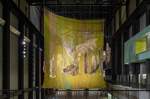
Artist El Anatsui shares the inspiration behind his work and reflects on the process of making his Hyundai Turbine Hall Commission Behind the Red Moon in 2023.
"When you link things, when you unite things, their power keeps growing"
El Anatsui
In 2023, El Anatsui transformed Tate Modern's Turbine Hall with a giant installation made of thousands of bottle tops and fragments of metal. This work built on his interest in the migration of goods and people during the transatlantic slave trade. The liquor bottle tops came from Nigeria and are from an industry built on colonial trade routes. He says that the bottle tops were 'there at the beginning of the contact between two continents' and that they hold the past and present of Africa and Europe. The sculptures he creates from these materials hang in the air and appear to float across the space.
Anatsui works with dozens of assistants, stitching and assembling his sculptures by hand. Connections are made organically between materials, shapes and colours as compositions are pieced together.

Hyundai Commission: El Anatsui: Behind the Red Moon, Installation View, Photo © Tate (Lucy Green)
Discuss
Your students' ideas and experiences are the best starting point for any discussion. Use the prompts below to support meaningful and creative discussions in the classroom about the films' key themes. Discover how El Anatsui's practice can inspire your students to learn with art.
Repetitive Action
Anatsui says that when you repeat something, its meaning becomes clearer to you. This could be repeating an action or phrase such as mending a net or speaking a mantra.
Prompts
- What actions or phrases do you repeat multiple times per day? Do you think about their meaning, or do they happen automatically?
- A mantra is a word or short phrase that is repeated to help calm the mind, build concentration, or support learning. Do you have a mantra that helps you concentrate, or something you tell yourself when learning a new skill? What do you think the value of a mantra might be?
- Some people feel that repetitive actions like knitting, sewing, or drawing circles are forms of meditation. Some people use repetitive actions for stimming and self-regulating. Can you think of activities or actions you repeat that help calm and centre you?
From One to Many
Anatsui works with large groups of similar materials, creating huge walls of shimmering bottlecap sculptures, wooden forests, or wood panels made up of tiny slices and cuts of wood. He also works with many assistants called artisans who assemble pieces based on his loose instructions.
Prompts
- Anatsui could tell the artisans he works with exactly how he wants something done, but instead he gives them simple, open instructions. Why do you think he lets them work in their own way?
- He says he feels like his job is to decide how to harness the differences in people’s work into something organic. He says those differences are desirable ‘in an art situation.’ Why might difference be a good thing, in art or in society?
- Anatsui says that in his work, the power of a simple object grows when it is multiplied many times. How does using lots of the same thing change how the artwork feels? Why might many people or many objects be stronger together than alone?
Legacies of Colonialism
Anatsui thinks about history and how it is connected to the world today. He is interested in the way commonplace objects, such as bottle caps, retain the histories and stories of places and people. In particular, he explores how these objects connect to the introduction of the slave trade to Africa and to the ways modern industry, and companies such as Tate & Lyle, benefitted from the infrastructure created by the transatlantic slave trade.
Prompts
- Anatsui feels that uniting and transforming these materials can bring about meaning and ‘help enrich the lives of people.’ Why do you think an artist would want to try to transform materials associated with the slave trade? How could this help people learn or feel differently?
- Do you think using an everyday object to make art can transform it into something new or unexpected? Does it break with its past or hold on to its history?
- Do you think art can help people learn about and understand what happened in the past? How might art help us remember and talk about the transatlantic slave trade and colonialism?
How to Use Artist Stories
Introduce art and artists into your classroom with Artist Stories resources. The resources combine engaging videos and thoughtful discussion points to encourage confidence, self-expression and critical thinking. Art is a powerful tool for discussing the big ideas that impact young people's lives today.
- Explore the video:
- Read About the video to introduce the artist to your students.
- Project the video or watch it in smaller groups.
- Each video is between 3–10 minutes.
- Transcripts are included where available.
2. Discuss the video:
- Select discussion prompts from the list to frame your conversation.
- Use a mix of individual reflection, pair work and group discussion.
- Use one set of prompts to explore a theme in depth or shape your discussion across different themes.
- Discussion prompts can also be used in a Q&A format.


