

Bhajan Hunjan
Discover the artist’s artwork through classroom discussions on memory, community and empowerment
Bhajan always liked to make things. She grew up surrounded by people who used the materials around them in creative ways. The women in her family were very skilled. They spent their afternoons sewing clothes, knitting and embroidering.
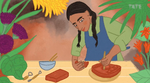
One day Bhajan was sitting in the garden with her mum. The garden was full of plants, flowers and vegetables that her mum had planted especially for her children to enjoy. "Bhajan, this looks like good soil". Together they made a small pot moulding it with their hands. Bhajan felt calm and peaceful, almost like time was standing still.
Bhajan Kour Hunjan was born in 1956 in a town at the foot of Mount Kenya, called Nanyuki. She was part of a large Indian Sikh family who had moved from India to work in Kenya in 1933, when it was part of the British colonial empire. Nanyuki had European, Asian and African families living throughout the town. Bhajan's father ran a hardware shop right in the centre. Bhajan would sit amongst all the building materials, listening to all the visitors conversations in many languages including Punjabi, Hindi, Gujarati Kiswahili, English and more.
At school Bhajan liked maths but she found English hard to understand. All the letters felt like a jumble of shapes She sometimes felt lost amongst the different languages, unsure of her voice. Bhajan's father wanted her to study accounting but he recognised his daughter's creativity.
So, when she was 18, with her family's love and support, Bhajan moved to the UK to study art. She arrived in autumn when it was cold and foggy - very different from sunny Kenya. Everything was different in England. The buildings, the landscape the weather.
She was one of only two artists of colour on her course. Bhajan noticed this and began to think about her history, culture and her place in the UK. In the library she poured over books, learning about the work of Frida Kahlo, the shapes of Georgia O'Keeffe and the materials of Barbara Hepworth.
But she missed home. The landscape of Nanyuki appeared in her artwork and the materials she used. Her prints and etchings grew full of organic shapes, swirling letters portraits of her family. Her artwork became a conversation with home. Working with clay, she remembered her mum in the garden digging up the good soil.
Bhajan's artwork grew bigger, becoming an extension of herself. Sitting on the floor she would draw huge shapes all around her, creating a place she could be fully immersed in.
Bhajan graduated from university and began to work as an artist. But it was difficult. Many Black and Asian artists weren't given the opportunity to show or make money from their artwork. Bhajan and her friends got around this by organising their own exhibitions She felt empowered in this community, surrounded by makers and activists. Bhajan was especially interested in showing the experiences of women like her, her mother and her sisters. Can you see the women looking at each other in this portrait like they're talking to each other?
Now, Bhajan also works as an artist educator bringing communities together in art workshops The ideas shared in these workshops are like little seeds being planted amongst the people taking part. These ideas grow into colourful public art pieces, covering the pavements and walls of hospitals schools, and playgrounds. Bhajan believes that life is made up of lots of little moments in time and making art allows time to stop still.
About the video
Encourage your students to respond to the video in their own ways – perhaps by making notes, doodles or drawings, or through gestures and sounds.
Hunjan grew up in Kenya surrounded by artists and makers.
‘Making art allows time to stop still’
Bhajan Hunjan
Discover the life of artist Bhajan Hunjan through this bright, colourful animation. Her public artworks begin in the studio with drawing, painting and printmaking using line, colour and shape. After moving to the UK to study art, she built a new community with her friends, putting on exhibitions together and celebrating each other’s work.

Photograph of Bhajan Hunjan with her installation 'Color Dialogues' © Bhajan Hunjan
Discuss
Your students' ideas and experiences are the best starting points. Using the prompts below, support meaningful and creative discussions in the classroom about the video’s key themes. Discover how Bhajan Hunjan’s practice can inspire your students to learn with art.
Memory and Making
One of Hunjan’s earliest memories is moulding a small pot from the soil in her garden. When playing with the clay soil alongside her mother, Hunjan says she felt peaceful and calm, 'like time was standing still’.
Prompts
- How do you feel when you make art?
- Have you ever experienced the feeling of ‘time standing still’? What were you doing?
- Can you remember a moment when you felt peaceful and calm? Where were you? Who was with you? How could you recreate that feeling now?
Scale and Shape
Hunjan’s artworks grew larger in scale over time, ‘becoming an extension of herself’. Sometimes she drew huge shapes all around herself on the floor, creating a space she could be fully immersed in.
Prompts
- Think about what you learned about Hunjan’s life from the video. Why do you think she wanted to create spaces for herself through her artwork?
- What shapes would you draw around yourself to create a space just for you? Why did you choose these shapes?
- Where in your school or community would you like to create a giant artwork, and why? What would change about the space you’ve chosen?
Community and Empowerment
After moving to the UK to study art, Hunjan built a community with her new friends, putting on exhibitions together and celebrating each other’s work. She now runs art workshops where she helps others to find their own creativity. The ideas shared in these workshops are like ‘little seeds being planted amongst the people taking part’.
Prompts
- Imagine that your ideas are little seeds too. What ideas would you plant? What kinds of artworks would you want your seeds to grow into?
- If you could run an art workshop for your friends and loved ones, inspired by Hunjan, what ideas and techniques would you explore?
- Think about someone in your life who’s never made art before. How would you encourage them to play with art materials, express themselves and try something new?
How to use artist stories
Introduce art and artists into your classroom with Artist Stories resources. The resources combine engaging videos and thoughtful discussion points to encourage confidence, self-expression and critical thinking. Art is a powerful tool for discussing the big ideas that impact young people's lives today.
- Explore the video:
- Read About the video to introduce the artist to your students.
- Project the video or watch it in smaller groups.
- Each video is between 3–10 minutes.
- Transcripts are included where available
2. Discuss the video:
- Select discussion prompts from the lists to frame your conversation.
- Use a mix of individual reflection, pair work and group discussion.
- Use one set of prompts to explore a theme in depth or shape your discussion across different themes.
- Discussion prompts can also be used in a Q&A format.


