
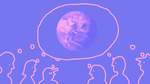

Can art save the world from environmental catastrophe?
Discover the role art can play in tackling the climate emergency
Content warning:
This video explores ideas of death and contains images of burial that may be difficult for some viewers.
Narrator: Can art save the world from environmental catastrophe? No. Well, not on its own.
But art can help us understand the impact our societies have had on the world we live in and inspire us to take action.
The term climate emergency wouldn't have meant much to artist L.S. Lowry but his paintings of the north of England show the effects of mass industrialisation on the natural and urban landscape.
Billowing clouds of smoke from huge factories dominate the scene. The people seem anonymous and powerless in comparison.
In Simryn Gill’s photographic series Channel humans aren't visible at all. We only see what they've left behind. Gill's photos document the pollution of the mangrove forests in her hometown of Port Dickson in Malaysia. The rubbish almost seems part of the natural world: brightly coloured flowers or fruit hanging from the trees.
There's a cargo ship on the horizon. Perhaps Gill is pointing to globalised trade and the uneven impact it has on nature and local communities.
In this work artist Abbas Akhavan covers the gallery floor with bronze sculptures of plants native to Iraq.
Abbas: Study for a Monument was made with the assistance of images provided to me by Dr. Sophie Neil from the Royal Botanical Gardens of Edinburgh.
Working from these images, I sculpted these plants out of wax much larger than their actual size to make them this scale of what you would find at the base of a monument.
Laid out on white bedsheets, the sculptures resemble specimens undergoing scientific study, confiscated goods, objects in a street market or bodies prepared for mass burial.
When I was watching on television, and in newspapers, images of the Iraq invasion. Iconoclastic images of American soldiers tearing down these massive egomaniacal monuments that Saddam Hussein had built for himself. I was thinking of how do you reconsider the kind of human-centric memorials and monuments that are often pyramid shaped?
This kind of pyramid vertical shape is something that I responded to with this work, which is horizontal, fragmented, has a bit of a more precarious or transient mode of display.
Narrator: After the first Gulf War in 1991, Saddam Hussein destroyed the Mesopotamian marshlands, to eradicate the Shia rebels who lived there. The technology to drain the marshes had been developed by the occupying British Mandate earlier in the 20th century.
This work is aimed at reconsidering what we memorialise. One of the things that we don't consider in a popular collective consciousness is the ecological damage of war. What happens to the soil and the toxicity on the ecology of the landscape in the aftermath of these wars?
Otobong Nkanga is interested in the bling of everyday cosmetics and technology, and our disconnection from the social and environmental cost of their production.
Otobong: I think one thing I would like to talk about was the notion of
dependency and of addiction. When you see that kinds of scars we have in our landscape, we are drug addicts in a way - and the drug is the resources.
If we start thinking in such a way that we're that connected and that we are also part of elements that are in the soil, we will maybe think of the way we work within our landscape differently.
Narrator: Some artists work with the landscape directly taking action outside of museums and galleries. During the Venice Biennale in 1968, Nicolás García Uriburu poured a chemical called Fluorescein into the waters of the Grand Canal.
This nontoxic chemical reacted with micro-organisms in the water and turned the canal bright green. He was making a point about water pollution and how we need to treat this precious and increasingly scarce resource with more care and respect. He went on to repeat this action in rivers and coastlines around the world.
In different ways, artists bring us face to face with the realities of natural destruction - whether through climate, war or pollution. They also urge us to think about new ways of imagining a more sustainable world and prompt us to take collective action to make it a reality.
About the video
Encourage your students to respond to the video in their own ways – perhaps by making notes, doodles or drawings, or through gestures and sounds.
This video asks the question, ‘Can art save the world from environmental catastrophe?’
"Art can help us understand... and inspire us to take action"
It shares artworks by L.S. Lowry, Simryn Gill, Abbas Akhavan, Otobong Nkanga and Nicolás García Uriburu, to explore how these artists raise issues connected to the environment and inspire us to take action.
Discuss
Your students' ideas and experiences are the best starting point for any discussion. Using the prompts below, support meaningful and creative discussions in the classroom about the video’s key themes. Discover how the artists in this video can inspire your students to learn with art.
The Impact of Climate Change
Artists often make work about ongoing changes in society and the wider world. The artists that have been brought together in this video are all making work that explore the impact of rapid climate change on their environments and communities. Climate change is affecting us all in our everyday lives; however, the effects are felt differently across the world, with Indigenous communities in the Global South often facing the worst impacts.
Prompts
- In the video, Otobong Nkanga’s work draws attention to how we all share responsibility, no matter where we live in the world. What do you understand about climate change? How is it affecting us in our everyday lives?
- Is there anything you’ve noticed in your local environment that might be explained by climate change? Think about how Simryn Gill photographed the rubbish that had accumulated in the mangrove forests where she lives.
- How do the artworks in this video tell us something important about this big issue?
Connections and Associations
In this video, artists are described as ‘pointing to’ something, or ‘showing’ something, rather than ‘telling’ something. For example, artist Abbas Akhavan’s artwork Study for a Monument 2022 could remind you of botanical drawings, objects in a street market or bodies laid out for burial. By having multiple possible meanings, the artwork prompts us to make different associations and connections with what we can see.
Prompts
- Think of an artwork from the video. How does it show us something about issues in the environment? For example, you could think about the way L.S. Lowry paints the pollution from the factories into his scenes.
- What can we learn about the everyday impact of climate change from the way these artists show us their environments?
- Think about a big issue that is important to you. What would you show someone from your own life that could capture this issue in an interesting way?
Direct Action in Art
In the video, artist Nicolás García Uriburu is shown taking direct action through his artwork Coloration of the Grand Canal, Venice 1968 to highlight water pollution.
Prompts
- What do you think counts as direct action? Why might someone take direct action to share something important with the world?
- How does García Uriburu’s artwork make you feel? What are the pros and cons of making an artwork like this?
- How do artworks like this support us to take action in our everyday lives?
How to use Artist Stories
Introduce art and artists into your classroom with Artist Stories resources. The resources combine engaging videos and thoughtful discussion points to encourage confidence, self-expression and critical thinking. Art is a powerful tool for discussing the big ideas that impact young people's lives today.
- Explore the video:
- Read About the video to introduce the artists to your students.
- Project the video or watch it in smaller groups.
- Each video is between 3–10 minutes.
- Transcripts are included where available.
2. Discuss the video:
- Invite your students to respond to a discussion prompt individually. They could record their responses through writing, drawing, making or voice recording. (5 minutes)
- Invite your students to share their ideas and responses with someone else. What have they learned about themselves or others by sharing their responses? (5 minutes)
- Invite your class to share their thoughts and ideas in groups or as a whole class, inviting multiple perspectives and experiences. (10 minutes)


