

Hew Locke
Join the artist as he walks us through his artwork The Procession and discover his ideas about togetherness, heroes and hope
Hew: When you make a piece of work you see things one way - and the piece of work has a life of its own. So, how this work is perceived over time will change and evolve and that's how it should be, you know.
The idea of who these people are for me in The Procession should be timeless, because it needs to stretch beyond where we are now.
My name is Hew Locke, I'm an artist. Sometimes I'm a sculptor, sometimes I'm a painter, sometimes I'm in photography. I was born in Edinburgh and at the age of five I went to Guyana. And this would have been in the sixties - I arrived just in time for independence. So, I saw the flag being designed. We were allowed to stay up at night to watch the handover from the British to Guyanese government and that had quite an impact on me.
And it gave me a lifelong interest in how nations are formed and what they choose as their symbols of nationhood. And that has particular relevance to Britain and my approach to this country, and how we accept what our images are. And that could stretch on even to ideas of who the national heroes are of this country, you know. Who gets a statue and who doesn't get a statue. And all of this stuff then feeds into ideas of nationhood and it gives me inspiration in my particular practice.
My work is influenced by many things and autobiography is definitely one of them. I arrived in Guyana as a five year old kid. I went there by boat because that's what you did in those days. And that had a kind of I think a deep psychological impact on me, and I've been making boat sculptures over the years and I think it has a direct reference back to that journey.
In Armada there's nobody on these boats; they're empty of people but the people who are travelling on it is you and me. Our minds go into the boats and we imagine the journey that we might take on them. The name Guyana means land of many waters, and to get anywhere you'd have to go by boat.
So it's not surprising that boats are part of who I am. They're containers for people trying to get to a new life. They're containers for a journey through life, into death. There are others which have references to colonial issues to conquistadors chasing gold. Some others have references to the Mediterranean refugee crisis. Boats are a metaphor for life, basically.
The Procession is about certain universal concerns, and they will always be there. I'm trying to tackle some really big, wide subjects over centuries and how things affect us today. But it's talking about the echoes of history basically. What I'm trying to do is make something attractive - to draw people in. And people go - 'What's that? What's that mean? What's that?' And then start to question what the imagery is all about.
It's highly detailed and that's deliberate. So it will give reward to longer viewing. There is lots of little bits of evidence, lots of bits of hint. Lots of bits of clues The piece can be read as a sort of puzzle, you know. Which you can piece together. There's beauty there I would like to think but it's a complicated messy kind of beauty.
What I'm trying to do is create something which I personally find emotional and emotionally charged, and emotionally moving. I hope that people will actually feel that they're part of something. I wanted the work not to be raised up above people's heads, I realised that the work needed to be human scale. We need to identify with these figures even though they look strange and wearing weird masks, and stuff like that. We need to identify with them.
I think of The Procession as an epic poem. It's a bit like a kind of national collective unconscious, it becomes part of who we are. So the material I use are quite contrasty. Some are quite golden and flamboyant, and some is quite rough. This is all deliberate. This is because I want different feels running through the whole thing. It looks as if it's got a history to it. It has some age to it.
I've been using cardboard for many years now. It's a warm material, it's a material we know. We understand it. As kids we get into cardboard boxes and they become boats, they become cars. It has a resonance beyond many other materials. It folds and bends in a particular way. But also conceptually, cardboard is interesting. It's very, very useful but then it's throwaway at the same time. It's a disposable thing.
What was also crucial to this project was figuring out that I could have my own custom made fabric. That made all the difference. So fabric which I was printing myself, but also fabric which I was buying at fabric shops dotted around London. I make work which there's a lot of difficulty in it, maybe defiance, maybe conflict, but it's about hope you know - It's essential. We can't survive without it. We drown without it and what's happening in the Duveen Hall is not a negative movement of people - it's a positive movement of people.
They're moving into another life, you know. They may be coming from difficult times, they may be heading through difficult times. But there's an energy there, which is about hope. The future. Let's make something positive.
About the video
Encourage your students to respond to the video in their own ways – perhaps by making notes, doodles or drawings, or through gestures and sounds.
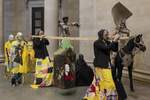
Artist Hew Locke shares the inspiration behind his work and reflects on the process of making The Procession in 2022.
‘Let’s make something positive’
Hew Locke
For the Tate Britain Commission in 2022, Hew Locke created a new and exciting large-scale installation artwork in response to the grand space of the Duveen Galleries. Locke’s The Procession invites visitors to ‘reflect on the cycles of history, and the ebb and flow of cultures, people and finance and power.' The installation takes inspiration from numerous real events and histories, but the figures in the whole piece invite us to walk alongside them into a hopeful vision of an imagined future.
Discuss
Your students' ideas and experiences are the best starting point for any discussion. Using the prompts below, support meaningful and creative discussions in the classroom about the video’s key themes. Discover how Hew Locke’s practice can inspire your students to learn with art.
Procession and Togetherness
Processions are a big part of the cycle of life; people gather and move together to celebrate, worship, protest, mourn, escape or even to better themselves. This idea is at the heart of The Procession.
Prompts
- Have you ever experienced a procession? What do you remember?
- Why do you think people sometimes choose to gather and move as a group, rather than as individuals?
- Imagine yourself moving within a large procession. Who would you want to move with you? This could be the people in your life, people you look up to or fictional characters! What do you think your procession would feel like?
Heroes and Statues
Locke is interested in how nations are formed and in what he calls ‘symbols of nationhood’. Through his work he often explores the idea of national heroes and asks the question, ‘who gets a statue and who doesn’t?’
Prompts
- Do you have a hero? What inspires you about them?
- Do you think they have a statue anywhere? Who do you think decides who gets a statue?
- Who would you make a statue of for your playground, and why?
Power and Hope
In the video, Locke says, ‘the piece can be read as a sort of puzzle’ and ‘I make work which … there’s a lot of difficulty in it, maybe defiance, maybe conflict. But it’s about hope.'
Prompts
- Did you see anything that felt hopeful in The Procession? What made it feel this way?
- Do you think there is power in hope? What can hope do?
- What do you hope for? How could hope help to make change in the world?
How to use Artist Stories
Introduce art and artists into your classroom with Artist Stories resources. The resources combine engaging videos and thoughtful discussion points to encourage confidence, self-expression and critical thinking. Art is a powerful tool for discussing the big ideas that impact young people's lives today.
- Explore the video:
- Read About the video to introduce the artist to your students.
- Project the video or watch it in smaller groups.
- Each video is between 3–10 minutes.
- Transcripts are included where available.
2. Discuss the video:
- Select discussion prompts from the list to frame your conversation.
- Use a mix of individual reflection, pair work and group discussion.
- Use one set of prompts to explore a theme in depth or shape your discussion across different themes.
- Discussion prompts can also be used in a Q&A format.


