

Hurvin Anderson
Discover the inspirations behind Hurvin Anderson’s paintings and how he uses photography to explore belonging, landscape and materials
Hurvin: I'm interested in the psychology, the kind of underlying feeling that a painting has. My name is Hurvin Anderson and I'm a painter.
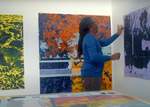
I paint landscapes and interiors in its kind of simplest form I don't have a strict process. I think there are parameters and, essentially using photographs as a starting point as a way, a way in to start thinking about painting.
And there is part of me that's a little bit restless in terms of painting, and quite likes the experimentation the use of materials, building up a painting from different sheets of paper and then putting them together.
I like to leave things and then come back to them. So you get a better idea of how things are working. Photographs, they're interesting. It's a love-hate relationship, maybe still in my mind, or maybe in the audience's mind the photograph is you're cheating somehow. It's a shortcut, you should be out there in the landscape. But at the same, I'm not sure, I'd be making the same kind of images if I was out in the landscape.
The idea came from this photograph I had in Handsworth Park of friends playing football and this ball had gone into a pond, and the photograph had two meanings. For me, it was this personal rare moment. When it became a painting it became about something else. It became about these kids adrift on this, what seemed to be an island. So it was just this question about belonging, in a way.
You know, I think about the paintings as sites where Black people occupy. My parents are from Jamaica, I was born in Britain. I guess it informs a lot of what I do, I'm trying to question what it brings up. At the same time I'm kind of interested in painting and ideas within painting - I will take a photograph like that and pull things in, and take things out. I literally painted a section out of here and then a section out of here and just played with the form.
We went to Sri Lanka, and this was a view from the hotel we were staying.
What I do is, it's about questioning my history, my place. These are landscapes that have no real connection to the Caribbean. Whereas these things were taken in Jamaica - I have more connection to them. I feel like I have a little bit more relationship to a landscape that I don't know than the British landscape, in a way I'm asking myself, 'why?'
The only way to question that is to paint something that's out of my context. It's getting to know the land, or being part of the land, seems to be part of the way you belong to a place, or understand a place.
About the video
Encourage your students to respond to the video in their own ways – perhaps by making notes, doodles or drawings, or through gestures and sounds.
Hurvin Anderson’s paintings engage with the traditions of landscape painting and the history of abstraction.
"What I do, it’s about questioning my history,
my place"
Hurvin Anderson
His pictorial world has been shaped by his relationship to the places he has lived in and visited, being born in Birmingham of Jamaican parents. Anderson's paintings draw on these influences as a way of understanding different landscapes and exploring them through paint. In the video he shares the inspiration and ideas behind his paintings and how he uses photography as a way in to create artworks that are drawn from real and imaginary places.
Discuss
Your students' ideas and experiences are the best starting point for any discussion. Using the prompts below, support meaningful and creative discussions in the classroom about the video’s key themes. Discover how Hurvin Anderson’s practice can inspire your students to learn with art.
Landscape and Feeling
Anderson talks about the ‘underlying feeling that a painting has’. He is interested in how painting can be a way of asking questions or finding out about something – particularly a place or landscape.
Prompts
- How do Anderson's paintings make you feel? Do you have any questions about his artwork?
- What types of landscapes or places do you connect with most, and why?
- How do you like to get to know a landscape or a place? What helps you to understand a new space?
Belonging and Place
In the video Anderson speaks about belonging. He says, ‘what I do, it’s about questioning my history, my place’. He uses painting to ask questions about himself and where he feels he belongs.
Prompts
- What does the word ‘belonging’ make you think of? What emotions could you connect with the idea of ‘belonging’?
- Where do you feel like you belong? Could you share how that place makes you feel?
- Is there something you would like to find out about yourself through making art? What questions would you ask?
Painting and Process
Anderson explains that he often makes up his landscapes, adding together bits from various photographs and different locations before then creating a painting. He links this process to his questions about where he belongs and which landscapes he connects to.
Prompts
- Why do you think someone might feel more at home in a made-up landscape?
- If you could combine two landscapes or places together, what would they be, and why?
- Anderson thinks that some people would think making a painting from a photograph is like cheating – do you think this is cheating? Have you ever made an artwork using a photograph? What makes this different to working from life, such as painting a landscape when outdoors?
How to use Artist Stories
Introduce art and artists into your classroom with Artist Stories resources. The resources combine engaging videos and thoughtful discussion points to encourage confidence, self-expression and critical thinking. Art is a powerful tool for discussing the big ideas that impact young people's lives today.
- Explore the video:
- Read About the video to introduce the artist to your students.
- Project the video or watch it in smaller groups.
- Each video is between 3–10 minutes.
- Transcripts are included where available.
2. Discuss the video:
- Select discussion prompts from the lists to frame your conversation.
- Use a mix of individual reflection, pair work and group discussion.
- Use one set of prompts to explore a theme in depth or shape your discussion across different themes.
- Discussion prompts can also be used in a Q&A format.


