

Mohammed Sami
Watch a video with Turner Prize nominee Mohammed Sami and explore absence, memory and ambiguity through discussion points
Mohammed: The power of the painting lies in evoking the presence of what is not shown. When you look at lightning you expect the thunder, and when you hear the thunder, you expect the lightning. What I depict on the paintings is the sound of the thunder, but no lightning at all
So, you are the person who's going to imagine, ‘Is this a sound of bombs, or a sound of thunder?’
When it comes to painting, there is a beauty in making the question, so why should I have to answer?
Preparing the canvas, it's inseparable from making the painting. You know, I would exaggerate if I say, ‘I prepare each linen as a father prepare his son for the first day in the school.’
All the canvases need to be done by myself, because when this painting will move to a museum, I will remember everything about this work, even the small scratch in my finger.
I am extremely emotionally fragile to build up a new collection in my studio. You have to face these white canvases. It's like a death penalty awaiting you.
In order to avoid the studio for a few hours in the morning, there are some ritual steps I do for myself. I wake up at 4:30 to go for a run, go for a long walk, sit down in coffee shops. I look at the silliest things ever, just to digest ideas.
The artist's mindset is to hunt or to be hunted by these triggers.
Sometimes the window in my studio trigger a scenario. There is net on the window. The window was broke, and yet the net on the window, it seems like holding the cloud, but give me a clue that the net is holding the clouds. There's no clue. This is your sensation.
It’s conjunctions of experience passed on your own memory. It's accumulation of repetitive events you have seen it over and over and over again, and then it stopped here, in this painting.
Empty spaces, internal spaces, external spaces, the everyday objects, the light and shadow – they act on the behalf of the human presence in order to convey what is not there. The absence in artworks allow wider room for the audience to engage with the artwork. To raise questions.
I believe in the power of a question more than the answer.
There will be absolutely no conclusion in the artworks. But at the same time, never denying the artist’s experience.
Of course, you know, I'm from Iraq. You know, there is an emotional connection with these spaces, but the memories refuse to define itself in the painting, because it may turn to a report of war, politics, and then the paintings are going to serve ideology rather than serving a purpose of art.
The Western audience, they have already impression about my homeland.
That's why they anticipate to see violence in my work. But there's no tangible violence. I take advantage from the collective memory.
The powerful work, in my opinion, is the one that, when you look at the painting, you think about something else. The paintings became a mirror for the audience’s perceptions. And that's why the paintings need to be timeless.
About the Video
Encourage your students to respond to the video in their own ways – perhaps by making notes, doodles or drawings, or through gestures and sounds.
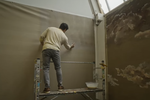
Mohammed Sami reflects on his artistic process as he approaches a new canvas for the first time.
“I believe in the power of a question more than the answer”
Mohammed Sami
Sami discusses the artist’s mindset and how everyday objects, empty spaces, light and shadow work to convey what is not there. By embracing ambiguity, absence and repetition, Sami invites viewers to always ask questions.

Discuss
Your students' ideas and experiences are the best starting point for any discussion. Using the prompts below, support meaningful and creative discussions in the classroom about the video’s key themes. Discover how Mohammed Sami's practice can inspire your students to learn with art.
Absence
The film begins and ends with an empty canvas of Sami’s, and at the beginning of the film, Sami says, ‘the power of the painting lies in evoking the presence of what is not shown.’ The artist himself also never shows his face to the viewer, instead focusing our attention on his artworks.
Prompts
- Why do you think an artist might want you to focus on what is not in a painting?
- Sami tells us about how he prepares an empty canvas and the ‘ritual steps’ he takes before he starts a new artwork. What helps you deal with the unknown or unfamiliar before you start something new?
Memory
Sami says that though he may have emotional connections to the places he paints, ‘the memories refuse to define [themselves] in the paintings’ and that he instead draws on the knowledge and information groups of people share through ‘collective memories.’ One example of ‘collective memories’ might be the stories we learn about big historical or current events. He triggers these memories through everyday objects and the use of light and shadow.
Prompts
- Sami’s works feature familiar-seeming spaces and everyday objects that act as clues for what may have happened in those spaces. He expects us to read these clues and make our own connections. What do you think might have happened in those spaces?
- Ambiguity means that something is open to more than one interpretation. Why do you think Sami has chosen to make his paintings ambiguous?
- Can you think of a collective memory – something everyone in your group or class remembers? Do you all remember the event, object, or situation the same way, or is everyone’s memory unique?
Making art today
Sami is one of four artists nominated for the 2025 Turner Prize, which celebrates the best of British art today. By examining absence, memory, and ambiguity, Sami creates canvases that ask us questions and prompt us to ask our own questions back.
Prompts
- Contemporary art means any artwork made in the present or recent past. Can you think of any other contemporary artists you’ve heard of before? What similarities and differences can you find between them and Sami?
- What do you think artworks should say? Do they need to have an important message? Why, or why not?
- What might you find out about Sami and his practice if you spent time with him as he worked?
How to Use Artist Stories
Introduce art and artists into your classroom with Artist Stories resources. The resources combine engaging videos and thoughtful discussion points to encourage confidence, self-expression and critical thinking. Art is a powerful tool for discussing the big ideas that impact young people's lives today.
- Explore the video:
- Read About the video to introduce the artist to your students.
- Project the video or watch it in smaller groups.
- Each video is between 3–10 minutes.
2. Discuss the video:
- Select discussion prompts from the lists to frame your conversation.
- Use a mix of individual reflection, pair work and group discussion.
- Use one set of prompts to explore a theme in depth or shape your discussion across different themes.
- Discussion prompts can also be used in a Q&A format.


