
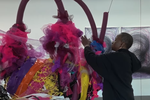

Nnena Kalu
Watch a video with Turner Prize winner Nnena Kalu and explore rhythm, repetition and unconventional materials through discussion points
Shelley Davies: I always think of Nnena’s practice as working to her own innate rhythm, whether it's wrapping, whether it's knotting, whether it's drawing. It is always to the same rhythm. It's like listening to the sound of the sea coming in and out. It’s so beautiful seeing Nnena being in her element
Charlotte Hollinshead: I've been working with Nnena since 1999. ActionSpace and Nnena have developed together. From the very beginning it was clear that she was phenomenal and creatively really driven. Her work is really contemporary. It’s really exciting. It's really fresh It feels really relatable and it's just utterly wonderful now that her work is out there.
From the early days Nnena’s need to layer and to constantly build on whatever she's working on was present, so, it's been a case of sourcing materials that suit her need to build with a line. VHS tape is something we found early on and she completely adores it.
So much of her work is about this continuous line. She wants to take that line on a really long journey and she wants to build it and build it and shape it.
Shelley: It's so repetitive and rhythmic. The rhythm, it's such an important part of her work and I get so drawn into the rhythm. I love it.
Jes Fernie: I remember it really vividly, Nnena working in a disused car showroom, making all of these incredible secreted sculptures, and what I really loved about the experience was that I felt so strongly that she was using her body to make these sculptures. So, they were dictated by the movement of her body. And I just thought, ‘Wow, this is ... this is incredible.’
Charlotte: She's completely in tune with her materials. It's absolutely beautiful to watch her working. She loves having the music on. She adores ABBA, a bit of Michael Jackson, Stevie Wonder.
Joan Allen St Hill: She’s wrapping, she's dancing. She's painting, she's dancing. Whatever it is, she's dancing. She loves it.
Lisa Slominski: When I first met Nnena the thing that really stuck out to me was her individual energy, her love for high fives, her amazing fingernails, and also incredible drive and passion
Luke Ottridge: She's taught me a lot about how to engage completely with your practice. It becomes about the work, about the joy of that process.
Sheryll Catto: She glows when she's making art and she really comes into her own when she's making art. She is a true artist.
Charlotte: Nnena’s relationship to her work has evolved in the most amazing way. Her early work was clusters of colour that she laid down in rows, and she did that for years. And then about 2013, she just suddenly stopped. She went straight into making these circular vortexes.
Sheryll: The other moment that Nnena’s work suddenly changed was when we did a project for Wandsworth Arts Fringe where we took over an empty shop and suddenly we had a lot more space and a lot more materials. And that was when the 3D work really took off, and she was binding around the security features and around the blinds and everything and by the end of it, there was this amazing city that she had created.
Charlotte: It's a very clear progression, a journey of scaling up from these sort of small little babies to these giant pieces which are far more complex.
As Nnena’s ambition grew, so has ActionSpace's, and so it's been this amazing development of journey together.
Nnena’s work would not happen without the support of ActionSpace. That is the reality, but that doesn't undermine her work. Her work is amazing. She is the artist. It's her work We're here as her facilitators to make sure that she can do what she needs to do
Lisa: ActionSpace have such an important role acting as agents and as advocates for learning disabled artists and as support for curators and institutions to access and work with learning disabled artists.
Nnena's nomination of the Turner Prize is a watershed moment and incredibly important that a learning disabled artist with limited verbal communication has been nominated and is exhibiting on this level, like at Manifesta, being written about, being published about. But at the same time I think it's very important that we don't limit her work and her practice to a disability lens only
Charlotte: I feel like every big exhibition she does now brings out something new in her work. You can really see her practice moving forward. This is a huge moment not just for Nnena, but for the learning-disabled community across the UK.
Luke: The broader community is now catching up with Nnena and Nnena’s work.
Sheryll: Seeing Nnena and what she's doing is encouraging younger people that they can do it too. She is a role model. Where she is now is amazing and fantastic. She has a gallery, Arcadia Missa, who are taking her to Frieze and to Basel, and who knows where she'll go from here.
About the Video
Encourage your students to respond to the video in their own ways – perhaps by making notes, doodles or drawings, or through gestures and sounds.
Nnena Kalu transforms her need to wrap, layer, and build into a powerful artistic language. Kalu’s practice is driven by rhythm and repetition that guides her movements and shapes her environments.
"She wants to take that line on a really long journey"
Charlotte Hollinshead, Head of Artist Development at ActionSpace, and Nnena's studio manager and artist facilitator
This video discusses her journey making art, exploring how her process has evolved. We hear from ActionSpace (an organisation that supports artists with learning disabilities through studio access, professional guidance, and support to grow their practice) and a range of voices who have supported and championed Kalu to create art on her own terms.

Portrait of Nnena Kalu in front of her drawings at the Turner Prize 2025. Photo © James Speakman/PA Media Assignments
Discuss
Your students' ideas and experiences are the best starting point for any discussion. Use the prompts below to support meaningful and creative discussions in the classroom about the films' key themes. Discover how Nnena Kalu’s practice can inspire your students to learn with art.
The Importance of Materials
Several of the facilitators at ActionSpace speak about how important materials are to Kalu, noting ‘she’s completely in tune with her materials’. Kalu builds with lines through wrapping, tying, knotting, and layering works in tape, plastic, and fabric. She rebuilds her sculptures nearly every time they are installed, reusing materials from previous works.
Prompts
- What do you think it means to be ‘in tune’ with your materials as an artist? What is something in your own life that you feel ‘in tune’ with?
- Are there any materials you saw in the video that surprised you, or that you wouldn’t have associated with art making? Can you think of any other artists who use similar materials?
- How does Kalu's use of different materials show you how the work was made? What do you think would happen if all the materials were the same colour or texture?
Rhythm and Repetition
Kalu's drawings and sculptures are shaped and defined by the repetitive and rhythmic movement of her body. Many people in the video talk about the rhythm of her making and her work, with one person comparing it to the movement of the sea coming in and out.
Prompts
- Kalu loves creating to music and to dance while she works. What music might inspire you? How could different types of music inspire you to create differently?
- Think of some different rhythms you've heard – maybe the beat in a song, the chuffing of a train or the tapping of someone typing. How could you express these rhythms to your peers?
- Kalu often repeats movements, making choices about repeating or changing materials as she moves. How could making the same gesture or motion with a different material change what you make? Try using a ribbon, or a torch in a dimly lit room, or another material you’ve never used to make art before!
Making Art Today
Kalu is the winner of the 2025 Turner Prize, which celebrates the best of British art today. By using her body to make rhythmic, repetitive drawings and wrapped, knotted installations, Kalu brings an important perspective to contemporary art in her own way.
Prompts
- “Contemporary art” means any artwork made in the present or recent past. Can you think of any other contemporary artists you’ve heard of before? What similarities and differences can you find between them and Kalu?
- What do you think artworks should say? Do they need to have an important message? Why, or why not?
- What might you find out about Kalu and her practice by spending time with her as she works?
How to Use artist stories
Introduce art and artists into your classroom with Artist Stories resources. The resources combine engaging videos and thoughtful discussion points to encourage confidence, self-expression and critical thinking. Art is a powerful tool for discussing the big ideas that impact young people's lives today.
- Explore the video:
- Read About the video to introduce the artist to your students.
- Project the video or watch it in smaller groups.
- Each video is between 3–10 minutes.
2. Discuss the video:
- Select discussion prompts from the lists to frame your conversation.
- Use a mix of individual reflection, pair work and group discussion.
- Use one set of prompts to explore a theme in depth or shape your discussion across different themes.
- Discussion prompts can also be used in a Q&A format.


