
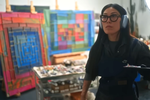

Zadie Xa
Watch a video with Turner Prize nominee Zadie Xa and explore folk art traditions, ancestry, and other worlds through discussion points
Zadie: I feel like oftentimes people either think of me as a performance artist [or] now people think of me as a painter. I actually think of myself as an installation artist. I just feel very multifaceted in many ways and I think that the ideas are essentially the most important thing to me. So that’s how I always start: it’s a core set of conceptual ideas and concerns, and then from that, I’ll think ‘what is the best way to tell this story?’
My name is Zadie Xa and I am a Canadian-Korean artist based in East London.
I grew up going to the church. I grew up Catholic, and I think there is a lot of performative aspects when you go to Catholic church. There’s a lot of rituals, there’s a lot of step-by-step things happen. The costumes, there’s kind of ornate performance, there’s grand, kind of like narratives being told at the pulpit. And I think the relationship between that, the audience, stained glass windows, illustrated Bibles, I think that actually led me into wanting to be creative. I’ve only realised now as an adult, which I think is really funny, because I’m not religious in that way.
[shakes a box] I guess these are in here. I hear the bells.
I think folk art is the most exciting thing to look at for me and the place where I draw the most inspiration, because I feel like it’s really the language of our ancestors directly to us. For example, with Korean Talchum, which is like a Korean folk mask drama, they call it. Something that was done and created for and by the people as a way to relieve social tension. There is a way in which they were able to criticise the kind of feudal system they were living under, in a way that was permissible. In that, there was a lot of comedy and a lot of joy and playfulness. That’s where I’ve tried to find a sense of hope and a desire for that resistance within the work. And also just this idea that, you know, shamans were like the first artists, thinking about the person in front of a fire, talking to an audience.
And I suppose, in many ways, that’s kind of the role I’m trying to fulfill within my own studio with my art practice. Thinking about ways to channel that energy, that experience.
[to Benito Mayor Vallejo while looking at a painting in progress]: Do you think I should start with the fabric that’s being tossed in the air, that’s a little bit pink, or do you think I should go on top of the orca?
The idea of home, or feeling kind of comfortable with oneself is always really shifting for me. I think as a young person I was so desperate to escape my home city, I suppose, wanting to do that, to find myself, without realising it. Often, I feel a real sense of existential crisis about it, because I almost don’t feel like I belong anywhere. When you move away from your home city, and you go back, there are parts of it that obviously change, and you also can feel a sense of an outsider energy, because you’re not part of the community as you once were.
For me, at this point, it’s mostly being in the natural landscape in Vancouver or the Pacific Northwest Coast.
For a long time, I’ve been really interested in marine life and deep ocean, just like I’ve been interested in deep space, because these are landscapes that a lot of us are familiar with, or we feel like we intimately know, but many of us have never actually physically been in those spaces. Because of that, we’re able to project a lot of our own imagination and longings and desires onto those places.
So, I grew up with a single mum. She was really open to encouraging me to do whatever I wanted. I feel like I was quite lucky in the sense that she really was open to kind of just encouraging me to try things and just see what I liked and be happy. I also feel like a really intense relationship that I have with my mum, in a way that I feel extremely close to her.
There was always this unspoken feeling of shame of growing up with a single parent and being in that type of non-nuclear family, which, you know, I think especially growing up in Vancouver, I felt isolated from.
Interviewer: Has this all been worth it for you?
Zadie: Mmm. [nods her head] I’m crying. Sorry.
I think the main takeaway that I want people to see in my work is that I have a profound respect for ancestry and for folk culture and traditions globally, irrespective of if they belong to the heritage of my family. I’m really trying to honour those traditions and have them kind of move forward into the future in different ways that are exciting, and hopefully try to inspire a sense of curiosity that a viewer might have then in their own heritage and their own folk tradition.
And obviously that’s a really weighty thing, and I don’t expect people to see that in my work, but I hope that they see that those are where the inspirations lie. And that through me, they’re looking at other people who have made work. Maybe has otherwise not always been recognised and been, you know, on the margins, as we all like to kind of talk about now, but I do really feel like it’s important. I know that word is thrown around a lot, but when thought about with genuine inquiry and love, it’s really powerful.
About the video
Encourage your students to respond to the video in their own ways – perhaps by making notes, doodles or drawings, or through gestures and sounds.
Zadie Xa’s art draws on ecology, science fiction, Korean folk art and ancestral storytelling.
“I have a profound respect for ancestry and for folk culture”
Zadie Xa
In this video, Xa talks to us about rituals, narratives, and the outsider energy of never fully feeling at home. Her work channels this search for identity, where myth, masquerade, and play open a space for erased or forgotten histories. Xa invites viewers into landscapes that feel strangely familiar yet distant, transforming questions of heritage, displacement, and community into powerful acts of storytelling.
Discuss
Your students' ideas and experiences are the best starting point for any discussion. Using the prompts below, support meaningful and creative discussions in the classroom about the video’s key themes. Discover how Zadie Xa’s practice can inspire your students to learn with art.
Folk Art
Xa feels folk art is the most exciting and inspirational form of art for her, and says she finds joy, playfulness and hope in these practices. She also notes that some forms of folk art served as socially acceptable political resistance, such as Korean Talchum, a masked drama. Xa wants to inspire a curiosity in viewers about their own heritage and their own folk traditions.
Prompts
- Can you think of any practices from your community or culture that you’re curious about? Share your traditions and curiosities with a peer and find out about theirs. What are similarities and differences in what you have shared?
- According to Xa, folk art is 'the language of our ancestors directly to us.’ What do you think your ancestors might want to say to you, or teach you about the world?
- Folk art has traditionally been ‘outside’ of what is shown in art galleries. Why do you think that is? Why do you think it’s important to recognise the contributions of folk artists?
Other Worlds
Xa is interested in 'other worlds' such as the deep ocean and deep space – places that feel familiar, but that most people haven’t seen in real life. These are unknown spaces that we can project hopes and fears onto. They are inspirations for the spaces she creates through her performances and installations.
Prompts
- What do you think could happen in the worlds Xa has created? What would you like to do in those spaces?
- Science fiction has focused on the same places to represent the wonder and terror of the unknown. Can you think of other places that have the same sense of the unknown? What stories do we tell about them?
- Xa works in many different art forms, asking ‘what is the best way to tell this story?’ rather than ‘what type of art do I want to make?’ Why do you think Xa thinks performance and installation might be the best way to tell stories about other worlds?
Making Art Today
Xa is one of four artists nominated for the 2025 Turner Prize, which celebrates the best of British art today. By interweaving folk traditions, ancestry and other worlds, Xa brings an important perspective to contemporary art in her own way.
Prompts
- Contemporary art means any artwork made in the present or recent past. Can you think of any other contemporary artists you’ve heard of before? What similarities and differences can you find between them and Xa?
- What do you think artworks should say? Do they need to have an important message? Why, or why not?
- What might you find out about Xa and her practice if you spent time with her as she worked?
How to use artist stories
Introduce art and artists into your classroom with Artist Stories resources. The resources combine engaging videos and thoughtful discussion points to encourage confidence, self-expression and critical thinking. Art is a powerful tool for discussing the big ideas that impact young people's lives today.
- Explore the video:
- Read About the video to introduce the artist to your students.
- Project the video or watch it in smaller groups.
- Each video is between 3–10 minutes.
2. Discuss the video:
- Select discussion prompts from the lists to frame your conversation.
- Use a mix of individual reflection, pair work and group discussion.
- Use one set of prompts to explore a theme in depth or shape your discussion across different themes.
- Discussion prompts can also be used in a Q&A format.


