
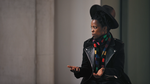

Zanele Muholi
Hear how the power of images can show LGBTQIA+ people that they are not alone through Muholi’s approach to portraiture and visual activism
Content Guidance
This video discusses racism, violence, and sexual violence, and contains images of nudity. We suggest teachers assess the suitability of this resource for their students
Zanele: What matters the most is the content, who is in the picture and why are they there? My name is Zanele Muholi, I call myself a visual activist I take photographs, I capture videos I just capture the moods that maybe other people cannot see.
I focus mainly on documentary photography and portraiture per se of black LGBTI people. Just to be precise, of black lesbian, gay, bisexual, trans, queer, intersex persons from South Africa.
The work that I produce is meant to be for every person. It could be a teacher, it could be a mother whose child is queer and want to have a reference point to show to their kids and say that you are not alone, and it could be for the LGBTI people themselves to understand their worthiness then it becomes political, to say, "How do we politicize spaces with ourselves in a conscious way that tends to be ignored by those who are in positions of power?"
Talking about photography specifically and the need to capture images of ourselves, of our lives is not necessarily about beauty per se, but it's about the need of documenting realities of people who deserve to be heard, who deserve to be seen, and whose lives are often excluded as part of the Canon.
I want to believe that the work touches the soul in ways that you don't often see.
I like to call the people who are in my photographs not subjects, but participants And I think that to say they're subjects, we're divorcing ourselves from that human to human connection that's supposed to happen.
One of the projects that I've focused on is titled 'Somnyama Ngonyama' in which I'm praising my ancestry. I thought that it was very, very important for one to do so, because when we document and photograph other people, we tend to forget about ourselves.
I wanted to find an artistic expression to deal with the painful experiences that I was going through, by drawing back to historical moments. I have photographed so many people, I have captured so many videos and having documented painful experiences of other people without dealing with my own pain, I needed to remember me.
I don't mind to be in front of the camera because I know how uneasy it is sometimes for people to be in front of the camera. That picture to someone looks beautiful or ugly, but to me it means something because it's based on an experience that I have faced or went through.
'Only Half the Picture' is mostly about skin. I wanted to say that sexuality and gender of a person is skin deep; it's not about the clothes that we wear, how you speak, how you walk.
The queer self is the heart in my world, every human is beautiful, it's the kindness and what comes from within that is beautiful. It's not the outer layer.
Then there's 'Brave Beauties' which is a series mainly of transgender women who are former beauty queens. Beautiful girls that I've worked with for many years now. Then there is 'Faces and Phases', which is a series of black and white portraits featuring lesbian, bi, trans and gender-nonconforming bodies. Mostly head and shoulders, which is in your face. I wanted the viewer or the person being photographed engage with each other, so each and every portrait becomes one biography.
The fact that they are there means they have given our movement something that is whole, that helps the next person to know that they are not alone. It's one thing to say that photography's easy, it’s universal, it speaks so many languages but deep down to homophobes, queerphobes and transphobes, it differs because seeing maybe a flamboyant queen changes the context altogether.
So, what then I'm trying to do now, was to find a language that spoke to me as a Zulu speaking person to say, "Okay, I'm creating ‘self’ and ‘selves’ in space and I want people to understand our existence and presence to say, ‘we exist’"
So that existence comes with a visibility that is positive. Photography has given me that space to express the self in ways that I would not have been able to if I used another medium.
Photography, like videography, is super expensive, which I think limits many people with beautiful stories and important narratives that could be conveyed. And I started without knowing where the work was going to end up at places like Tate I knew that something important had to happen but I didn't know that it was going to end up in places.
About the video
Encourage your students to respond to the video in their own ways – perhaps by making notes, doodles or drawings, or through gestures and sounds.
Visual activist Zanele Muholi uses photography and film to document and explore issues of race and representation and to celebrate the LGBTQIA+ community in South Africa and beyond.
"In my world, every human is beautiful"
Zanele Muholi
In this video they talk about how the power of images can show LGBTQIA+ people that they are not alone. Watch as they introduce us to four key bodies of work and the ideas behind them. Zanele Muholi is rewriting visual history and challenging the way we think about art. Their work is bold and confrontational but also tender, beautiful and loving. It includes self-portraits that explore themes of Blackness and selfhood, and intimate photographs of LGBTQIA+ people of colour.
Discuss
Your students' ideas and experiences are the best starting point for any discussion. Using the prompts below, support meaningful and creative discussions in the classroom about the video’s key themes. Discover how Zanele Muholi’s practice can inspire your students to learn with art.
Portraiture and Representation
Speaking about their work Muholi says, ‘what matters most is who is in the picture, and why’. While making their artwork they work in collaboration with the people in their pictures to maintain a human-to-human connection.
Prompts
- What do you think about Muholi’s statement that what matters most about their work is ‘who is in the picture’? Why do you think they’ve chosen to take photographs of specific people? What stories are they trying to share with us?
- How can a portrait can tell us something about the person in the image? What can we learn from their expression, clothes, objects and the background setting?
- Muholi suggests that portraits of individuals can tell us something about the community that they come from. Think about your family photographs; what might someone else be able to learn about your family's connections, interests, history or culture?
Visual Activism
Muholi describes themself as a visual activist. They use their camera as a way of capturing important issues and increasing awareness. They describe their work as ‘documenting realities of people who deserve to be heard, who deserve to be seen and whose lives are often excluded as part of the canon’.
Prompts
- Have you heard of visual activism before? What do you think this suggests about the importance of the role art and artists can have in raising awareness about different issues?
- What would you like to see changed in the world? Think about this from as many perspectives as possible. These prompt words might help: environment, community, health, discrimination, injustice, poverty, diversity.
- How could your art change how people think and feel about the issues you care about?
Beauty and Belonging
When Muholi says, ‘In my world, every human is beautiful’, it suggests that sometimes some people, places and things are considered to be not beautiful. Muholi has decided to state that everyone is beautiful and wants to share this message with the world.
Prompts
- What have you learned about beauty in art? Are there any rules you’d like to break?
- How would you capture the things you find beautiful? How would you share this with others?
- How could you use art to empower the people in your life and help them feel beautiful?
How to use Artist Stories
Introduce art and artists into your classroom with Artist Stories resources. The resources combine engaging videos and thoughtful discussion points to encourage confidence, self-expression and critical thinking. Art is a powerful tool for discussing the big ideas that impact young people's lives today.
- Explore the video:
- Read About the video to introduce the artists to your students.
- Project the video or watch it in smaller groups.
- Each video is between 3–10 minutes.
- Transcripts are included where available
2. Discuss the video:
- Invite your students to respond to a discussion prompt individually. They could record their responses through writing, drawing, making or voice recording. (5 minutes)
- Invite your students to share their ideas and responses with someone else. What have they learned about themselves or others by sharing their responses? (5 minutes)
- Invite your class to share their thoughts and ideas in groups or as a whole class, inviting multiple perspectives and experiences. (10 minutes)


