
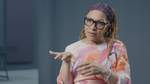

Veronica Ryan
Meet the Turner Prize-winning artist who makes sculptural works from everyday materials about our shared histories
Veronica: I'd like to describe myself as a visual artist. I'm really interested in contradiction and paradox and how that really speaks to our wider culture.
Yeah we've just had a conversation with the gulls and we're in Lisa and Mark's fabrication studio. It's been really lovely working with Lisa and Mark.
When I first started the residency in Spike we got to know each other a bit and we've been working ever since together. I tend to collect things wherever I am, and that's become part of how the work gets made as well - a bit like a magpie.
I collect stacks of vegetable trays and food trays and I've used dried flowers quite a lot in some work. I've used dust and a lot of detritis, a lot of rubbish so it could be organic or it can be some kind of manufactured thing. It did become a problem though when I was flying from one country to the other, or even if you go into government buildings and the alarm system would go off because I had scissors and tweezers and other odd paraphernalia in my bag.
My mum makes all these pincushions, has hundreds of pincushions and I asked my mum if I could have some and then I've made other pincushions. And then I've made a dot in the middle because I like the way the dot begins to look like a belly button. My mum always embroidered our pillowcases when we were little and we didn't really seem to have very much in the house when I was little. I just remember these patchworks that my mum made and embroidered pillowcases.
When my mum was a girl they would get cotton sacks and then they'd wash them until they were soft enough to use as pillowcases and so I kind of extended that to the idea of pillows, dream states and what kind of dreams you have.
So the Relics was also thinking about loss and memories. and kind of dislocated states and kind of disintegration and so on. Well, one of the ways that I found I could keep working when I'm travelling is if I'm sewing or crocheting I make sure that I'm travelling somewhere on public transport where I have privacy because people could stare at you and want to know what you're doing or just you know be intrusive so it's important to get on with things.
Last week when I was here someone had spilled quite a lot of red wine I think it was after a busy drinking session over there.
The project in Hackney around Windrush I wanted it to be a celebratory work. My parents came to England in the 50's so I have early memories of going to Ridley Road Market, mostly because my mother always met her friends.
It's interesting that I've chosen those particular fruit and veg because they're what my mum what she ate when she was pregnant with me. I like the idea that I might have internalised these particular soursop, custard apple and breadfruit.
I like the idea that you know there's this whole side of nurture and healing, and mother and daughter relationships, and intergenerational information being passed on. Every time I'm in Hackney I'm always fascinated because children just sit on them and they climb on them and I really like that. That there's a serious conversation around the work, but then there's this possibility for play, and that children are learning about structures and sculpture - and about foods from the place that their parents come from, so they connect them on lots of different levels.
About the video
Encourage your students to respond to the video in their own ways – perhaps by making notes, doodles or drawings, or through gestures and sounds.
Ryan takes us inside the fabrication studio at Bristol's Spike Island where a lot of her artworks are made. She also takes us shopping down Ridley Road Market in East London, which is just around the corner from her public sculptures honouring the Windrush Generation.
"I'm interested in contradiction and paradox"
Veronica Ryan
Seeds, fruit, vegetable trays, volcanic ash, teabags, dried flowers and cushions. These are just some of the objects that artist Veronica Ryan uses in her sculptural works that are based on organic forms, but which suggest complex historical networks of commercial exchange.
Discuss
Your students' ideas and experiences are the best starting point for any discussion. Using the prompts below, support meaningful and creative discussions in the classroom about the video’s key themes. Discover how Veronica Ryan’s practice can inspire your students to learn with art.
Objects and Collections
Veronica Ryan talks about making artworks from things that she has collected ‘a bit like a magpie’, on her travels and in her environment. She is also drawn to things that remind her of objects from her childhood. Some of the things she uses include pillowcases, fruit cartons, dust, rubbish and tea bags! She makes artworks by using the objects as they are, making casts of them or wrapping them up.
Prompts
- Think of a particular time in your life that reminds you of a friend or family member. What objects help you remember that time, and why?
- Do you collect anything, or do you know someone who has a collection of particular objects? What makes these objects special? Why might someone have a collection?
- Why do you think Veronica Ryan often casts these objects rather than just using the real thing? What objects would you make casts of, and why?
Making Art in Unexpected Places
In the video Ryan talks about sewing and crocheting on public transport, as a way of ‘keeping making’.
Prompts
- Have you ever seen anyone making something in an unusual place? What did you think? Why do you think they chose that place?
- Have you ever had a lesson somewhere unusual? Think of places that might help you make or learn something new.
- Where do you like to make things, and why? If other people saw you there, what would you want them to ask you?
Shared Histories and Public Art
In 2021 Ryan’s sculpture was one of two artist commissions to celebrate the Windrush Generation, which became the first permanent, public artworks in the UK to pay homage to the Windrush Generation and their descendants. The Windrush Generation are the many people who moved from the Caribbean to the UK to make a home, between 1948 and the 1970s.
In the video we see young people sitting and chatting on these sculptures which are giant casts of fruits that remind Ryan of her childhood and heritage.
Prompts
- Imagine passing by Ryan’s sculptures on your way to school. What would you do, think or imagine when you saw them?
- Are there any public sculptures in your community? What are they about? How do people treat them?
- What familiar object would you like to enlarge and put outside as a public display? What would you like people to think about or do when they see your objects?
How to use artist stories
Introduce art and artists into your classroom with Artist Stories resources. The resources combine engaging videos and thoughtful discussion points to encourage confidence, self-expression and critical thinking. Art is a powerful tool for discussing the big ideas that impact young people's lives today.
- Explore the video:
- Read About the video to introduce the artists to your students.
- Project the video or watch it in smaller groups.
- Each video is between 3–10 minutes.
- Transcripts are included where available.
2. Discuss the video:
- Invite your students to respond to a discussion prompt individually. They could record their responses through writing, drawing, making or voice recording. (5 minutes)
- Invite your students to share their ideas and responses with someone else. What have they learned about themselves or others by sharing their responses? (5 minutes)
- Invite your class to share their thoughts and ideas in groups or as a whole class, inviting multiple perspectives and experiences. (10 minutes)


