

Hamad Butt, Transmission 1990. Tate. © Jamal Butt.
Transmission explores the relationship between seeing and knowing. Hamad Butt places the supernatural and the scientific together to interrogate how both ideas and diseases can spread
Etched on each of these nine glass books is the image of a triffid, the fictional plant that blinds and eats humans. Butt borrowed the image from the cover of John Wyndham’s novel The Day of the Triffids (1951). As you move around the circle, the triffid becomes more and less visible as the glass pages of each book turn. The books are lit by ultraviolet light. They are intended to be looked at through protective glasses. Butt said, ‘Ultraviolet light is an invisible light available in all light, and there is invisible knowledge available in all knowledge. The closer you get to it the more dangerous it becomes.’
Each book sits on a rehal (Quran stand). Books can transmit religion and knowledge, yet the title also suggests a blind or hidden exchange. Butt explained, ‘there was a play with the whole notion of blind faith, in faith in written things, which I was equating with the transmission of disease.’ He was interested in how vision is privileged above other senses. In particular, he reflected on the diagnostic gaze that aims to understand and catalogue human disease through external observation.
Transmission was Butt’s earliest exploration of the causal link between science and art, reason and danger and, ultimately, life and death. He made the work when the threat and impact of the AIDS epidemic was having a devastating effect on a generation of gay and queer people.
Butt wrote the nine phrases reproduced on the wall here. When he first displayed Transmission in the 1990 student exhibition at Goldsmith’s School of Art, he inscribed them on paper soaked in sugar solution. He then sealed the paper in a glass case, along with fly pupae. Over time, the flies hatched, ate the paper and died. For Butt, this symbolised the cycles of human history.
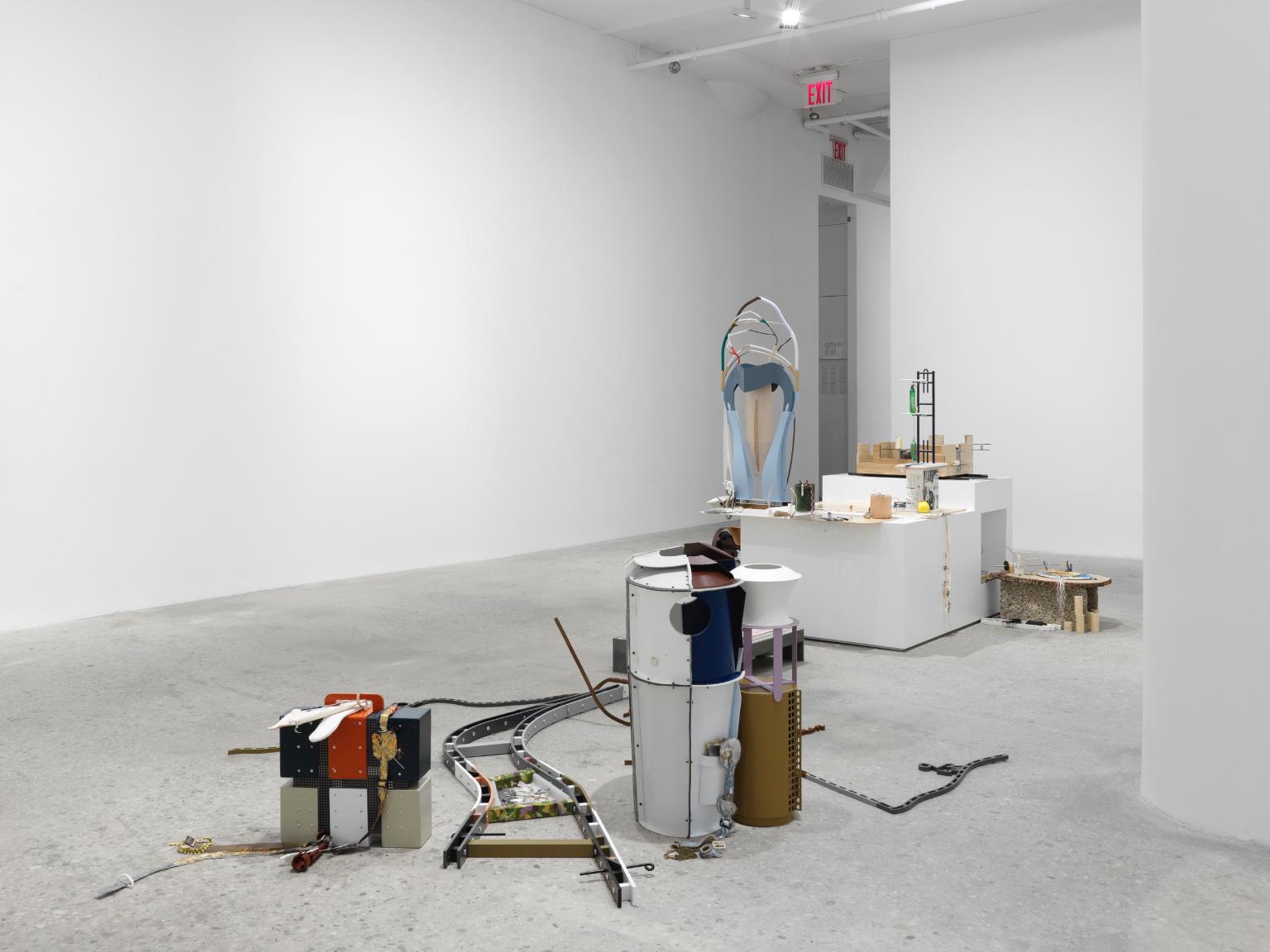
Helen Marten, The Lemon 2015
The Lemon 2015 is a large multipart sculpture comprising a wide range of objects, some found and others handmade from various materials, which are displayed both on plinths and directly on the gallery floor. Disparate objects, including three bright yellow citrus fruits and a pair of jugs – all cast in resin – an upturned Dulux paint bucket, spools of sewing thread and a brass cup, are brought together on and across a range of surfaces. The elements that form the work exemplify the precise and immaculately detailed objects that have become part of Marten’s visual lexicon, such as embroidered fabric, model replicas of natural objects like trees and fruit, and ceramics and powder-coated metal constructions.
1/2
artworks in Hamad Butt
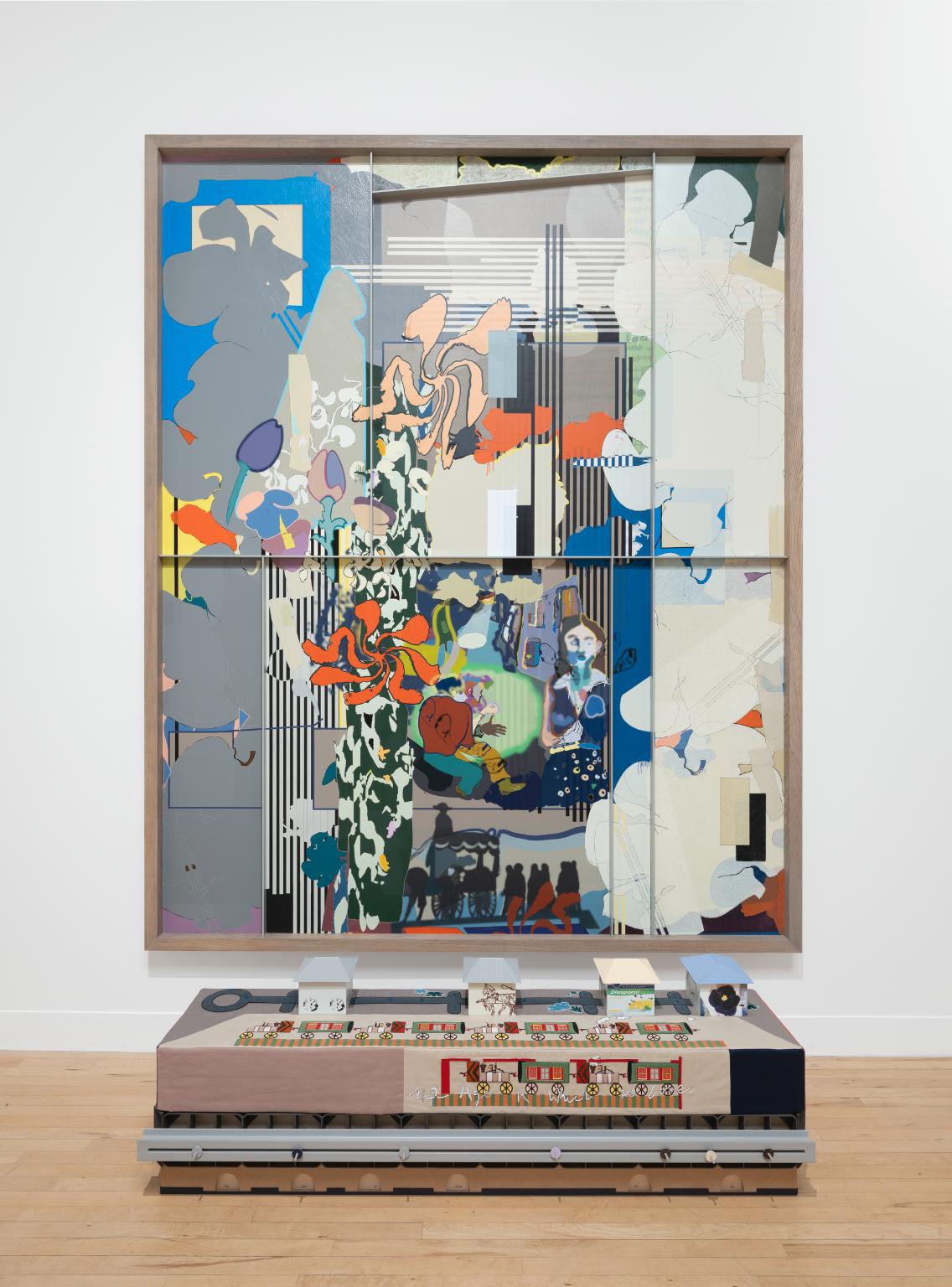
Helen Marten, The Age in Which We Love (Bulging the House) 2021
The Age in Which We Love (Bulging the House) 2021 is a two-part work that comprises a large-scale painting and a sculpture that is placed on the floor directly in front of it. The painting, which measures three by almost two and a half metres, is composed of a series of screenprinted and hand-painted elements that were produced separately and then joined together using a series of metal ‘dividers’, which follow the linear printed elements of the work. The seven separate panels (each of different dimensions) that make up the work are screenprints on different materials – synthetic leather, suede, brocade, leatherette, printed cotton and crushed velvet – the textures of which remain visible to the viewer.
2/2
artworks in Hamad Butt
Art in this room
Helen Marten
The Lemon
2015
Helen Marten
The Age in Which We Love (Bulging the House)
2021