

What can images and objects tell us about how colonialism shapes our understanding of the past and the present?
Colonialism is a violent system of control achieved through the exploitation and extraction of labour and resources. Growing up in the Katanga province of the Democratic Republic of Congo (DRC), a region rich in natural resources, Baloji’s work explores the drain on human and natural resources that shape ongoing colonial legacies. As Baloji has stated, ‘I am not interested in colonialism as nostalgia, or in it as a thing of the past, but in the continuation of that system.’
The installation is centred around the mining and circulation of copper, a mineral that is central to the country’s economy and political conflicts. Nearly all copper from DRC was extracted and exported for large-scale industrial use, impacting local infrastructure and livelihoods. Arranged to look like classified museum objects on a plinth, the mortar shells are displayed here as planters. Baloji has filled them with plants indigenous to central Africa’s copper belt, now commonplace in botanical gardens across Europe. The title of the work refers to phrases from the Vocabulary of Elisabethville (1965) by André Yav, a book documenting the contribution of African soldiers and communities to the First and Second World Wars.
The work also includes archival photographs found in a Belgium ethnographic museum. Taken during the colonial era, the images document the scarification of the body – a practice commonly used across Africa during initiation rites as a means of identifying a person’s community. These photographs show the common colonial practice of othering African subjects through scientific and ethnographic studies. Commenting on the connection between scarified skin and mined copper, Baloji hammered each photograph by hand and inscribed the copper plates and wallpapers with scarification patterns.
Baloji reclaims the material and embodied histories of his home country in order to change the ways in which we see the past and the present. He says, ‘It was interesting for me to find these traces of the pre-colonial system. There was a whole cultural, social, aesthetic and meaningful system in place before, and working with copper was a way to re-direct the system, denouncing the political and economic impact that colonialism had in the Congo.’
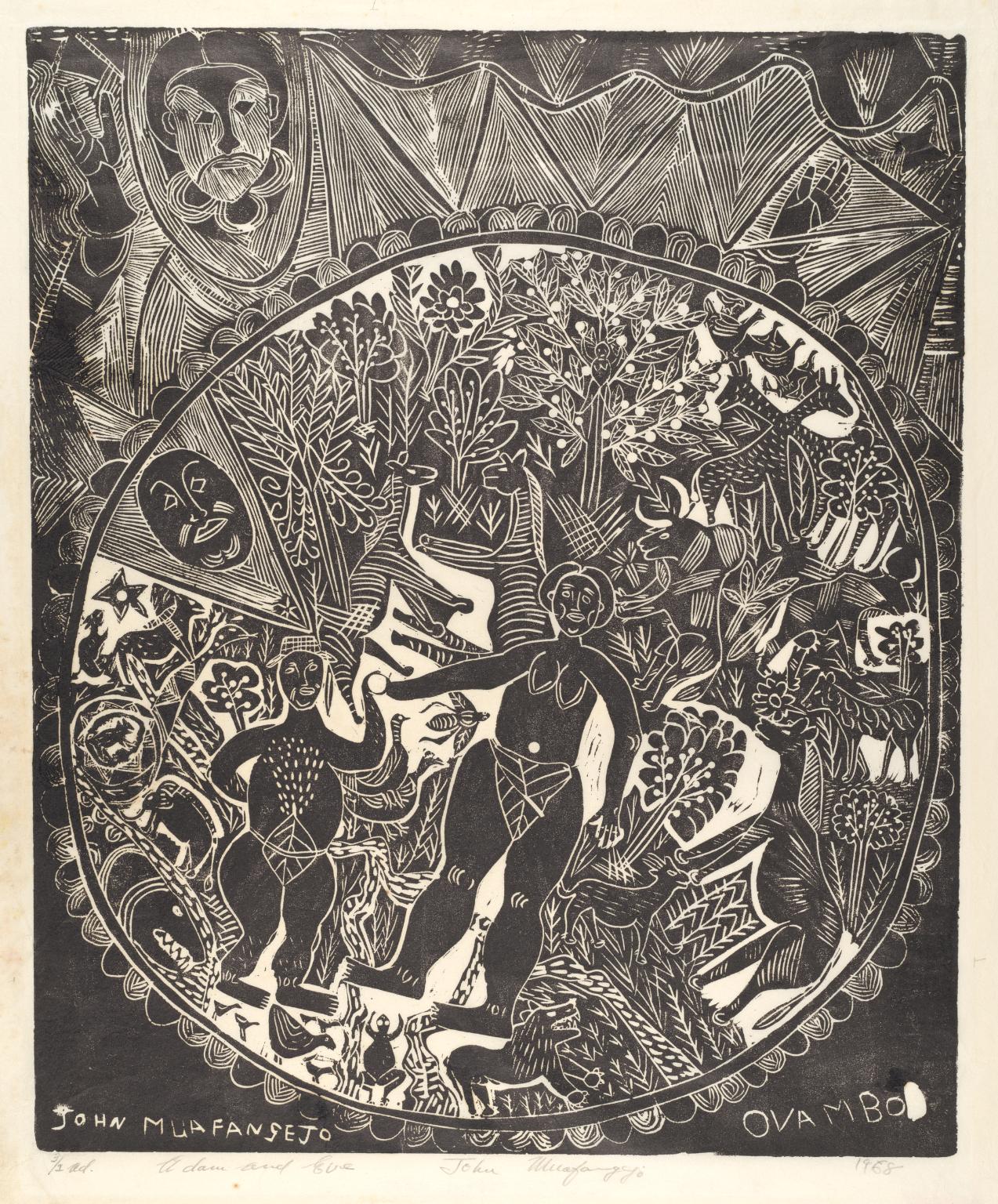
John Muafangejo, Adam and Eva 1968
This is one of a group of black and white linocut prints in Tate’s collection by the South African artist John Muafangejo (Tate P82832, P82831, P82830, P82828, P82835, P82834, P82833, P82829). Densely worked across whole sheets of often large paper, they depict details of human interactions and ritual, as well as scenes of human engagement with the land. Muafangejo embraces a flattened picture plane, often including intricate patterns as a counterpoint to untextured areas, which are usually the faces and bodies of his figures. Each print includes text that provides the title or location of the work, or a lengthier explanation of the image’s narrative. The prints explore subjects typical of Muafangejo’s practice, such as family, childhood, Christianity, ancestry, African colonial history, political conflicts and the complexity of race relations.
1/15
artworks in Sammy Baloji
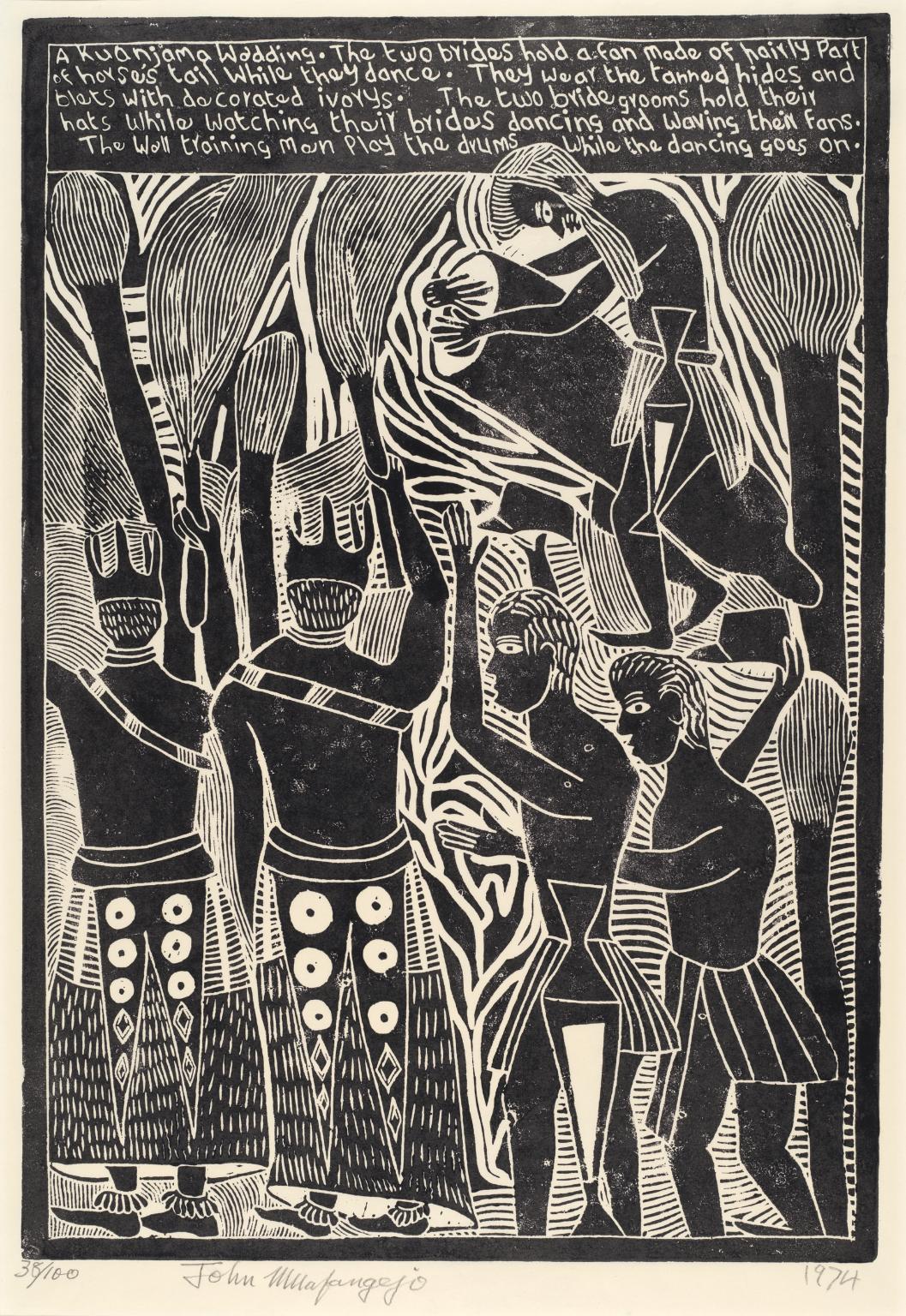
John Muafangejo, Kuanjama Wedding 1970
This is one of a group of black and white linocut prints in Tate’s collection by the South African artist John Muafangejo (Tate P82832, P82831, P82830, P82828, P82835, P82834, P82833, P82829). Densely worked across whole sheets of often large paper, they depict details of human interactions and ritual, as well as scenes of human engagement with the land. Muafangejo embraces a flattened picture plane, often including intricate patterns as a counterpoint to untextured areas, which are usually the faces and bodies of his figures. Each print includes text that provides the title or location of the work, or a lengthier explanation of the image’s narrative. The prints explore subjects typical of Muafangejo’s practice, such as family, childhood, Christianity, ancestry, African colonial history, political conflicts and the complexity of race relations.
2/15
artworks in Sammy Baloji
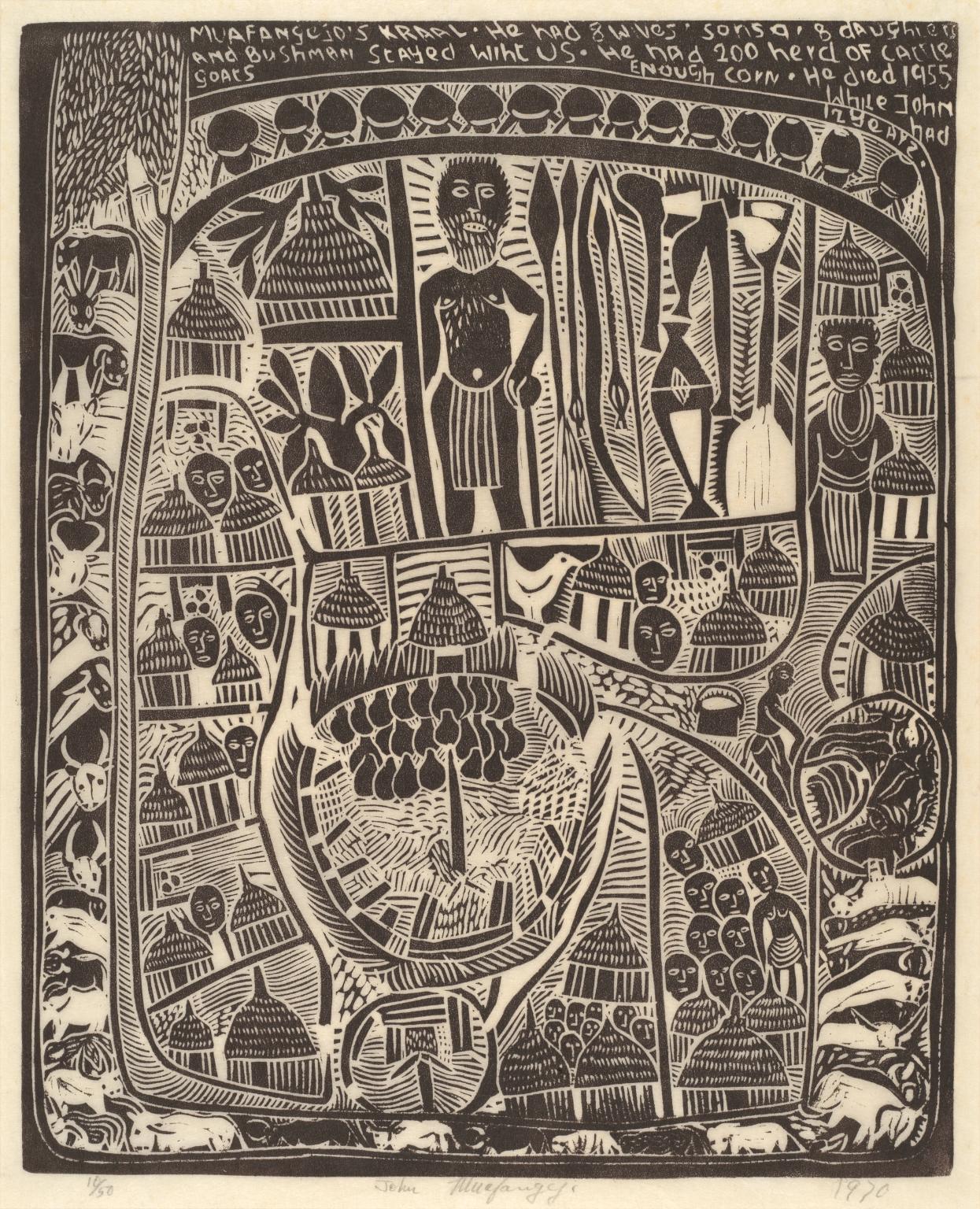
John Muafangejo, Muafangejo’s Kraal 1970
This is one of a group of black and white linocut prints in Tate’s collection by the South African artist John Muafangejo (Tate P82832, P82831, P82830, P82828, P82835, P82834, P82833, P82829). Densely worked across whole sheets of often large paper, they depict details of human interactions and ritual, as well as scenes of human engagement with the land. Muafangejo embraces a flattened picture plane, often including intricate patterns as a counterpoint to untextured areas, which are usually the faces and bodies of his figures. Each print includes text that provides the title or location of the work, or a lengthier explanation of the image’s narrative. The prints explore subjects typical of Muafangejo’s practice, such as family, childhood, Christianity, ancestry, African colonial history, political conflicts and the complexity of race relations.
3/15
artworks in Sammy Baloji
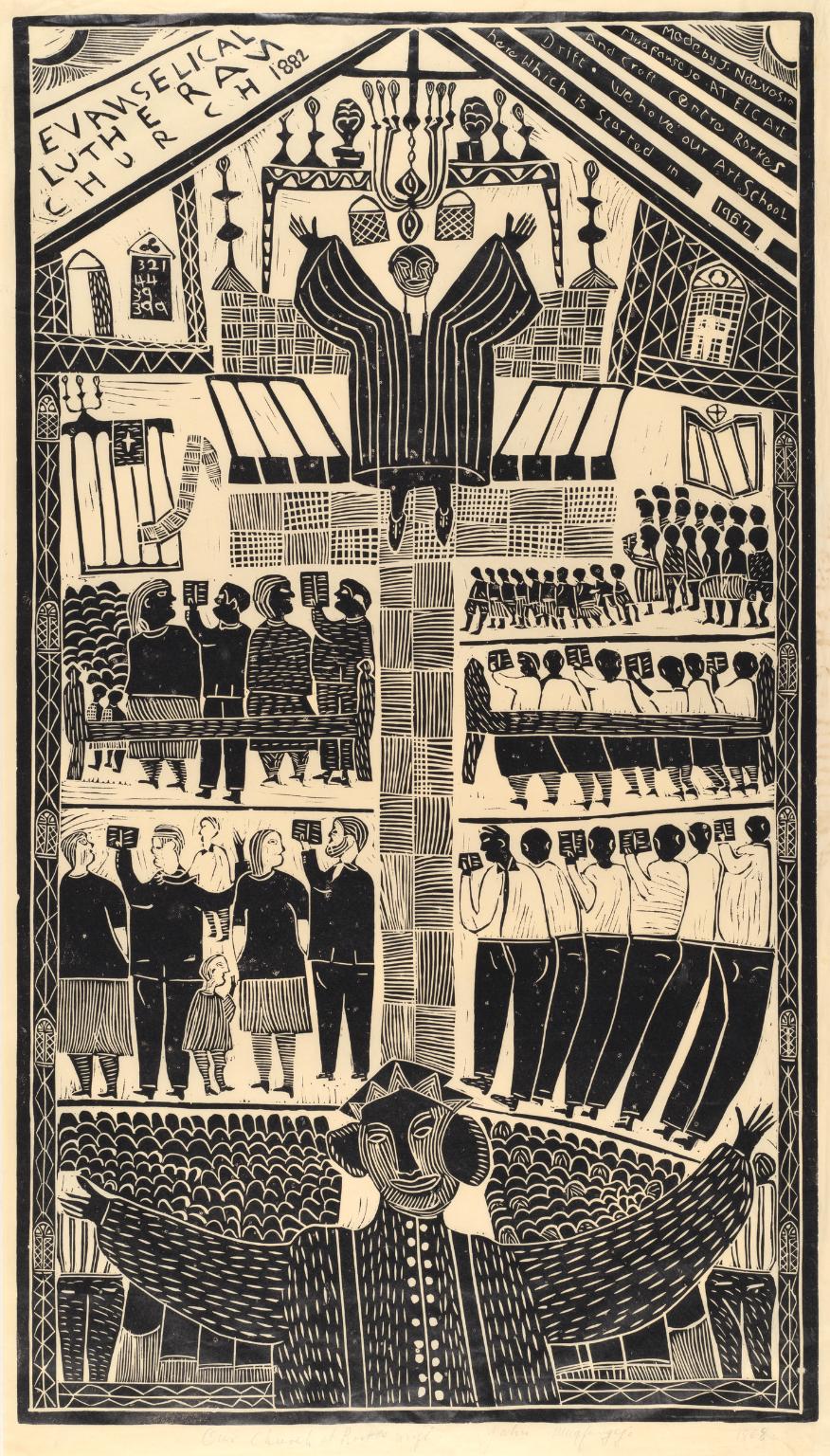
John Muafangejo, Our Church at Rorkes Drift 1970
This is one of a group of black and white linocut prints in Tate’s collection by the South African artist John Muafangejo (Tate P82832, P82831, P82830, P82828, P82835, P82834, P82833, P82829). Densely worked across whole sheets of often large paper, they depict details of human interactions and ritual, as well as scenes of human engagement with the land. Muafangejo embraces a flattened picture plane, often including intricate patterns as a counterpoint to untextured areas, which are usually the faces and bodies of his figures. Each print includes text that provides the title or location of the work, or a lengthier explanation of the image’s narrative. The prints explore subjects typical of Muafangejo’s practice, such as family, childhood, Christianity, ancestry, African colonial history, political conflicts and the complexity of race relations.
4/15
artworks in Sammy Baloji
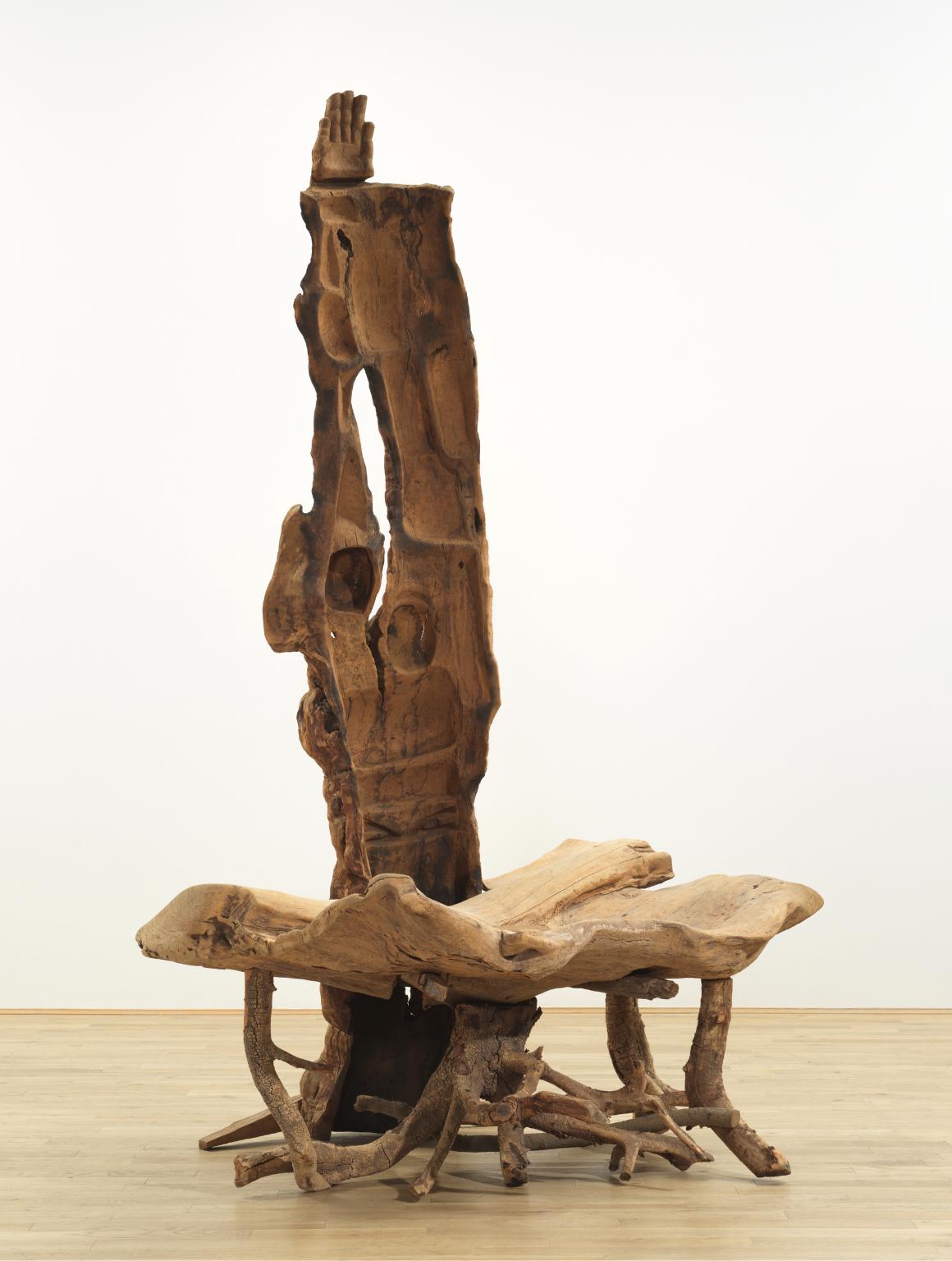
Jackson Hlungwani, Throne 1989
This work is one of a series of seven thrones made for the artist’s retrospective The Neglected Tradition Towards a New History of South African Art (1930–1988) at the Johannesburg Art Gallery in 1989. This unnumbered Throne 1989 was subsequently included in the exhibition Art from South Africa at the Museum of Modern Art, Oxford in 1990, the year it was acquired by its former owner, the collector Robert Loder. Constructed from pieces of driftwood, the seven thrones retain the original shapes of the tree trunks, which the artist either left rough or carved and sanded to appear smooth. The thrones differ from traditional southern African wood sculptures, as they are assembled rather than being made from a single piece of wood or shaped into a recognisable ‘figure’. While most carved African stools are usually without a back, Hlungwani’s Throne 1989 more closely resembles a high-backed chair.
7/15
artworks in Sammy Baloji
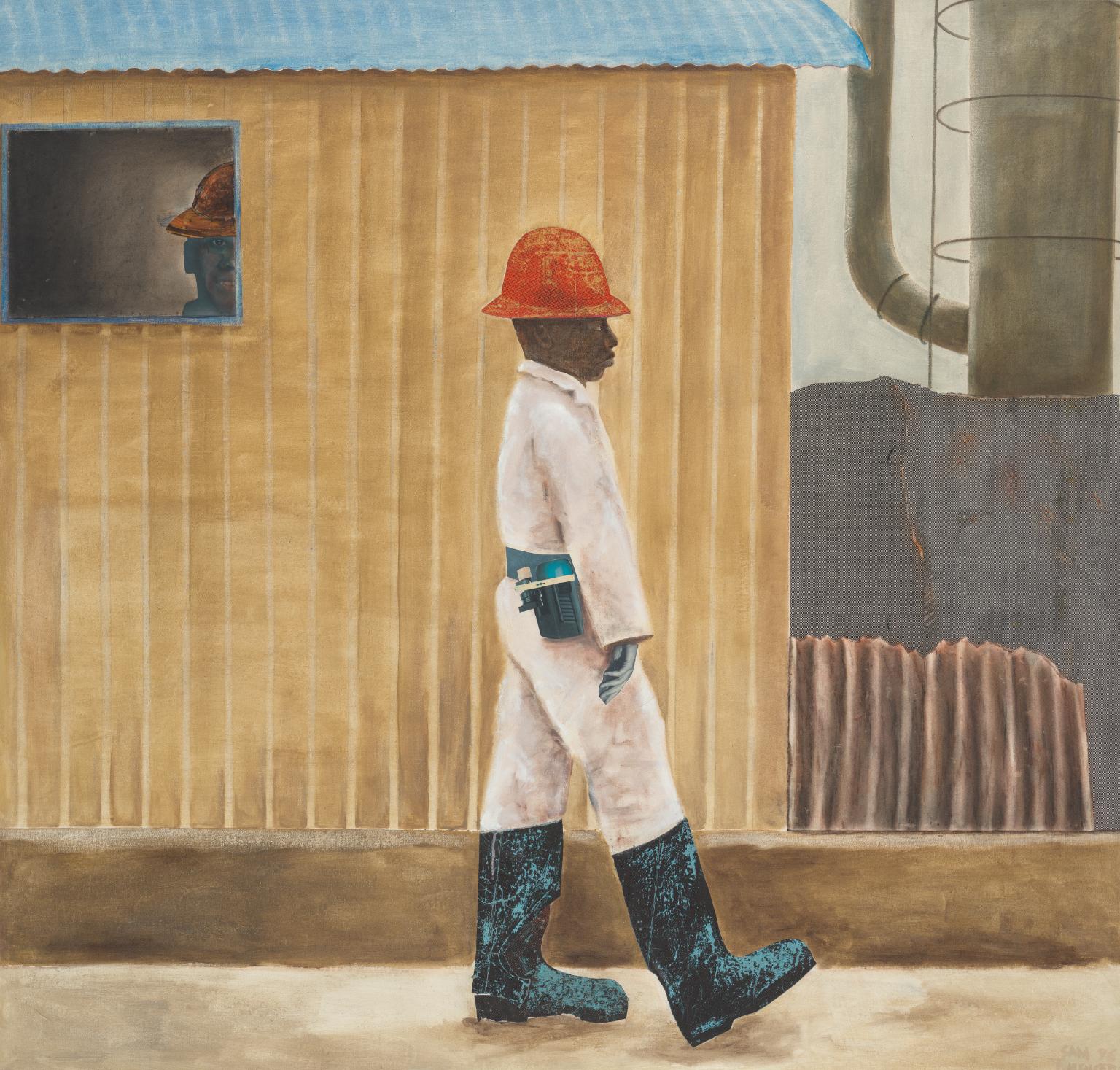
Sam Nhlengethwa, Fatigue 1996
8/15
artworks in Sammy Baloji
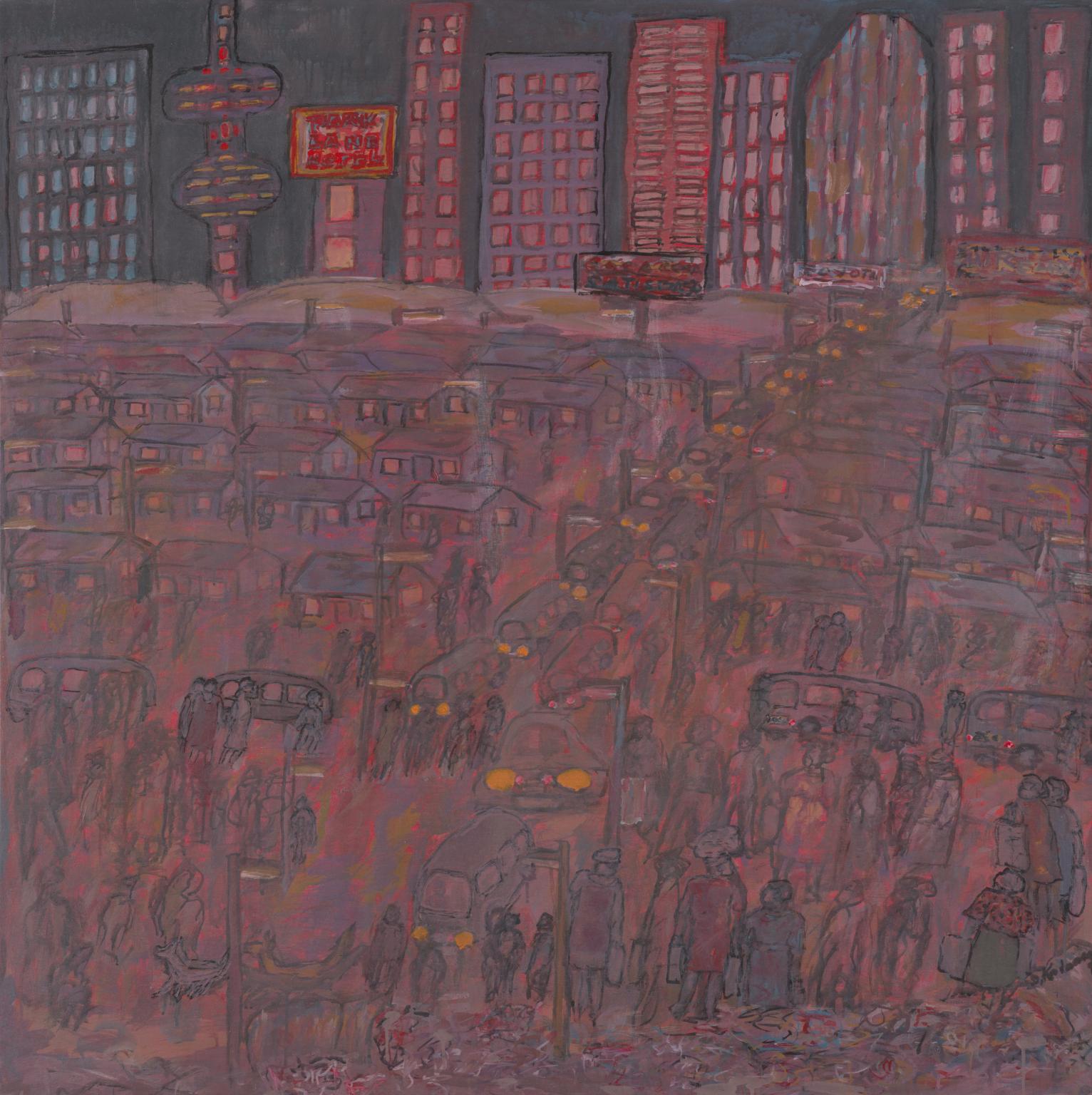
David Koloane, Dusk 1996
9/15
artworks in Sammy Baloji
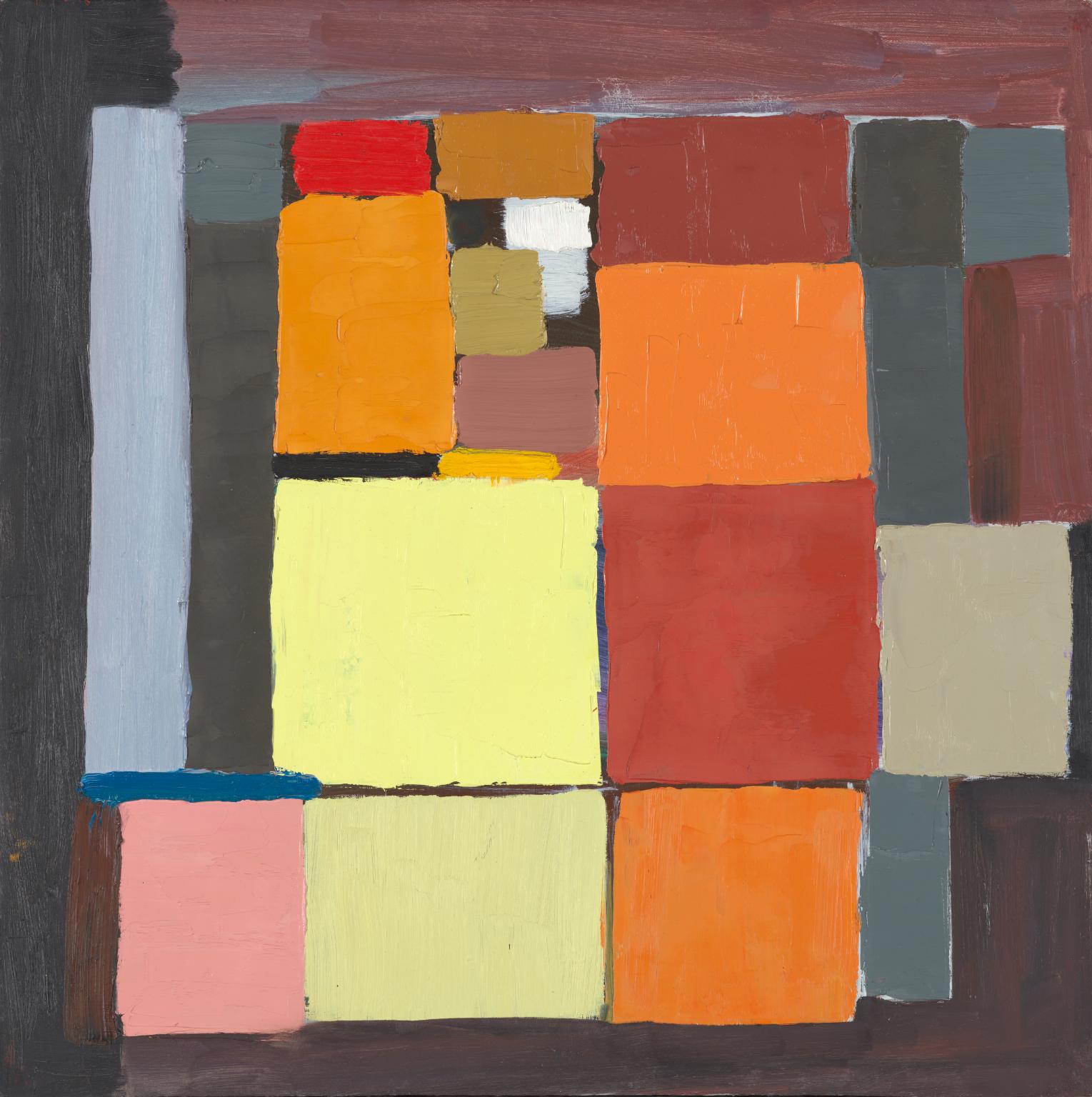
Atta Kwami, Mask Painting 1992
Mask Painting 1992 is a square painting that features several multi-coloured rectangular and square forms. The composition is centred around a four-by-four grid-like formation of rough squares that create a series of rows and columns across the canvas. The larger squares are painted in repeated shades of orange, red, green and yellow, and the smaller squares are painted in muted tones of blue, white and pink. The central grid of multi-coloured squares is framed by thick strokes of navy blue and purple, themselves framed by a thin edge of light blue paint. In certain areas of the composition, the grid-like formation is interrupted by the deliberate blurring of colours and overlapping of squares. The off-centred composition of slanted vertical and horizontal lines creates a dynamic sense of movement, as if the squares are floating on the surface of the canvas. The painting is indicative of Kwami’s interest in experimenting with form and colour.
10/15
artworks in Sammy Baloji
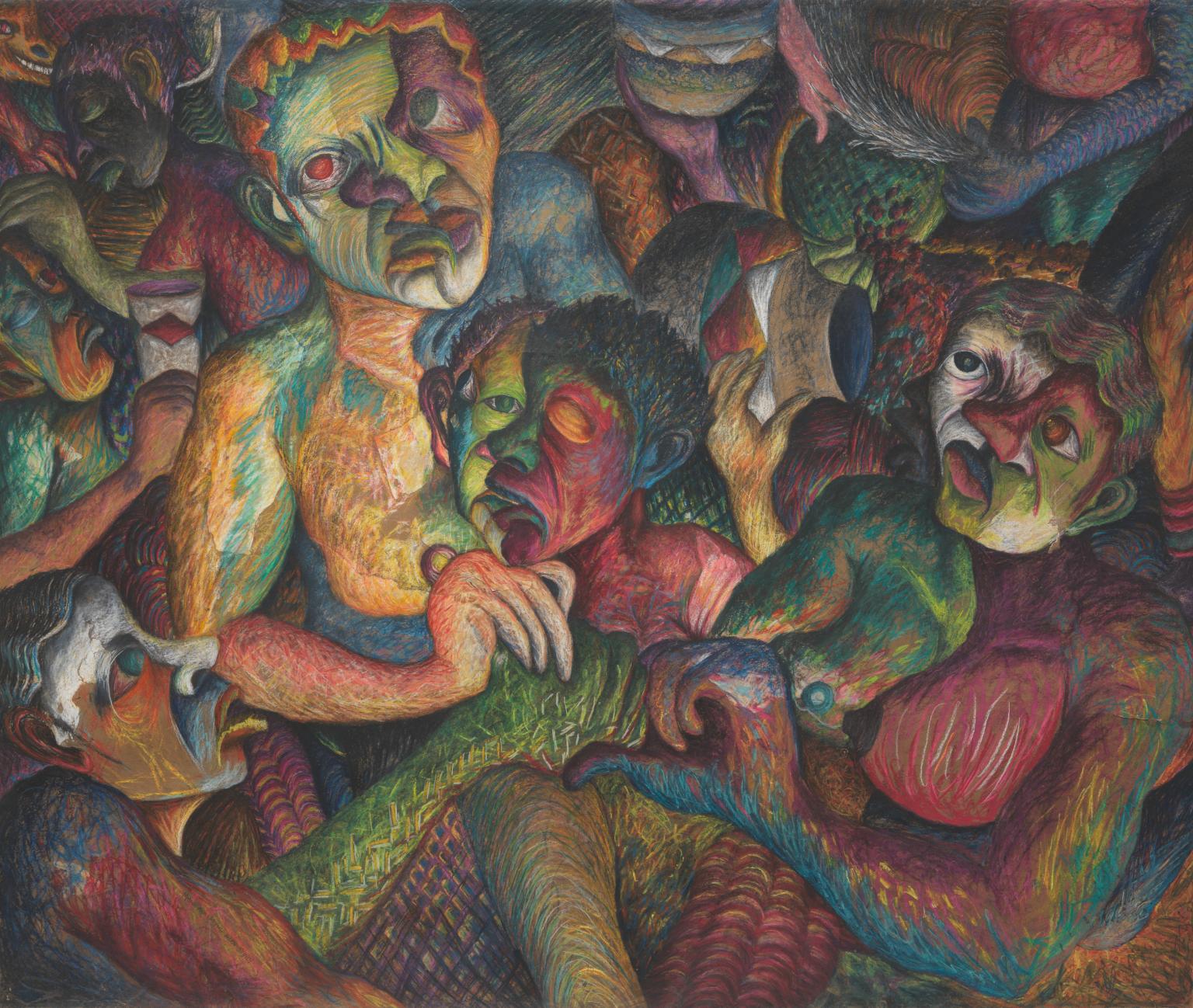
Mmakgabo Mmapula Helen Sebidi, Cyrene 1990
Measuring over one and a half by two metres, Cyrene is a large drawing in coloured oil pastels on paper featuring a crowd of figures and animals with distorted bodies and features. Four women emerge at the centre of the composition with three hands holding each other in the foreground. Thick strokes of oil pastel are visible across the surface of the paper, which is torn in places, in a cacophony of bright greens, blues, yellows and pinks. The textured treatment of the work ambiguously conjures hair, scales and skin.
11/15
artworks in Sammy Baloji
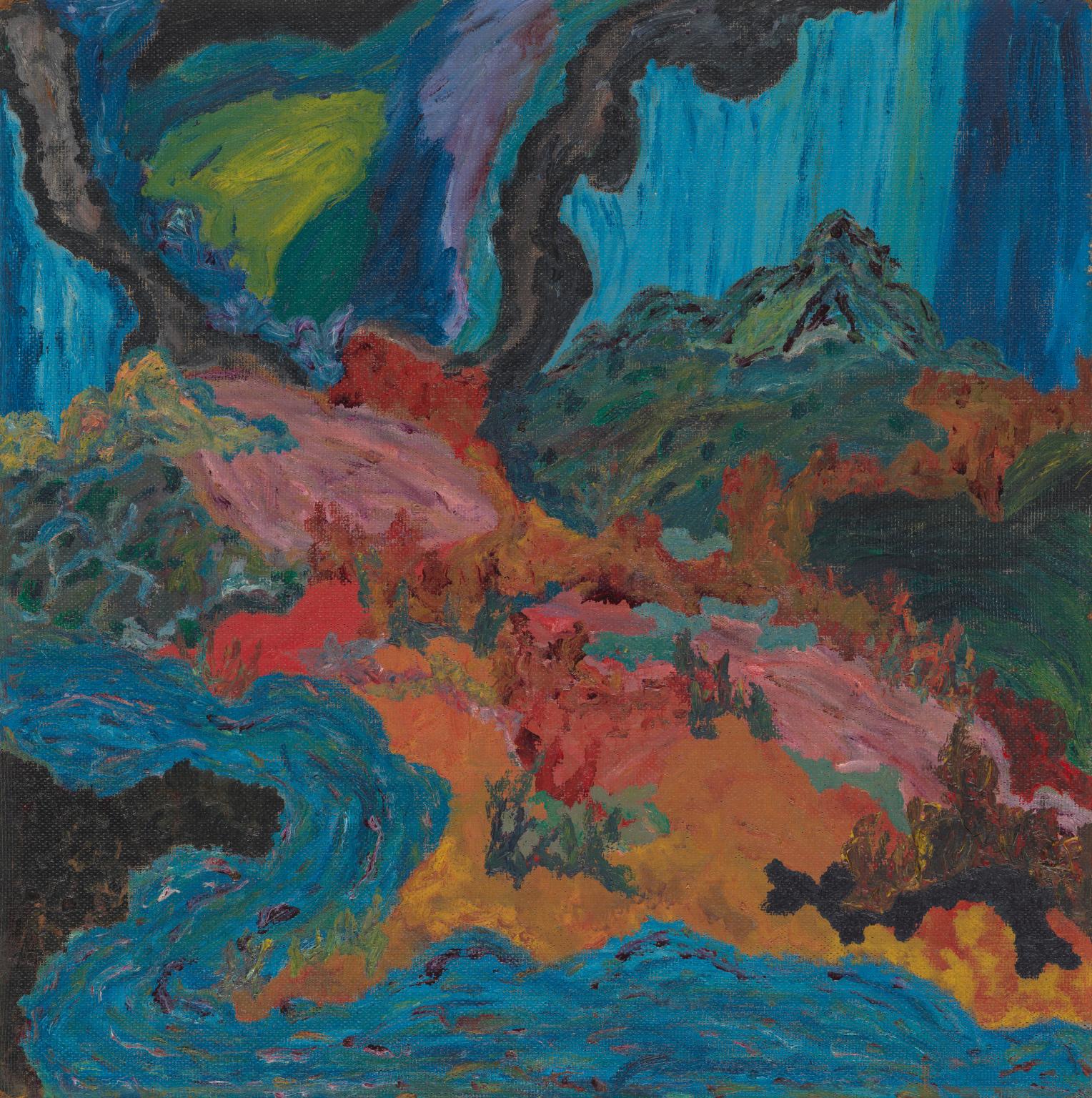
Thomas Mukarobgwa, View from the Hill Where My Father Used to Chase His Cattle 1961
12/15
artworks in Sammy Baloji
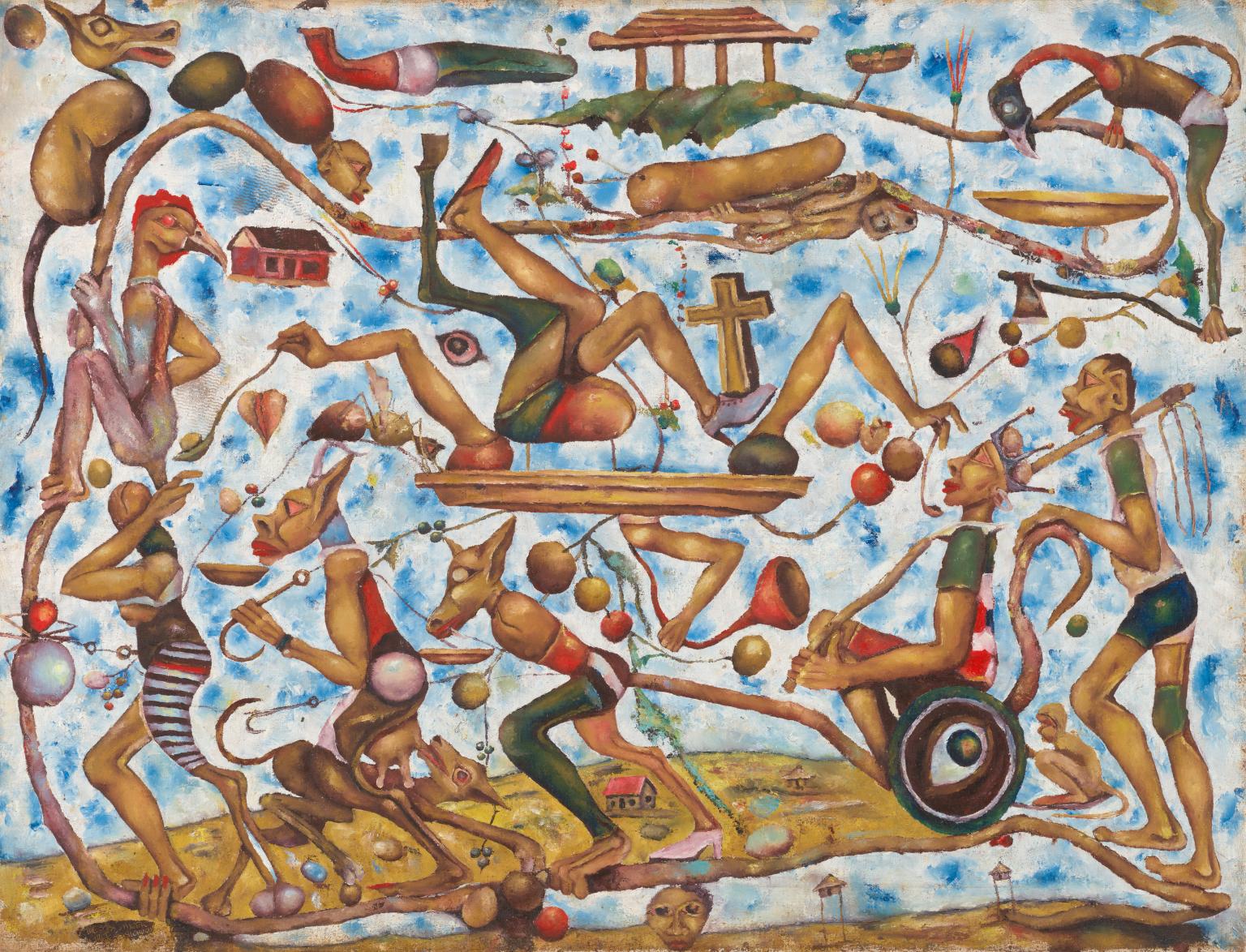
John Mburu Njenga ‘Meek’ Gichugu, Funny World 1997
Funny World 1997 is a large-scale oil painting depicting a fantastical world of hybrid creatures who parade across the canvas in a carnival-like procession. It demonstrates Gichugu’s distinctive visual language that consists of images of beasts, machinery, fruit and animals crowded into the picture plane. The composition is centred around a group of animalistic creatures who perform various acrobatic movements and gestures, while the flattened landscape is populated with exotic fruits, flowers, strange birds and dismembered body parts that appear to be floating in the air. As the title suggests, the work refers to a comical or parodic vision of the world, with various symbols referring to daily social and political realities in the artist’s home country of Kenya. Gichugu brings together the real and fantastical in ways that reveal a pointed yet subtle use of symbolism and allegory.
13/15
artworks in Sammy Baloji
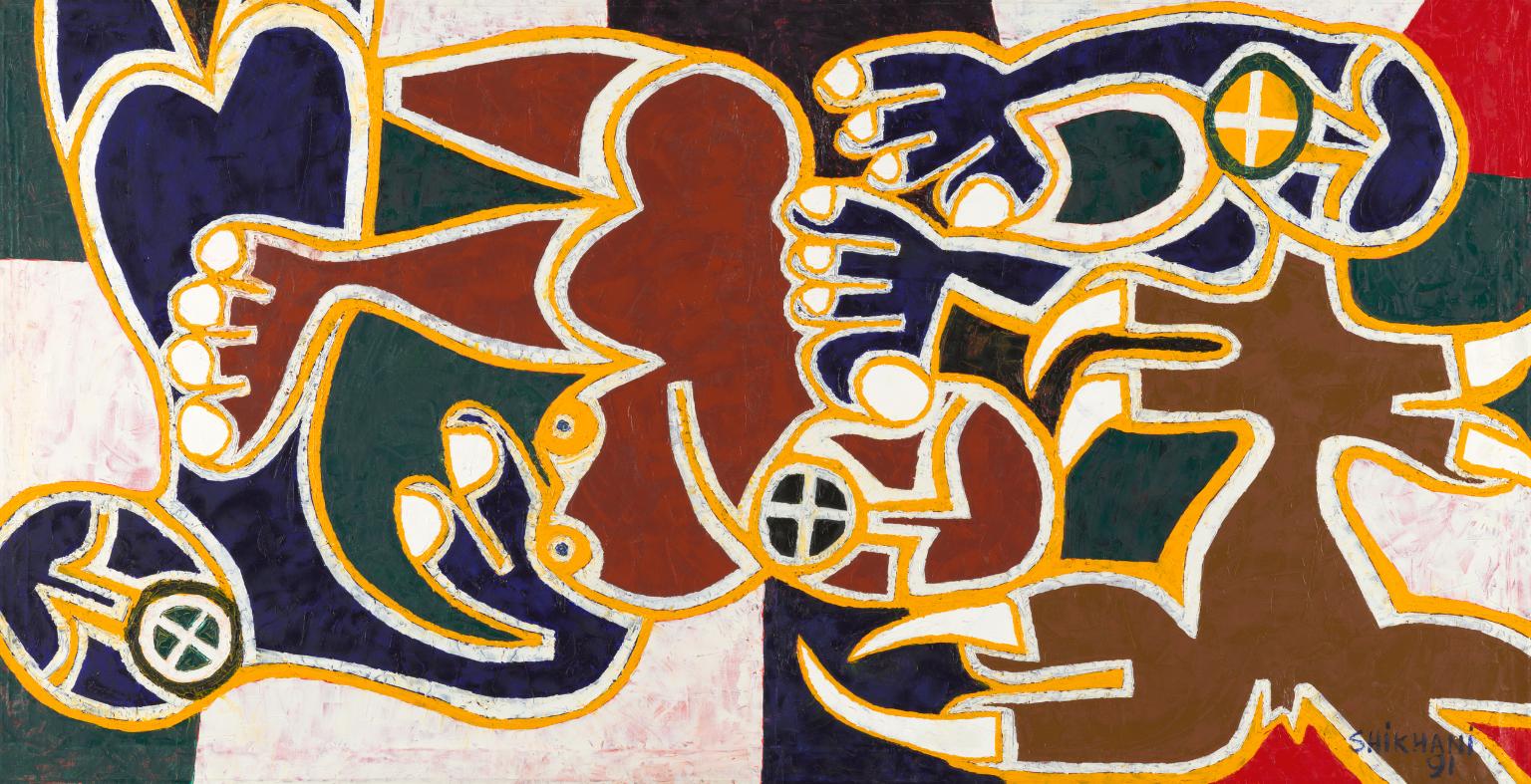
Pais Ernesto Shikhani, Untitled 1991
14/15
artworks in Sammy Baloji
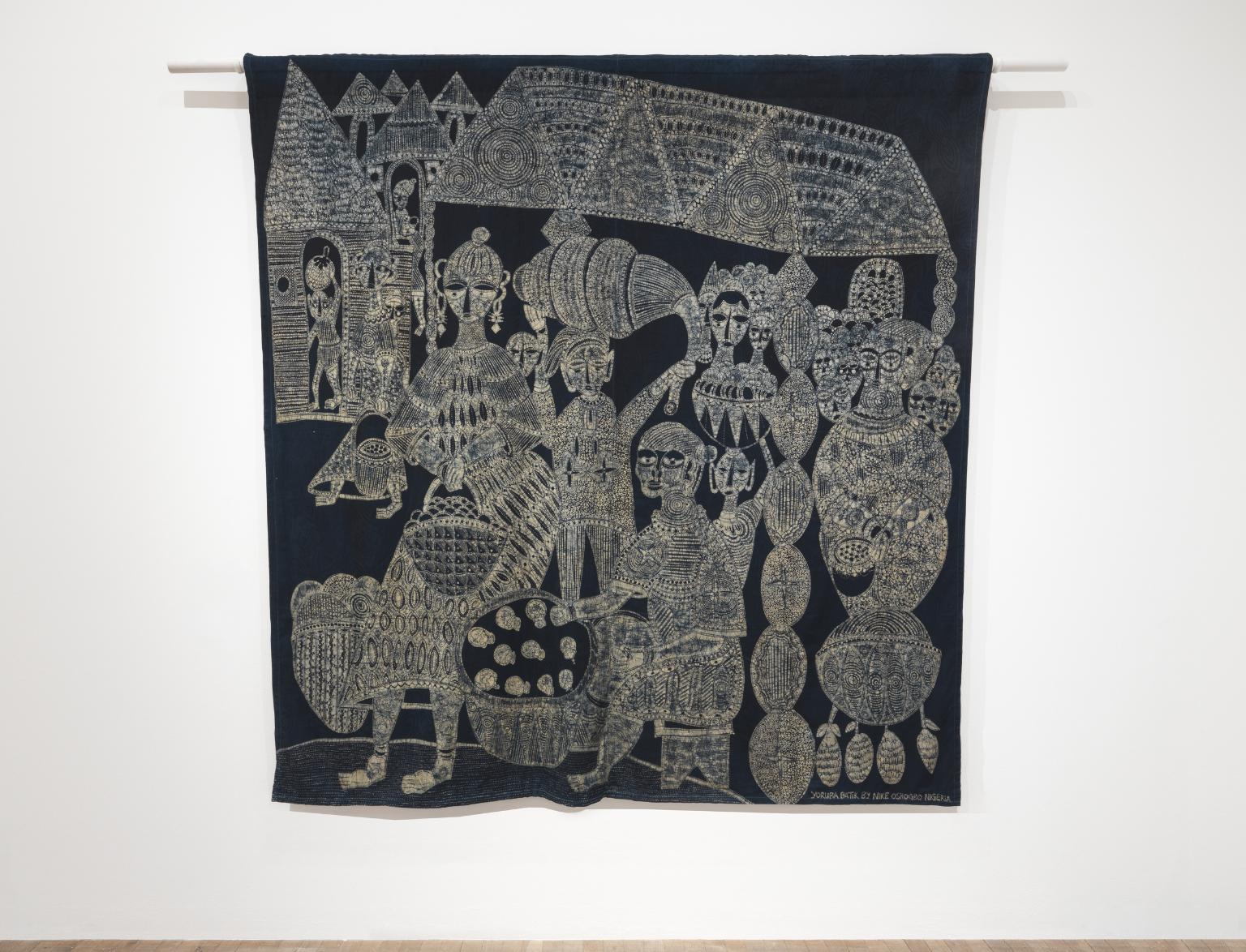
Nike Davies-Okundaye, The Wall 1994
15/15
artworks in Sammy Baloji
Art in this room
John Muafangejo
Adam and Eva
1968
John Muafangejo
Kuanjama Wedding
1970
John Muafangejo
Muafangejo’s Kraal
1970
John Muafangejo
Our Church at Rorkes Drift
1970
Sorry, no image available
Bruce Onobrakpeya
Images I Brown Base
1993
Sorry, no image available
Bruce Onobrakpeya
Images III Red/Blue Base
1993
You've viewed 6/15 artworks
You've viewed 15/15 artworks