
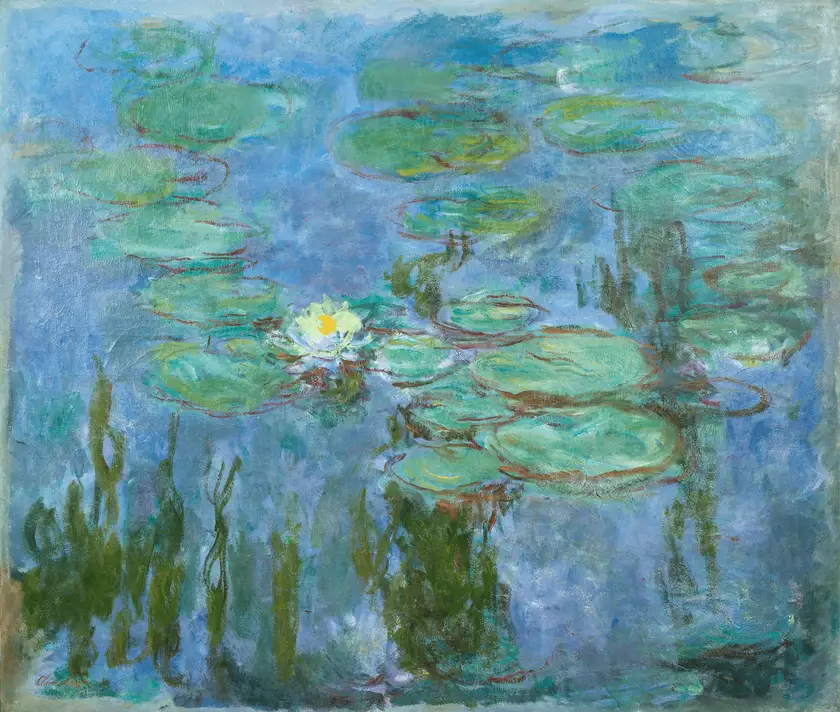
Tate Modern’s first ever exhibition focusing exclusively on Claude Monet brings together breathtaking paintings from lenders across the globe, including rarely seen works from private collections.
Based mainly in France, Monet lived through an era which saw the rise of railways, industrialisation, the modern city, and the adoption of standardised timekeeping. Drawing on new research, the show explores how Monet responded to these seismic changes through his work.
The exhibition centres on Monet’s profound and evolving relationship with time. We see how he echoed the rapid pace of modern life by capturing the fleeting, instantaneous ‘impressionist’ moment, through works such as Arrival of the Normandy Train, Gare Saint-Lazare (1877). We are also shown, in celebrated series such as Poplars on the Epte (1891–1897), Monet’s attempts, through variations of the same subject, to capture a specific, transient instant in time.
Finally, the show reveals Monet’s enduring relationship with nature and how, as a subject in perpetual movement, it shifts with the passing years and seasons. We see his retreat into his beloved garden in Giverny, resulting in the creation of the world-famous Water Lilies cycle.
Monet: Painting Time is supported by Lead Supporter, Morgan Stanley. Further support from Anthropic. With additional support from the Monet: Painting Time Exhibition Supporters Circle, Tate Members and Tate Americas Foundation. Exhibition organised by Tate Modern and Musée de l'Orangerie.
The exhibition will be open until 22.00 on the following dates:
Monday 22 March 2027
Tuesday 23 March 2027
Wednesday 24 March 2027
Thursday 25 March 2027
Monday 29 March 2027
Tuesday 30 March 2027
Wednesday 31 March 2027
Thursday 1 April 2027
Monday 5 April 2027
Tuesday 6 April 2027
Wednesday 7 April 2027
Thursday 8 April 2027
Monday 31 May 2027
Wednesday 2 June 2027
Thursday 3 June 2027
All Tate Modern entrances are step-free. You can enter via the Turbine Hall and into the Natalie Bell Building on Holland Street, or into the Blavatnik Building on Sumner street. There are lifts to every floor of the Blavatnik and Natalie Bell buildings. Alternatively you can take the stairs.
- Fully accessible toilets are located on every floor on the concourses.
- A quiet room is available to use in the Natalie Bell Building on Level 4.
- Ear defenders can be borrowed from the Ticket desks.
To help plan your visit to Tate Modern, have a look at our visual story. It includes photographs and information about what you can expect from a visit to the gallery.
For more information before your visit:
- Email hello@tate.org.uk
- Call +44 (0)20 7887 8888 (daily 10.00–17.00)


