
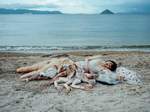

Mari Katayama
Discover why art should be for everyone and hear how mottos, fashion and wellbeing inform Katayama’s practice
Mari: I wanted a quiet place. A very quiet place. I really love music, maybe more than art, but I don't listen to music that much when I'm creating. I believe I can face myself when it's really quiet. I used to sing in a jazz bar. And, the master, owner gave me this speaker after the jazz bar closed.
It's like a guardian angel. Dancing in a club is very important. The reason for this is that clubs are very dark and the only light is from a mirror ball. Then it doesn't matter if you are big or small, what kind of clothes you are wearing, what kind of dance you are doing, or even if you have no feet or fingers.
I always press the shutter myself. That's my motto. Why is that? Because when I was young, when I was a teenager, I didn't know much about the camera, even though the objects were made by me, when others photograph me and the objects, they become their works of art.
It's a really tiny shutter, but if you just press it, it takes it away from me. It sounds a bit violent, but it becomes the other persons' work of art. It's easy to deprive a person of their existence, by simply pressing that one little button.
I always think about the relationship through the camera. The relationship between the photographer, the person being photographed and the viewer is not equal. I think it is possible to establish an equal relationship between the photographer, the photographed, and the viewer. Art can do that.
This is my first portfolio. At that time I couldn't imagine what is a portfolio, so I sent just three papers. Only this. I think no one knew it. It was like: “What is a portfolio? Is it a bit like a CV?" I guess that's what I imagined. My grandfather was a real art lover, and he used to take me to art galleries and museums on weekends. I grew up looking at Japanese paintings, Japanese art, crafts. I think that's why I couldn't call my obscure objects art. My mother would always tell me not to do what I couldn't do. “Do what you can do”.
So, for example, the option of cutting off my leg, a choice that I could make and I chose it because I knew that by choosing it, I could go on to the next step. and if it was something impossible, I probably would have looked for a different way. and I've kept doing what I could really do.
So now I can do things that I couldn't do in the past. That kind of experience, that kind of thing, makes me who I am now. I have a motto about materials. It's always to use materials that anyone can get anywhere. and I think that the needle and thread are the strongest tools.
I think we can make anything with a needle and thread. Therefore, those two points about materials are so important to me. It may be a leap to say this from talking about materials, but the ultimate goal of art, in my own childhood experience is to become something public. I think the most public thing is education. So art should be for everyone, no matter what materials are used. But, I want to make my work, as much as possible, from materials that are available to everyone. I don't want my work to be something special.
I think I'm using material that I can relate to internally. If you cut a shell, there is a golden ratio. I feel that humans also have that kind of thing (golden ratio). So even if we add something artificial, put on makeup, change our hairstyle, etc., we still have the same thing as these shells.
I think fashion is a ticket to go out into society. So, in childhood, children imitate their parents and put their feet in their mother's or father's big shoes at the entrance. It's really a small event in everyday life. The biggest challenge within the High Heel Project was that fashion and dressing up were considered unnecessary in the context of welfare, especially disability welfare and medical treatment. It was said that it is not a necessary act or thing to go out into society. This child, oops I called it my child! This work will travel many places. It needs to be strong, so I sew it up firmly by hand.
When I was a child, adults used to say that nature, the earth, wonderful and beautiful nature, that nature is simply beautiful in its own way. The natural form is beautiful. Then I had to do a lot of surgical reshaping of my body, do something artificial, to survive. This body is not natural. So it's not beautiful? I was wondering if it was beautiful or not.
So I have chosen to create something with the beauty of nature in an artificial way. I might be making those choices with the feeling of challenging this idea. I walk step by step, and even when I think I might not be able to reach a place that is so far away, every step I take brings me closer and closer to it. And here I am, it's about 400 meters long. I'm sewing, but every stitch I make brings me closer to completion. There is such a similar relationship. Like making each stitch, no matter whether it is a goal or a destination, if you keep on walking, you will always reach it.
About the video
Encourage your students to respond to the video in their own ways – perhaps by making notes, doodles or drawings, or through gestures and sounds.
Artist Mari Katayama creates hand-sewn sculptures and photographs that prompt conversations and challenge misconceptions about our bodies.
"I always press the shutter myself. That's my motto"
Mari Katayama
Born with the developmental condition tibial hemimelia, Katayama chose to have her legs amputated at the age of nine. Her wearable sculptures, which also feature in her images, often include limbs, hands and embellished hearts.
Discuss
Your students' ideas and experiences are the best starting point for any discussion. Using the prompts below, support meaningful and creative discussions in the classroom about the video’s key themes. Discover how Mari Katayama’s practice can inspire your students to learn with art.
Mottos and Rules
In the video Katayama shares that ‘I always press the shutter myself. That’s my motto.’
Prompts
- Imagine yourself on either side of the camera: as sitter, as photographer, and then as both. What do you think about each relationship? Does it feel equal?
- Can you think of any rules or mottos you have for your life? If you don’t have one already could you come up with one?
- How could this motto help you make art? Does it create a rule or instruction for the decisions you make when creating your artwork?
Fashion and Wellbeing
Katayama uses fashion to go out in society feeling confident. However, she also shares her experience of other people thinking that dressing up is unnecessary for her wellbeing and how this makes it even more difficult for disabled people to access creative expression.
Prompts
- Think about Katayama’s ‘High Heel Project’. Why do you think she made this artwork? What is she trying to tell us about the importance of fashion and creativity in her life?
- How do you feel about the assumption that fashion matters less if you have a disability? Why might this be a harmful idea and how could you argue against it?
- What does fashion mean to you? How do you like to express yourself through the clothes you wear?
Beauty and the Body
Katayama had many surgeries growing up to manage her health. As a result, she feels that her body is somehow ‘artificial’, and contrasts this with the idea of ‘natural beauty’. ‘This body is not natural’, she says, ‘I was wondering if it was beautiful or not.’
Prompts
- Who gets to decide what beauty looks like? Where do you think the rules about beauty come from?
- Think of something ‘artificial’ that you find beautiful. What makes you feel that way?
- What impact might cultural beauty standards be having on you and your loved ones? How could you use your creativity to break some of these rules?
How to use Artist Stories
Introduce art and artists into your classroom with Artist Stories resources. The resources combine engaging videos and thoughtful discussion points to encourage confidence, self-expression and critical thinking. Art is a powerful tool for discussing the big ideas that impact young people's lives today.
- Explore the video:
- Read About the video to introduce the artists to your students.
- Project the video or watch it in smaller groups.
- Each video is between 3–10 minutes.
- Transcripts are included where available.
2. Discuss the video:
- Invite your students to respond to a discussion prompt individually. They could record their responses through writing, drawing, making or voice recording. (5 minutes)
- Invite your students to share their ideas and responses with someone else. What have they learned about themselves or others by sharing their responses? (5 minutes)
- Invite your class to share their thoughts and ideas in groups or as a whole class, inviting multiple perspectives and experiences. (10 minutes)


