Skip navigation

Main menu

  • What's On
  • Visit
  • Art
    • Discover Art
    • Artists
    • Artworks
    • Stories
    Stories
    Stories

    Watch, listen and read

  • Learn
    • Schools
    • Tate Kids
    • Research
    • Activities and workshops
    Tate Kids
    Tate Kids

    Games, quizzes and films for kids

  • Shop
Become a Member
  • View All
  • Exhibitions And Displays
  • On Today
  • Events
  • Tate Modern
  • Tate Britain
  • Tate St Ives
  • Tate Liverpool
  • Tate Britain
    Tate Britain Free admission
  • Tate Modern
    Tate Modern Free admission
  • Tate Liverpool + RIBA North
    Tate Liverpool + RIBA North Free admission
  • Tate St Ives
    Tate St Ives Ticket or membership card required
  • Families
  • Accessibility
  • Schools
  • Private tours
  • Discover Art
  • Artists
  • Artworks
  • Stories
  • Schools
  • Tate Kids
  • Research
  • Activities and workshops
Tate Logo

Try searching for...

  • Hurvin Anderson
  • Ophelia
  • School visits to Tate
  • Tate Modern Lates
  • Tracey Emin

DON'T MISS

Exhibition

Hurvin Anderson

Tate Britain
Until 23 Aug 2026
Exhibition

Tracey Emin: A Second Life

Tate Modern
Until 31 Aug 2026
Become a Member
This is a past display. Go to current displays

León Ferrari, [no title] 2001, reproduced 2007. Tate. © Leon Ferrari.

León Ferrari

Explore an artist who was central to debates about art and politics in Latin America and question what newspapers tell us about society and politics

'Art is not beauty or novelty, art is effectiveness and disruption', Ferrari wrote. Throughout his career he used his art to draw attention to state-sponsored crimes and censorship. He often criticised the Argentine government and the Catholic Church for their human rights abuses. In 1976, a right-wing military dictatorship seized power in Argentina. Due to his political stance, Ferrari and his family were forced to flee to Brazil. His son, Ariel, was one of the many citizens abducted by the military. His whereabouts remain unknown and he is presumed to be dead.

While in exile, Ferrari began to explore ways to distribute his art more widely. His methods included photocopying, heliography (an early method of photographic printing) and the internet. The works in this room are based on newspaper and magazine extracts. Ferrari would cut them out, sometimes add his own drawings or collage, and photocopy them. Ferrari's reworking of religious imagery led to controversy. In 2004, Pope Francis—then Archbishop of Buenos Aires—called his art blasphemous. He demanded that an exhibition of Ferrari's work should be closed. 'It isn't anti-religious art', Ferrari responded, 'but an art that is against repression and against torture, whether it is religious or not.

Read more

Tate Modern
Natalie Bell Building Level 4 East
Room 3

Getting Here

16 November 2020 – 7 July 2024

Free

Shashi Bikram Shah, Royal Massacre Series 7  2001

1/14
artworks in León Ferrari

More on this artwork

Shashi Bikram Shah, Royal Massacre Series 9  2001

2/14
artworks in León Ferrari

More on this artwork

Shashi Bikram Shah, Royal Massacre Series 10  2001

3/14
artworks in León Ferrari

More on this artwork

Shashi Bikram Shah, Royal Massacre Series 3  2001

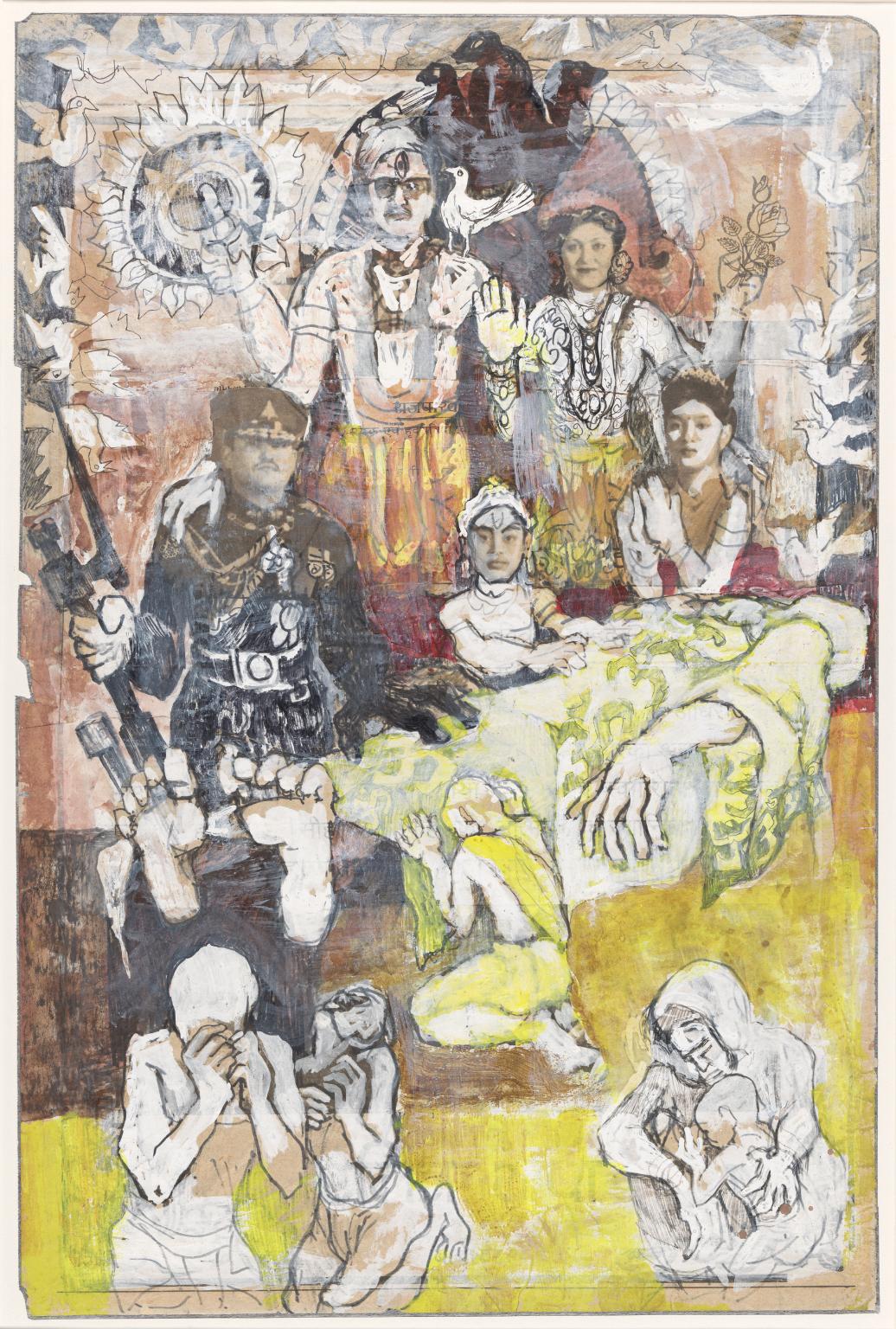
In these works, Shah adds a sword in Crown Prince Dipendra’s hand. Following the massacre, a government-led investigation concluded that Dipendra was responsible for killing his own family, before turning the gun on himself. He passed away just three days after being declared king. The original photograph reproduced in these works shows the royal family inside the throne room in Kathmandu’s Narayanhiti Palace. The throne features the Hindu motif of a many-headed snake god. Throughout the Royal Massacre Series, Shah often draws dark snakes surrounding the figures, symbolising danger and betrayal.

Gallery label, February 2026

4/14
artworks in León Ferrari

More on this artwork

Shashi Bikram Shah, Royal Massacre Series 4  2001

In these works, Shah adds a sword in Crown Prince Dipendra’s hand. Following the massacre, a government-led investigation concluded that Dipendra was responsible for killing his own family, before turning the gun on himself. He passed away just three days after being declared king. The original photograph reproduced in these works shows the royal family inside the throne room in Kathmandu’s Narayanhiti Palace. The throne features the Hindu motif of a many-headed snake god. Throughout the Royal Massacre Series, Shah often draws dark snakes surrounding the figures, symbolising danger and betrayal.

Gallery label, February 2026

5/14
artworks in León Ferrari

More on this artwork

Shashi Bikram Shah, Royal Massacre Series 5  2001

Grieving figures can be seen at the bottom of many works in the series, illustrating the shock and despair felt in Nepal following the massacre. Shah has said that ‘the series is not just about one family. I was thinking deeply about the situation across Nepal. In the early 2000s, there was an ongoing conflict in the country and the Maoist insurgency was very active. People were suffering both at the hands of the Maoists and the government. My drawings contextualise the pain that was unfolding.’

Gallery label, February 2026

6/14
artworks in León Ferrari

More on this artwork

Shashi Bikram Shah, Royal Massacre Series 6  2001

7/14
artworks in León Ferrari

More on this artwork

Shashi Bikram Shah, Royal Massacre Series 11  2001

8/14
artworks in León Ferrari

More on this artwork

Shashi Bikram Shah, Royal Massacre Series 15  2001

9/14
artworks in León Ferrari

More on this artwork

Shashi Bikram Shah, Royal Massacre Series 14  2001

Here, Shah combines the faces of King Birendra and Queen Ayshwaryato to portray the Hindu god Vishnu in his androgynous form, the Vaikuntha-Kamalaja. This form represents the oneness with his female consort Lakshmi. The artist also draws inspiration from the Dashavatar, Vishnu’s ten incarnations who descend to Earth to restore order during times of crisis. Some of these incarnations – the fish, the tortoise, the boar and the half-lion – can be seen near the Vishnu figure. Shah’s expressive linework and exaggerated shapes speak to his past experience as a caricaturist for a local newspaper.

Gallery label, February 2026

10/14
artworks in León Ferrari

More on this artwork

Shashi Bikram Shah, Royal Massacre Series 1  2001

11/14
artworks in León Ferrari

More on this artwork

Shashi Bikram Shah, Royal Massacre Series 12  2001

12/14
artworks in León Ferrari

More on this artwork

Shashi Bikram Shah, Royal Massacre Series 13  2001

13/14
artworks in León Ferrari

More on this artwork

Shashi Bikram Shah, Royal Massacre Series 8  2001

14/14
artworks in León Ferrari

More on this artwork

Art in this room

Sorry, no image available

Shashi Bikram Shah Royal Massacre Series 7 2001

Sorry, no image available

Shashi Bikram Shah Royal Massacre Series 9 2001

Sorry, no image available

Shashi Bikram Shah Royal Massacre Series 10 2001

Sorry, no image available

Shashi Bikram Shah Royal Massacre Series 3 2001

Sorry, no image available

Shashi Bikram Shah Royal Massacre Series 4 2001

Sorry, no image available

Shashi Bikram Shah Royal Massacre Series 5 2001

Sorry, no image available

Shashi Bikram Shah Royal Massacre Series 6 2001

Sorry, no image available

Shashi Bikram Shah Royal Massacre Series 11 2001

Sorry, no image available

Shashi Bikram Shah Royal Massacre Series 15 2001

Sorry, no image available

Shashi Bikram Shah Royal Massacre Series 14 2001
T16279: Royal Massacre Series 1
Shashi Bikram Shah Royal Massacre Series 1 2001

Sorry, no image available

Shashi Bikram Shah Royal Massacre Series 12 2001

Sorry, no image available

Shashi Bikram Shah Royal Massacre Series 13 2001

Sorry, no image available

Shashi Bikram Shah Royal Massacre Series 8 2001

You've viewed 6/14 artworks

You've viewed 14/14 artworks

Artwork
Close

Join in

  • Twitter
  • Facebook
  • YouTube
  • Instagram
  • Pinterest
Sign up to emails

Sign up to emails

This site is protected by reCAPTCHA and the Google Privacy Policy and Terms of Service apply.

Tate’s privacy policy

About

  • About us
  • Our collection
  • Terms and copyright
  • Governance
  • Picture library
  • ARTIST ROOMS
  • Tate Kids

Support

  • Tate Collective
  • Members
  • Patrons
  • Donate
  • Corporate
  • My account
  • Press
  • Jobs
  • Accessibility
  • Privacy
  • Cookies
  • Contact
© The Board of Trustees of the Tate Gallery, 2026
All rights reserved