
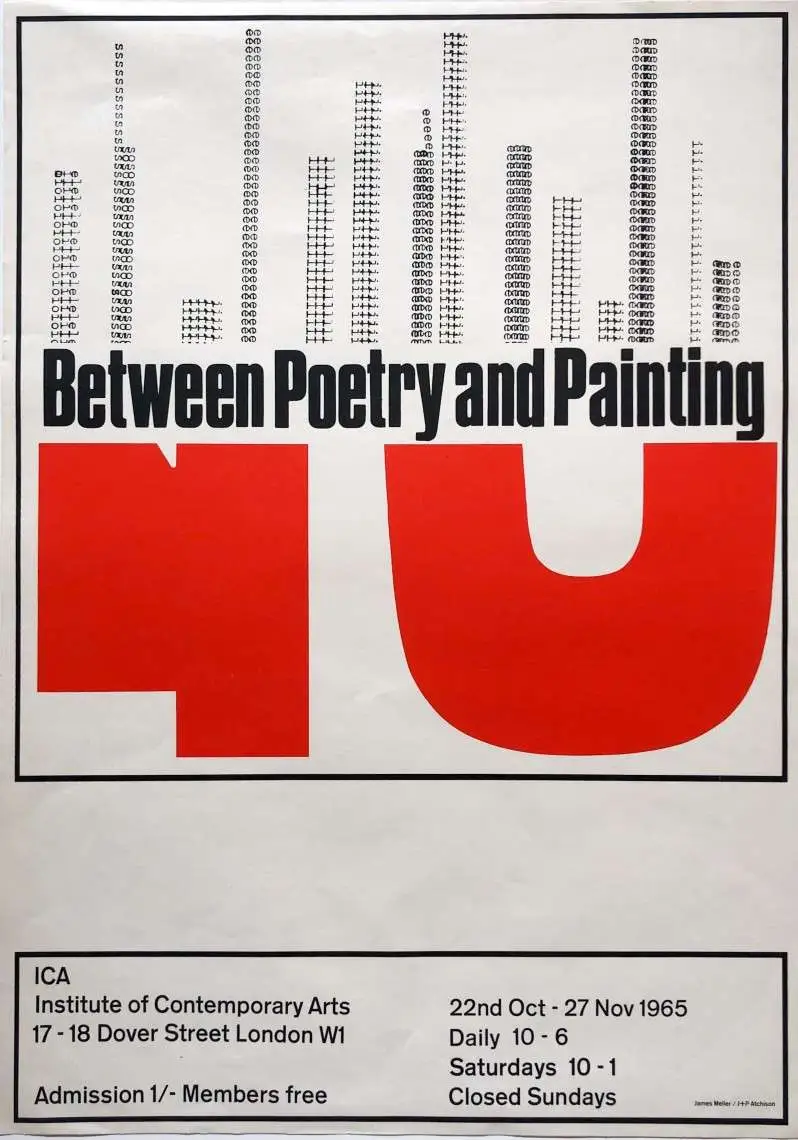
In Celebration of Typography is a new book about about typography in books, art, and poetry.
We are marking the 60th anniversary of Between Poetry and Painting, a landmark exhibition held in 1965 at the Institute of Contemporary Arts, the first London show dedicated to concrete poetry. Concrete poetry was an international literary movement that started in the 1950s influenced by Constructivism and Concrete art, and characterized for privileging the visual, particularly typographical, arrangement of words over more traditional elements of the poem. During the 1960s, many visual artists adopted concrete poetry and incorporated it into art practice, with Britain as one of its international centres.
The publication has been edited by British art critic and curator Jasia Reichardt, and includes contributions by Stephen Bann, Bronać Ferran, Piet Gerards, Gustavo Grandal Montero, Hansjörg Mayer, Emily McVarish and Piotr Rypson, as well as a reprint of the original catalogue.
The event will feature a panel discussion chaired by David Morris (at 15.00) with Reichardt and many of the contributors to the book, and a show and share display of rare concrete poetry publications from Tate Library's collection.
Jasia Reichardt
Art critic, curator, art gallery director, teacher, writer and archivist, born in 1933, in Warsaw, Poland. In the 1950s Reichardt was assistant editor of Art News and Review, a weekly arts magazine. From 1963 to 1971 she was assistant director of the Institute of Contemporary Arts in London where she curated Between Poetry and Painting in 1965 and other landmark exhibitions, including Cybernetic Serendipity in 1968 and Play Orbit in 1969. From 1974 to 1976 Reichardt was director of the Whitechapel Art Gallery. She taught at the Architectural Association for 10 years, and other colleges. From 1989 to 1998 she was director of ARTEC Biennale in Japan. In 1998 she curated Electronically Yours at the Tokyo Metropolitan Museum.
David Morris
Dr David Morris is a writer, researcher and educator. He is a research fellow and editor at Afterall (Central Saint Martins, London). His writing and research has appeared in a wide range of books, journals and publications. He is co-editor, with David Teh, of Artist-to-Artist: Independent Art Festivals in Chiang Mai 1992–98 (Afterall Books, 2018) among other publications. With Helena Vilalta he leads the MRes Art: Exhibition Studies research masters course at Central Saint Martins (UAL).
Tate Britain's step-free entrance is on Atterbury Street. It has automatic sliding doors and there is a ramp down to the entrance with central handrails.
- Accessible, standard and Changing Places toilets are located on the Lower floor.
- Ear defenders can be borrowed from the ticket desk on the Lower floor.
To help plan your visit to Tate Britain, have a look at our visual story. It includes photographs and information about what you can expect from a visit to the gallery.
For more information before your visit:
- Email hello@tate.org.uk
- Call +44 (0)20 7887 8888 (daily 10.00–17.00)


