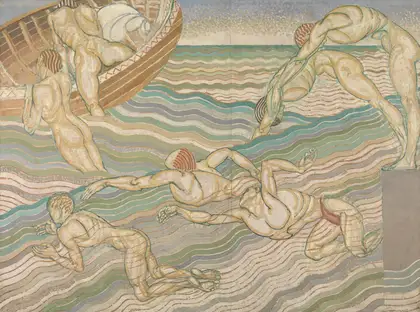
About the exhibition
Vanessa Bell (1879–1961) and Duncan Grant (1885–1978) forged an extraordinary partnership in which art, family and friendships were intimately intertwined. They reshaped the course of modern art in Britain, creating vibrant paintings alongside decorative works and interiors that broke down the boundaries between art and everyday life.
Featuring over 300 works, Vanessa Bell & Duncan Grant: Inside Bloomsbury is the first major exhibition to chart their relationship and artistic legacy.

Vanessa Bell Self Portrait c.1915 (detail). Yale Center for British Art, Paul Mellon Fund © estate of Vanessa Bell. All rights reserved, DACS 2026

Duncan Grant Self-Portrait c.1920 (detail). Private Collection © estate of Duncan Grant. All rights reserved, DACS 2026
Five things to know about Bell and Grant
1. Their relationship lasted over 50 years
Dear Duncan, May I call you so & will you call me Vanessa? It seems rather absurd to begin with 'Dear Mr. Grant'
- Letter from Vanessa Bell to Duncan Grant, 1909
In 1909, Bell invited Grant to tea, proposing they address one another by their first names. At a time when informality was considered improper, this simple request challenged convention. It marked the beginning of a relationship that would define their lives and artistic practices.
Bell and Grant’s partnership grew from a shared passion for art and developed into a loving and domestic relationship. Their unconventional relationship was sustained by enduring love and creative companionship.
2. They were members of the Bloomsbury Group
The Bloomsbury Group was not a formal artistic movement but a group of friends and relatives. Many of these artists, writers and thinkers lived in the Bloomsbury area of London. Although the name was adopted by the papers and the public, some members questioned whether they belonged to a ‘Group’.
The friends shared a commitment to intellectual debates about art, literature and social freedom, rejecting the strict morality of the Victorian generation. This included supporting women’s rights, pacifist beliefs and non-monogamous and queer relationships.
The group's experimental ways of living and working had a significant impact on art and society in 20th-century Britain.
3. They experimented with post-impressionist ideas
In the 1910s, Bell and Grant began a period of intense artistic experimentation.
Inspired by post-impressionist works included in the Manet and the Post-Impressionists exhibition at Grafton Galleries, Bell and Grant began to paint with heightened colours, simplified forms and strong lines in increasingly ambitious ways.
In her painting Studland Beach c.1912, Bell simplifies the figures and the seascape, reflecting her increasingly abstract style.

Vanessa Bell Studland Beach c.1912. Tate
These paintings of the mantelpiece at Gordon Square were made during a period when Bell and Grant were spending more time together.
Working side by side, she sat to the left while Grant stood to the right, resulting in slightly different viewpoints of the same subject. Their choice of materials and techniques also differed. Bell worked solely in oil paint while Grant incorporated painted collage elements.

Vanessa Bell Still Life on Corner of a Mantelpiece 1914. Tate

Duncan Grant The Mantelpiece 1914. Tate
4. They joined the Omega Workshops
In 1913, Bell and Grant joined the Omega Workshops, a design collective founded by fellow Bloomsbury Group artist and critic Roger Fry. The Workshops brought the bold colours and shapes of avant-garde painting into the home.
Bell and Grant acted as co-directors, creating abstract designs that were applied to furniture, textiles, ceramics and other household items.

Duncan Grant, Folding screen 1913
Painted screens were among the most distinctive items produced by the Omega Workshops.
Grant’s four-panelled screen features two angular figures carrying a bucket, painted in vivid colours and jagged cross-hatching.
5. They sought inspiration overseas
After the First World War, Bell and Grant moved away from abstraction and towards a more naturalistic style.
When Europe's borders reopened after the war, travel became a significant influence. During stays in Cassis and St Tropez with their family, they found fresh inspiration in the landscapes and golden light of the south of France. They also enjoyed travelling to Italy and Spain.
In the winter of 1921-2, Bell and Grant rented La Maison Blanche, a villa just outside St. Tropez on the southern French coast. Bell's painting Interior with a Table 1921 depicts the view from their villa, across the landscape to the gulf beyond.

Vanessa Bell Interior with a Table 1921. Tate
In South of France 1922, Grant depicts farm buildings and fields near La Maison Blanche. Using a palette of warm browns and earth colours, he captures the dark shadows and crisp contrasts of the low winter sun, bringing a sense of boldness and modernity to the rural scene.

Duncan Grant South of France 1922. Tate
Exhibition highlight
In 1916, Bell and Grant moved to Charleston, a farmhouse in East Sussex. They transformed their home into a living work of art, painting walls and furniture as well as displaying artworks they made throughout their careers. They built a studio on the ground floor of Charleston in 1925. Designed by Roger Fry, it became the creative heart of the house, where they painted, welcomed friends and exchanged ideas.
The studio has been restaged for this exhibition. The painted walls and mantelpiece have been faithfully recreated, along with Bell’s murals, while every object on display has been relocated from Charleston. They include the painted fireplace surround by Grant and a bust of Virginia Woolf. Visitors are invited to experience the studio as Bell and Grant used it in the 1950s.