
Turner Bequest CCCLIV 1–37a
Sketchbook bound in thin card, laminated with glossy black paper with a slight regular embossed pattern
37 leaves and paste-downs of white wove paper; page size approximately 72 x 109 mm
Numbered 212 as part of the Turner Schedule in 1854 and endorsed by the Executors of the Turner Bequest, inside front cover (see main catalogue entry)
Blind-stamped with Turner Bequest monogram inside front cover, showing through in reverse on outside
Stamped in black ‘CCCLIV’ on front cover, top right
Inscribed in pencil and stamped in black ‘CCCLIV’ inside front cover, towards top left
37 leaves and paste-downs of white wove paper; page size approximately 72 x 109 mm
Numbered 212 as part of the Turner Schedule in 1854 and endorsed by the Executors of the Turner Bequest, inside front cover (see main catalogue entry)
Blind-stamped with Turner Bequest monogram inside front cover, showing through in reverse on outside
Stamped in black ‘CCCLIV’ on front cover, top right
Inscribed in pencil and stamped in black ‘CCCLIV’ inside front cover, towards top left
Accepted by the nation as part of the Turner Bequest 1856
References
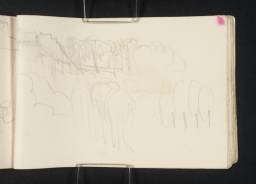
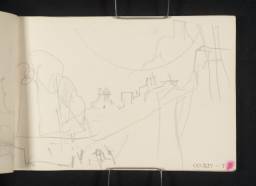
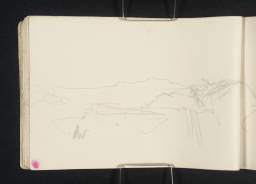
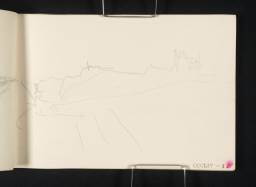
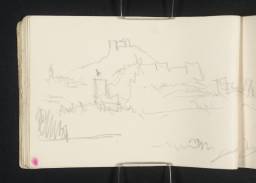
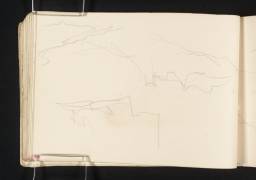
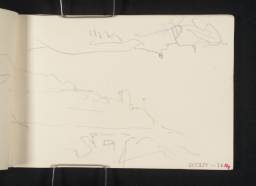
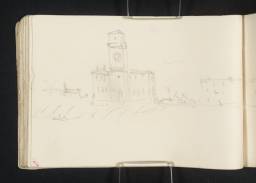
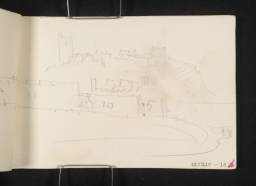
Lewes and Folkestone is a small pocket sketchbook with black paper covers. It is horizontal in format, although four drawings, on folios 11 recto, 16 verso, 30 verso and 36 recto (D35281, D35292, D35320, D35331) are portrait in orientation. Turner has used pencil throughout, except for two drawings in which he has deployed crayon (folios 1 recto and 37 verso (D35262, D35334). The majority of sketches are relatively small in scale, often indistinct and difficult to identify topographically. Many sketches extend across the double page spread, some overlap one another while others are tessellated on the page, typifying Turner’s idiosyncratic approach to sketching and, in their repetitive subject matter, his sheer compulsion to draw.
Finberg offered no topographical identifications for these drawings, although the sketchbook was given the hesitant but clearly informed title of ‘Near Folkestone (?)’,1 possibly suggested by Turner’s inscription ‘Rd to Fol’ on folio 13 recto (D35285). As a result of new identifications the sketchbook is here renamed Lewes and Folkestone. The date Finberg suggested, 1845, the year the artist turned seventy years of age, is adhered to here. Although no drawings are dated specifically, Turner was known to have travelled to the Kent coast twice in 1845, once in late spring and again in early autumn.
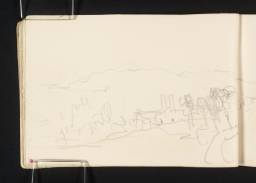
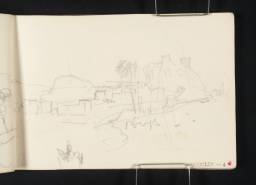
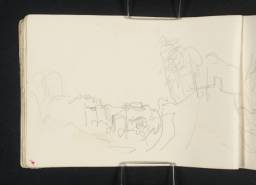
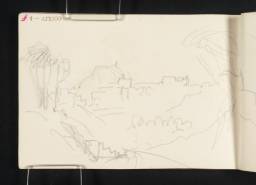
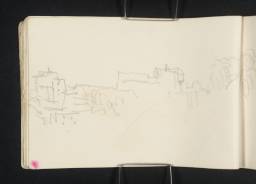
Most of Turner’s sketches in this Lewes and Folkestone sketchbookdepict the historic town and environs of Lewes, in the county of Sussex (in the half now officially named East Sussex). Lewes Castle, dating back to 1067 and dramatically situated above the town on its man-made mound, is a repeated feature that Turner appears to have delighted in sketching from every angle, particularly against the backdrop of the South Downs (for examples folios 32 verso and 33 verso; D35324, D35326), or alternatively with a focus on its main entrance, the imposing Barbican Gate (folios 10 verso and 35 verso; D35280, D35329). Turner had sketched this same castle many years earlier, in the Herstmonceux and Pevensey sketchbook of c.1806–10 (see, for example, Tate D65649; Turner Bequest XCI 32).
Interspersing the two runs of Lewes studies are sketches of places along the Sussex and Kent coasts. Brighton Pavilion features in the first sketch, perhaps indicating that Turner began his visit there (folio 1 recto; D35262). An excursion from Brighton to nearby Shoreham-by-Sea is evident from the sketch on folio 2 recto (D35263), which immediately precedes the first run of Lewes sketches. Travelling east from Lewes and along the coast into Kent, Turner then took a view of Dover Castle from Shakespeare Cliff (folio 11 verso; D35282) before heading west to sketch the coastal town of Folkestone, where the tower of the Church of St Mary and St Eanswythe, perched on the cliff above the town, and the harbour buildings held Turner’s attention, exemplified on folio 14 verso (D35288). It is highly possible that the artist travelled along the coast around Dover and Folkstone by boat, perhaps making several cliff studies from his seaborne vantage point (see folios 13 verso–14 recto; D35286–D35287). After returning to Dover Turner then revisited Lewes, which occupied his focus for the remainder of the sketchbook.
Only the final page departs from topographical subject matter in its depiction of a female nude (folio 37 verso; D35334); the use of brown crayon in this drawing would suggest it was possibly worked on at the same time as folio 1 recto (D35262), when Turner was in Brighton, the only other drawing to employ crayon.
Apart from the drama of the natural landscape of the south coast and the Downs, Turner’s interest in Brighton, Folkestone and Lewes at this time may have been piqued by the development of the rail network in this area during the ‘railway mania’ of the 1840s. He wrote in a letter of 1840 of the prospect of travelling by train to meet his Brighton-based solicitor George Cobb, anticipating the opening of the London to Brighton line in 1841: ‘having locomotive Engines in Progress towards you, we may meet again ere long – by rail-road, either at Brighton or London’.2
It is entirely possible that Turner travelled by train from London to Brighton, the location for the first sketch in the present book. Other sketches portray these new railroads and their imprint on the landscape: the dual bore of the Shakespeare Cliff tunnel for the Folkestone to Dover railway, which opened in 1844, can clearly be seen in two drawings (folios 12 verso and 19 recto; D35284, D35297), while it is very possible that the sketch on folios 24 verso and 25 recto (D35308–D35309) shows the site of the cutting for the Brighton, Lewes and Hastings Railway, which opened in 1846. Work on the cutting exhumed a hundred skeletons buried near the eleventh century Priory of St Pancras.3 It is entirely characteristic that Turner would seek out these sites of intersection between past and present, and between man and nature, where the landscape was bearing the imprint of the modern age.
The book carries the customary endorsement of the Turner Bequest Executors across the top of the front pastedown, signed by Turner’s artist friend George Jones and initialled by the Bequest’s assessors, Charles Lock Eastlake and John Prescott Knight, in ink ‘No 212 – 37 leaves drawn on both | sides – Geo Jones’ and below in pencil ‘C.L.E.’ and ‘JPK’. John Ruskin’s dismissive note on his usual separate wrapper (since lost, like most others) is transcribed in Finberg’s 1909 Inventory of the Bequest: ‘No. 212. Valueless.’4
Many thanks are due to former Tate curator and Turner scholar Ian Warrell (who had first noted in 1995 that ‘[m]any of the pages of this book depict the castle and cliffs at Dover’5) for identifying a number of these drawings.
Note: This sketchbook’s entries, initially drafted in 2013, have been brought up to date for publication by the Turner Bequest project’s editor Matthew Imms, in particular with regard to footnoted website references.
Letter from Turner to George Cobb, dated 7 October 1840, quoted in John Gage, Turner: Rain, Steam and Speed, Art in Context, London 1972, p.43; transcribed in full in John Gage, Collected Correspondence of J.M.W. Turner with an Early Diary and a Memoir by George Jones, Oxford 1980, p.180 letter no.238.
See Mark Antony Lower, ‘A Hand-book for Lewes’, London 1845, reissued with additions 1847, quoted in ‘Lewes History Group: Bulletin 7, (11 February 2011)’, Lewes History Group, accessed 14 March 2025, http://leweshistory.org.uk/2011/02/12/lewes-history-group-bulletin-7-11-february-2011/ ; and ‘The Railway’, Lewes Priory Trust, accessed 14 March 2025, http://www.lewespriory.org.uk/railway .
Technical Notes
-
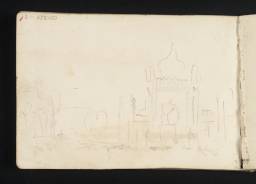 Joseph Mallord William TurnerLewes and Folkestone SketchbookD35262
 -
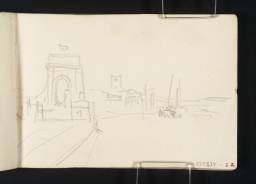 Joseph Mallord William TurnerLewes and Folkestone SketchbookD35263
 -
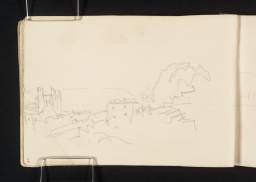 Joseph Mallord William TurnerLewes and Folkestone SketchbookD35264
 -
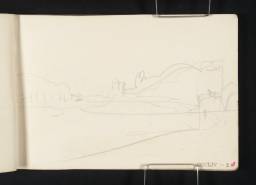 Joseph Mallord William TurnerLewes and Folkestone SketchbookD35265
 -
-
-
-
-
-
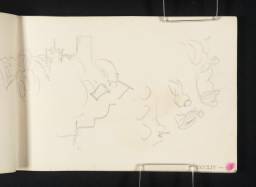 Joseph Mallord William TurnerLewes and Folkestone SketchbookD35271
 -
-
-
-
-
-
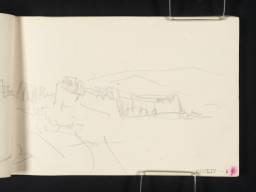 Joseph Mallord William TurnerLewes and Folkestone SketchbookD35277
 -
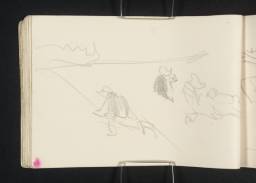 Joseph Mallord William TurnerLewes and Folkestone SketchbookD35278
 -
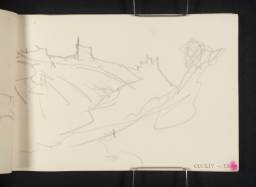
-
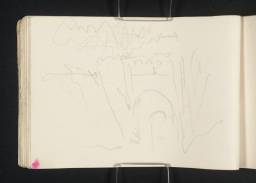 Joseph Mallord William TurnerLewes and Folkestone SketchbookD35280
 -
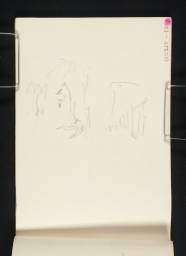
-
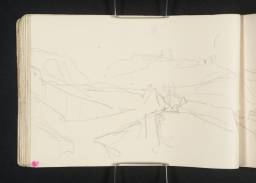 Joseph Mallord William TurnerLewes and Folkestone SketchbookD35282
 -
 Joseph Mallord William TurnerLewes and Folkestone SketchbookD35283
 -
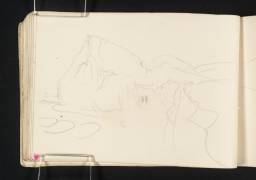 Joseph Mallord William TurnerLewes and Folkestone SketchbookD35284
 -
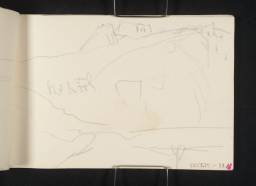 Joseph Mallord William TurnerLewes and Folkestone SketchbookD35285
 -
-
-
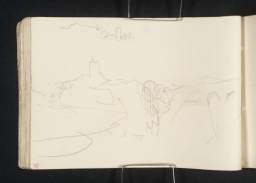 Joseph Mallord William TurnerLewes and Folkestone SketchbookD35288
 -
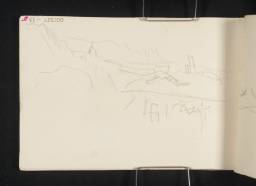 Joseph Mallord William TurnerLewes and Folkestone SketchbookD35289
 -
-
How to cite
Amy Concannon, ‘Lewes and Folkestone Sketchbook 1845’, sketchbook, May 2025, in David Blayney Brown (ed.), J.M.W. Turner: Sketchbooks, Drawings and Watercolours, Tate Research Publication, July 2026, https://www