

Prunella Clough, Wire and Demolition 1982. Tate. © The estate of Prunella Clough.
14 rooms in Modern and Contemporary British Art
‘Anything that the eye or the mind’s eye sees with intensity and excitement will do for a start; a gasometer is as good as a garden, probably better’ – Prunella Clough, 1949
Prunella Clough (1919–99) was fascinated by urban and industrial landscapes – what she called ‘urbscapes’. She painted places and things that were forgotten and overlooked. Dockyards, wastelands and factories appear in her work, as well as the discarded, mass-produced objects she found littering the contemporary urban environment. In a style that hovers between abstraction and figuration, Clough teased images of unexpected resonance and beauty from everyday subjects.
Born in London, Clough enrolled at Chelsea School of Art in 1937. Her studies were interrupted by the outbreak of the Second World War, during which she drew maps and charts for the US Office of War Information. Although her early work focused on fishermen, lorry drivers and factory workers, Clough soon abandoned the human figure, turning her attention to capturing and distilling the forms, colours and textures of her urban surroundings. Despite this, a persistent human presence lingers on in her work, through her fascination with the traces left by people on the landscape.
Clough maintained that ‘nothing that I do is “abstract”. I can locate all the ingredients of a painting in the richness of the outside world,the world of perception.’ Her paintings offer a different way of looking: familiar things glimpsed fleetingly, scrutinised close-up, or filtered through memory. As the artist Patrick Heron wrote, ‘her paintings are machines for seeing with.'
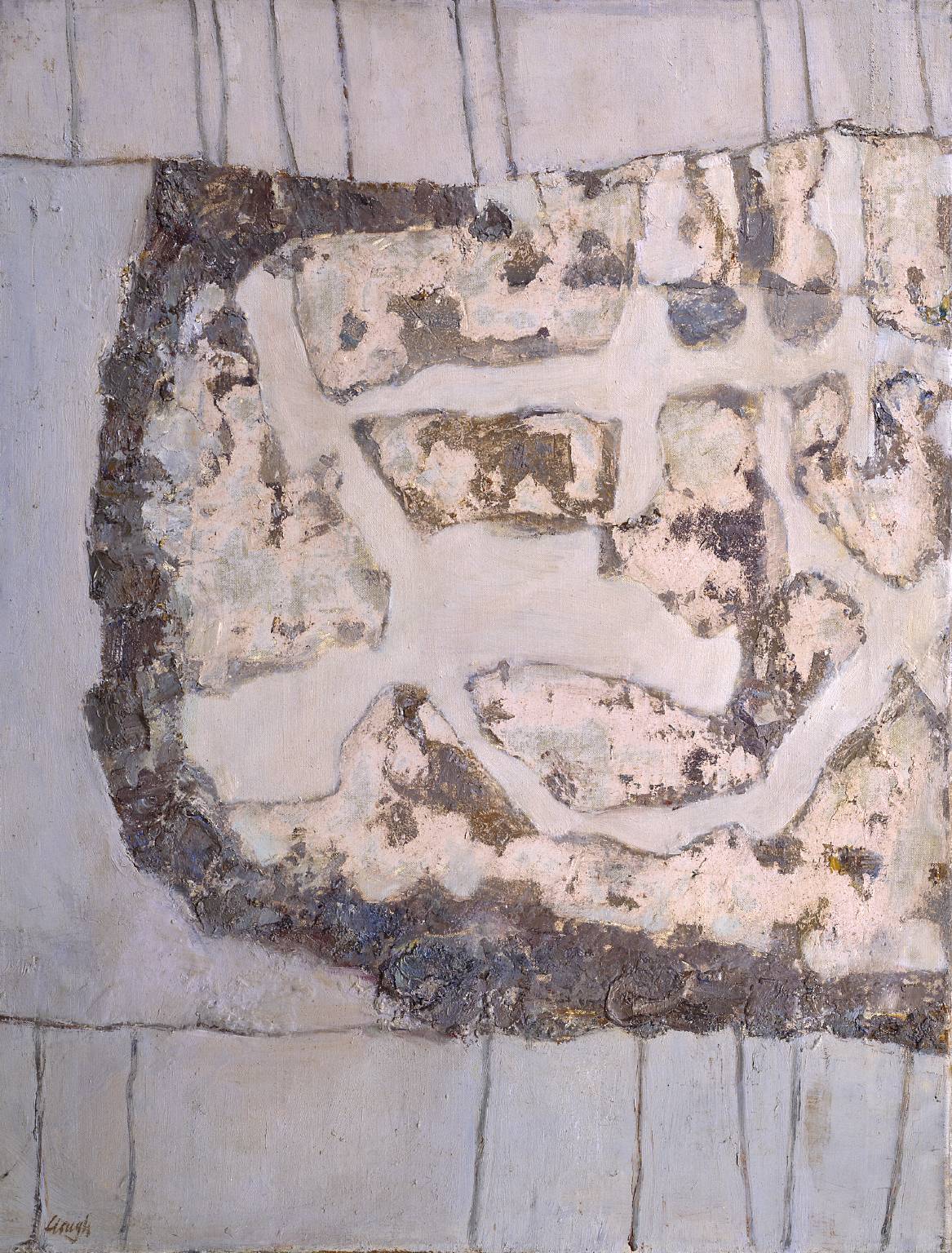
Prunella Clough, Rockery, 1963 1962–3
Clough described her use of colour as ‘muffled, tonal, and murky’. Here, as the title suggests, she depicts a garden in which plants grow among heaped, rough stones. Clough became known as an abstract painter, but she saw her ‘subject matter mainly as landscape’. However, it was the feeling, not just the look of a place that mattered to her. She walked through the landscapes she wanted to paint, explaining: ‘the sense of place is crucial for me and involves sensations other than the purely optical ones of observation’.
Gallery label, June 2020
1/13
artworks in Prunella Clough: Urbscapes
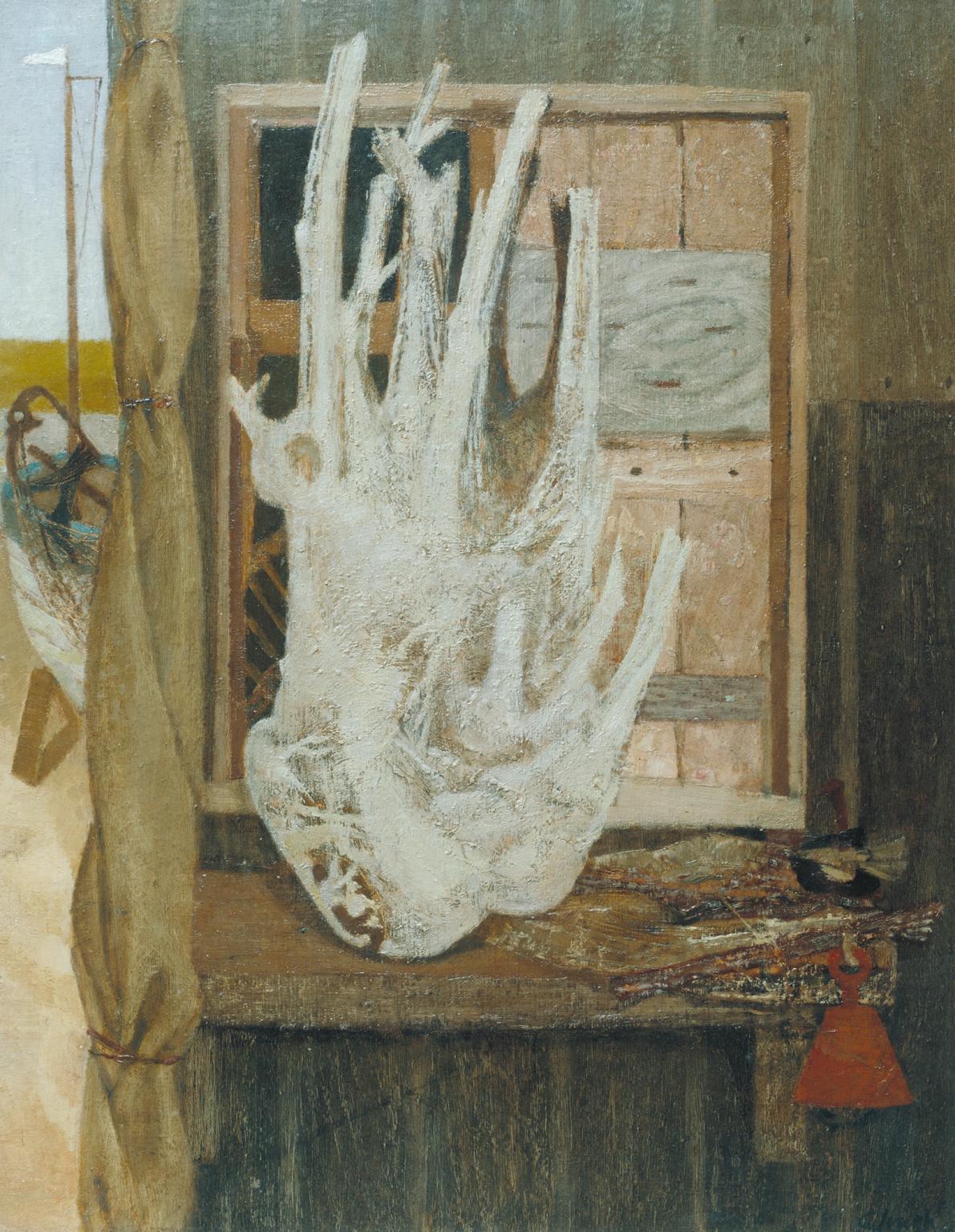
Prunella Clough, The White Root 1946
Clough’s first solo show in 1947 was at the Leger Gallery in London. It included still lifes and landscapes. Throughout the late 1940s, she visited the Suffolk Coast and her paintings from that time often show coastal subjects. The White Root features a bleached root structure, a wooden box or door and other debris. Although Clough painted it from observation, she focused on the abstract qualities of the root’s texture and shape.
Gallery label, April 2019
2/13
artworks in Prunella Clough: Urbscapes
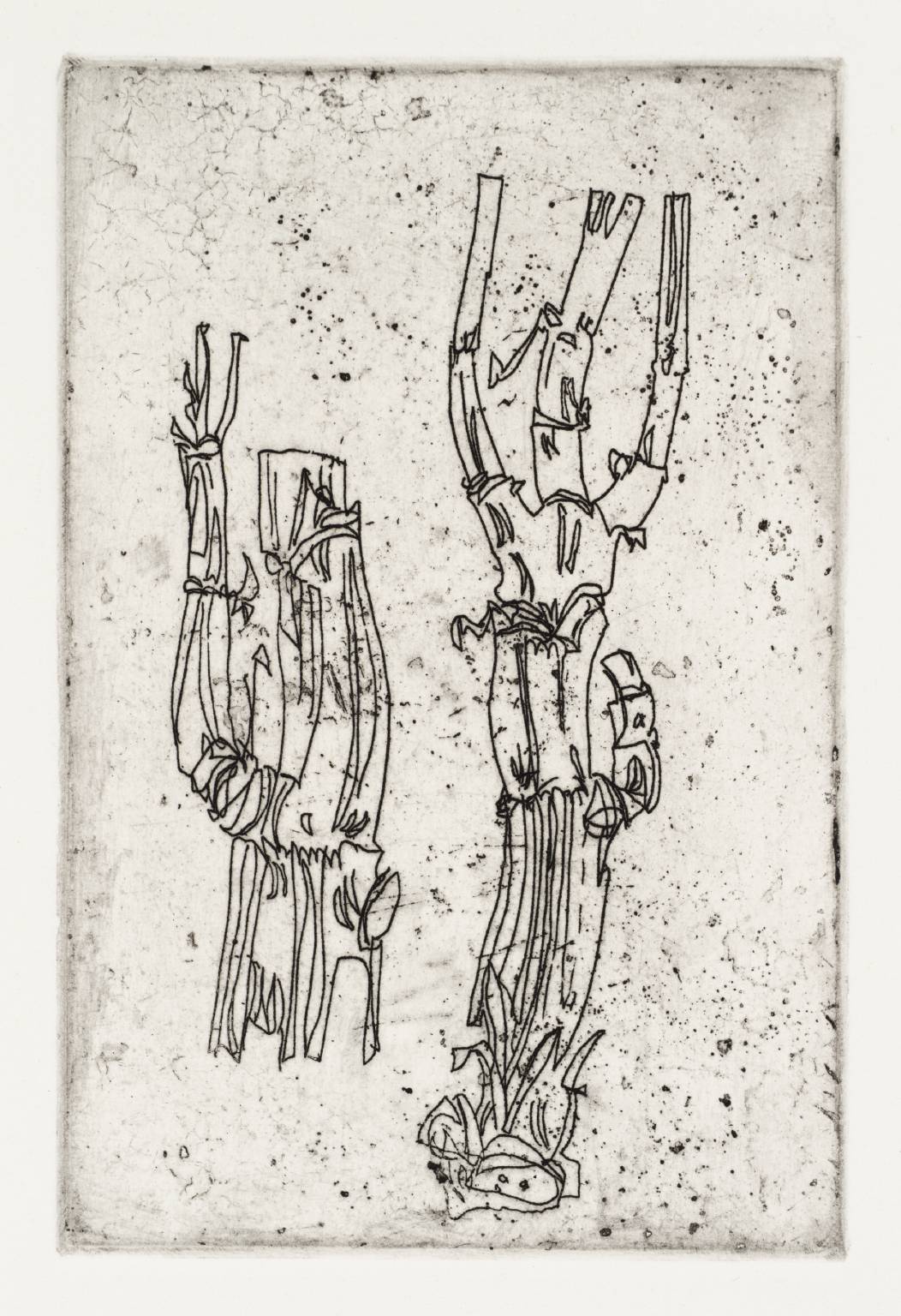
Prunella Clough, Marsh Plants 1954
3/13
artworks in Prunella Clough: Urbscapes
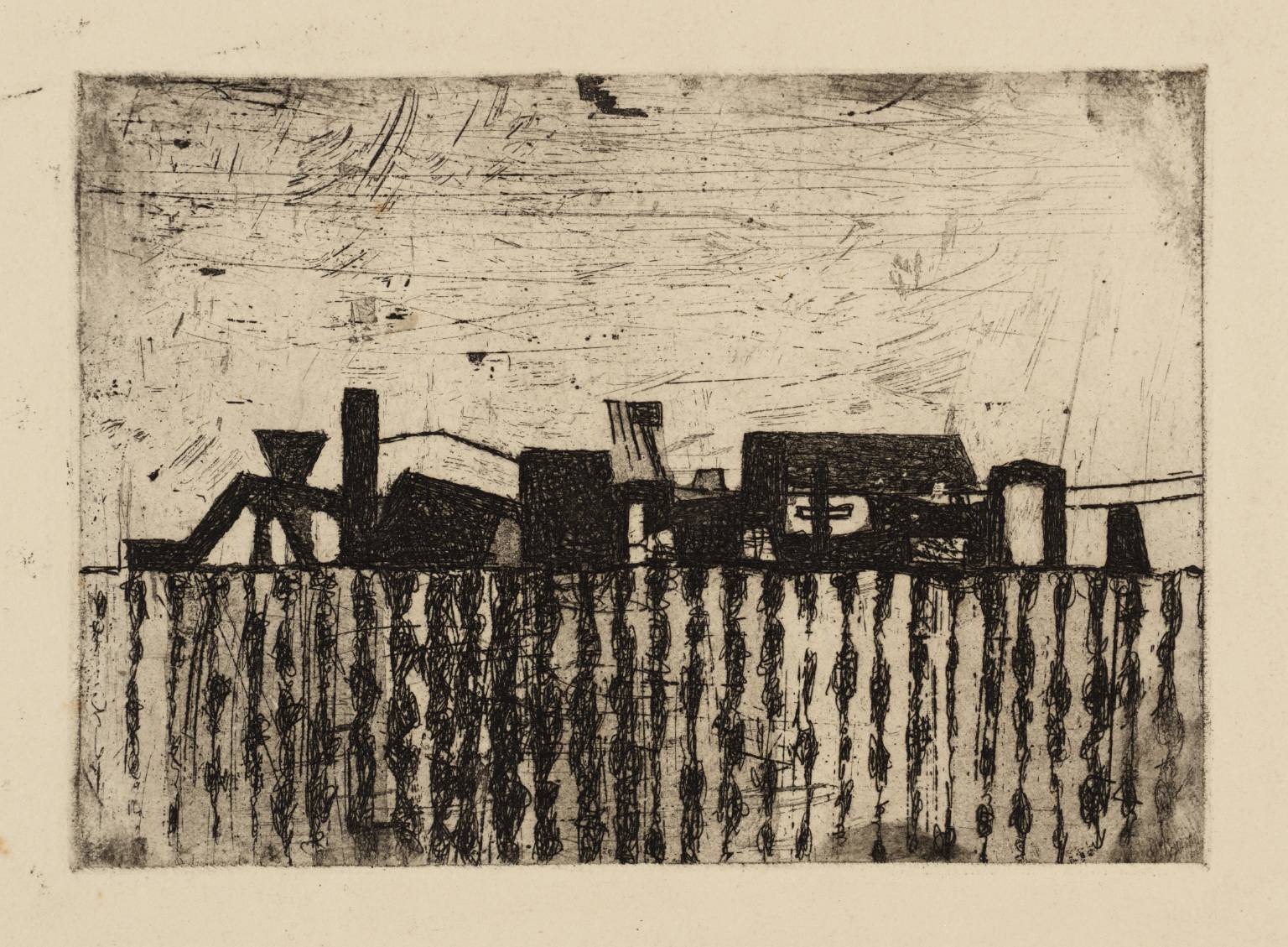
Prunella Clough, Corrugated Fence 1955
4/13
artworks in Prunella Clough: Urbscapes
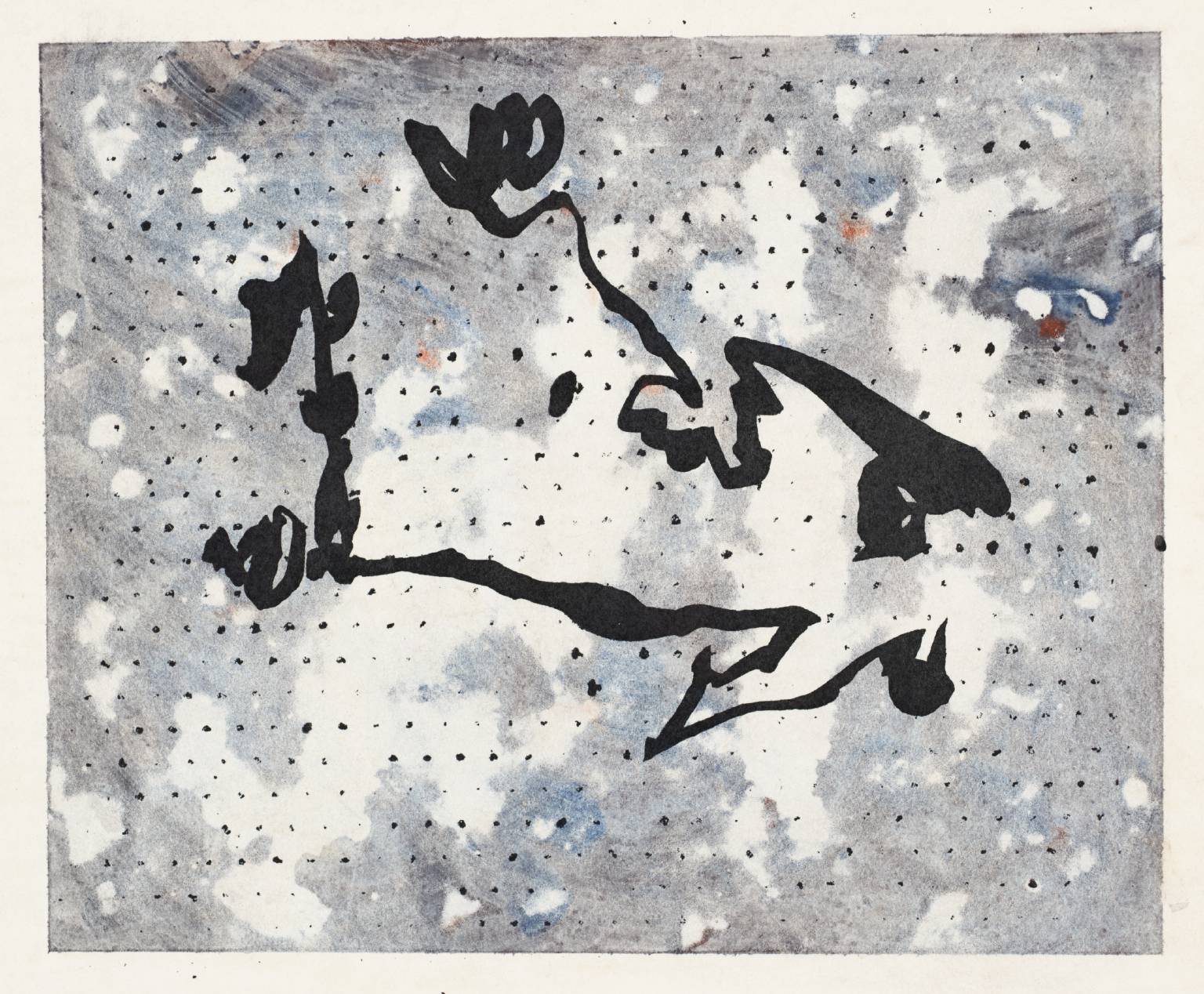
Prunella Clough, Fence/Climbing Plant 1978
5/13
artworks in Prunella Clough: Urbscapes
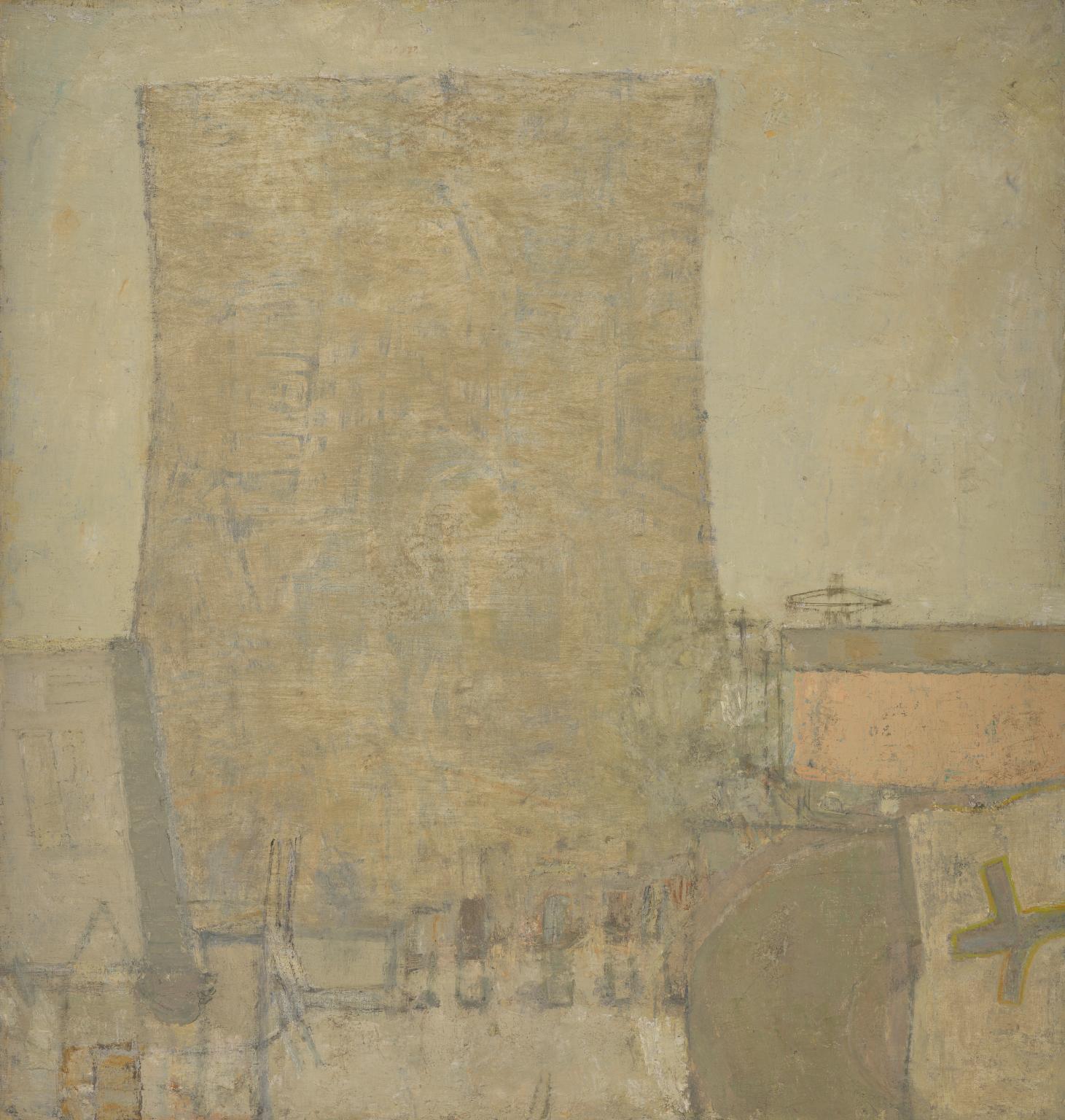
Prunella Clough, Cooling Tower II 1958
One of Britain's most respected post-war painters, Prunella Clough developed a highly personalised visual language that hovered between abstraction and figuration. She frequently depicted urban or industrial motifs derived from her London environment, and she would set these against a soft, indeterminate background. The imposing tower structure of 'Cooling Tower II' has been simplified to its most basic form. It dominates the sky and dwarfs the smaller crane feature sitting to its right. However, the emphatic horizon line, characteristic of CLough's work, checks the overwhelming presence of the tower and balances the painting.
Gallery label, September 2004
6/13
artworks in Prunella Clough: Urbscapes
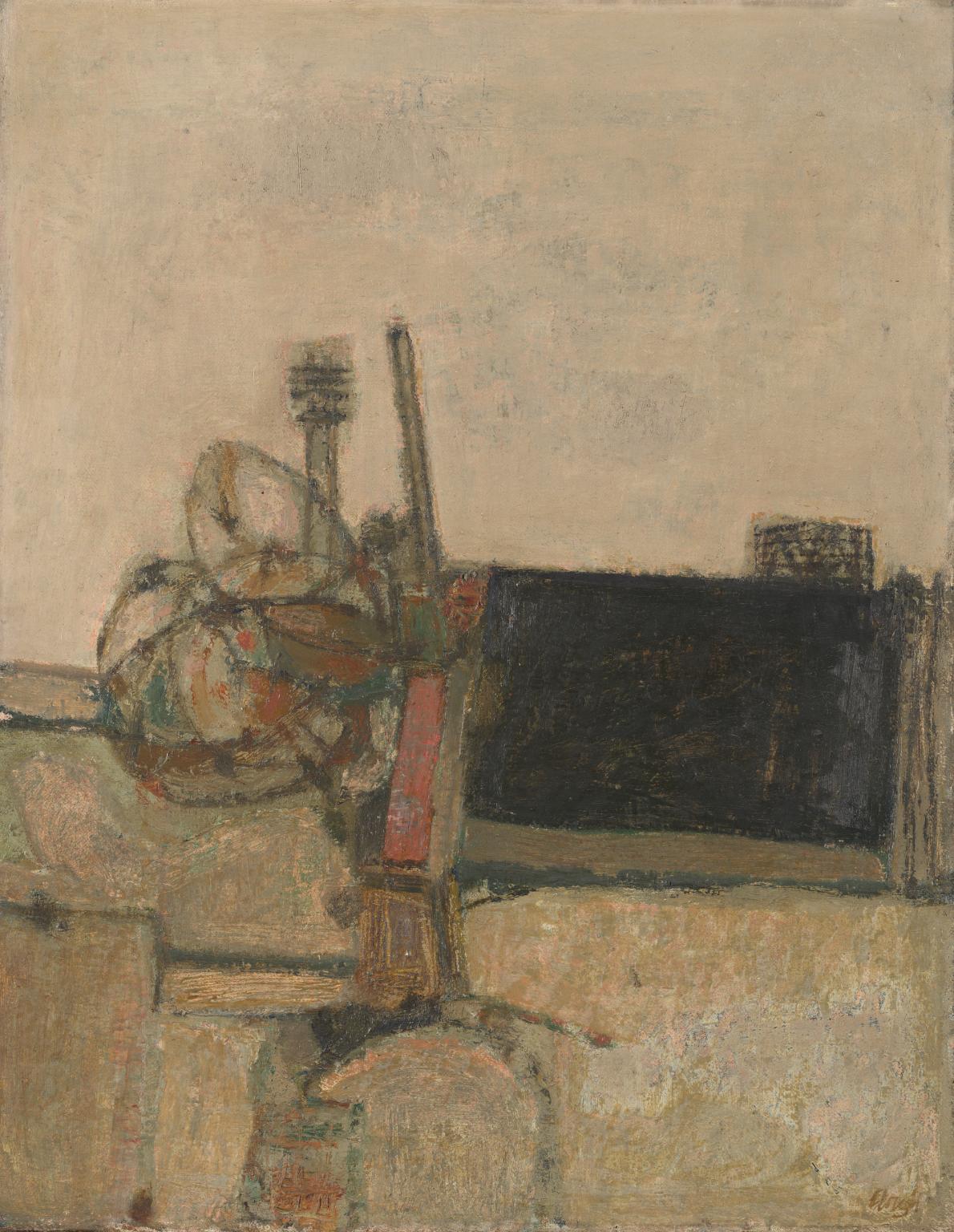
Prunella Clough, Road to Wharf 1954
Road to Wharf 1954 is an oil painting that depicts a collection of solid abstract forms that, when considered as a whole, appear to show the back entrance to an industrial site like those found at the street entrance to a wharf. The canvas is split fairly evenly in half, the foregrounded composite shapes inhabiting the lower half. A grey-blue even sky punctuated by two dark grey towering frames make up the upper half of the work. The central right quadrant of the work is dominated by a large blue rectangle, framed on two sides by brown lines and on one by a red strip. One of the aforementioned tower constructions emerges from the framed rectangle above, while to its left emanate swirls of black, punctuated by orange and grey-blue daubs of colour. Below and to the left of this fused arrangement, straight and curved black lines cut the screen of dark beige-grey that anchors the bottom of the painting.
7/13
artworks in Prunella Clough: Urbscapes
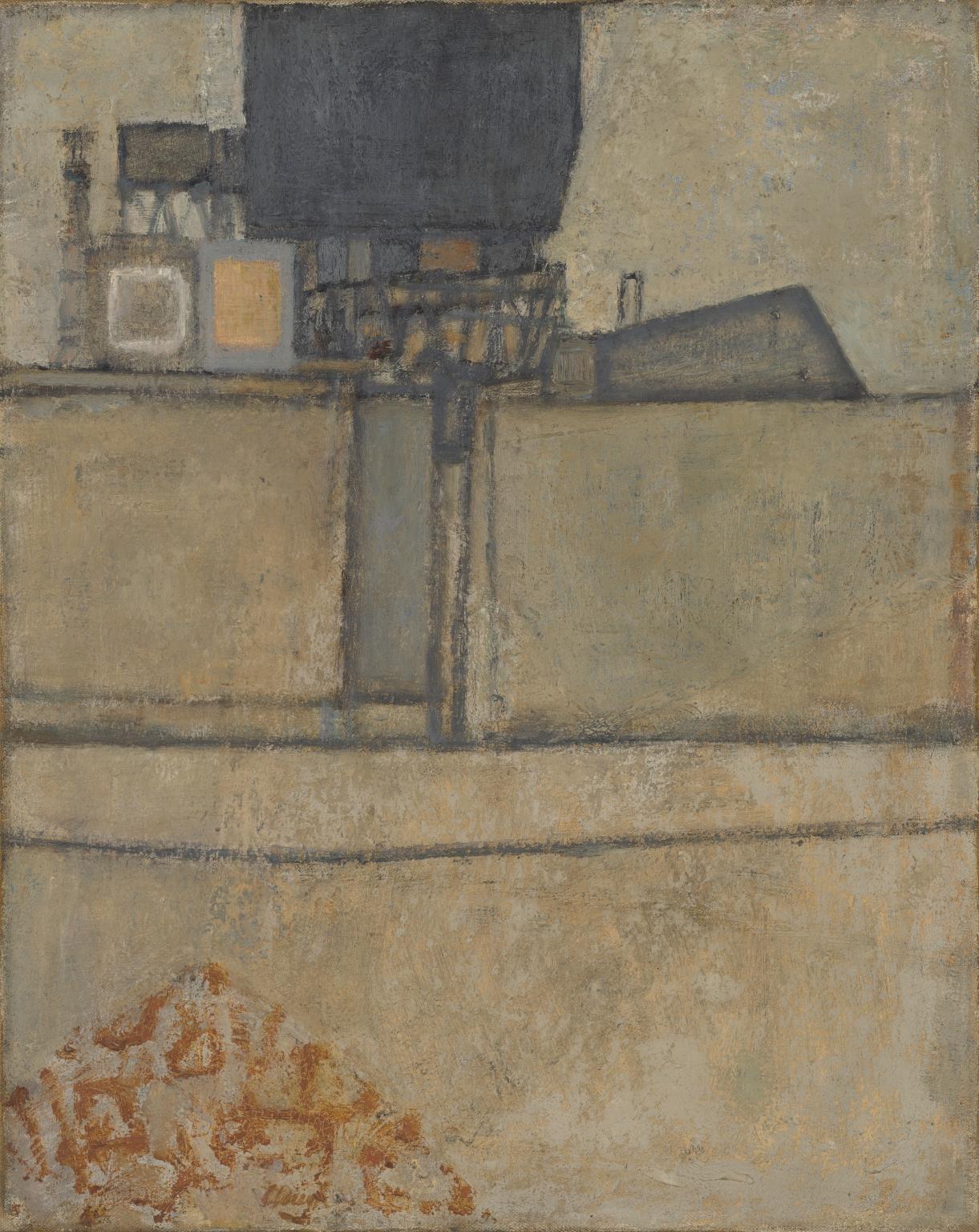
Prunella Clough, Industrial Landscape 1954
Industrial Landscape 1954 is a portrait-oriented oil painting on canvas. A selection of geometric forms rendered with a flat expansive surface and mottled colouring make up the upper background of the work. A lightly maculated grey ground frames the painting’s foreground, which is punctuated by a configuration of textured orange swirls that bores upwards from the lower left corner of the work. A division of horizontal rectangular grey shapes knitted together by a thinner, vertical darker grey shape traverse the middle of the composition. In the upper third of the work, a selection of blue and grey rhombuses and looser rectangles rise, entwining with tight collections of straight black lines to form a selection of motley contours against the beige-grey ground that continues to the painting’s edge.
8/13
artworks in Prunella Clough: Urbscapes
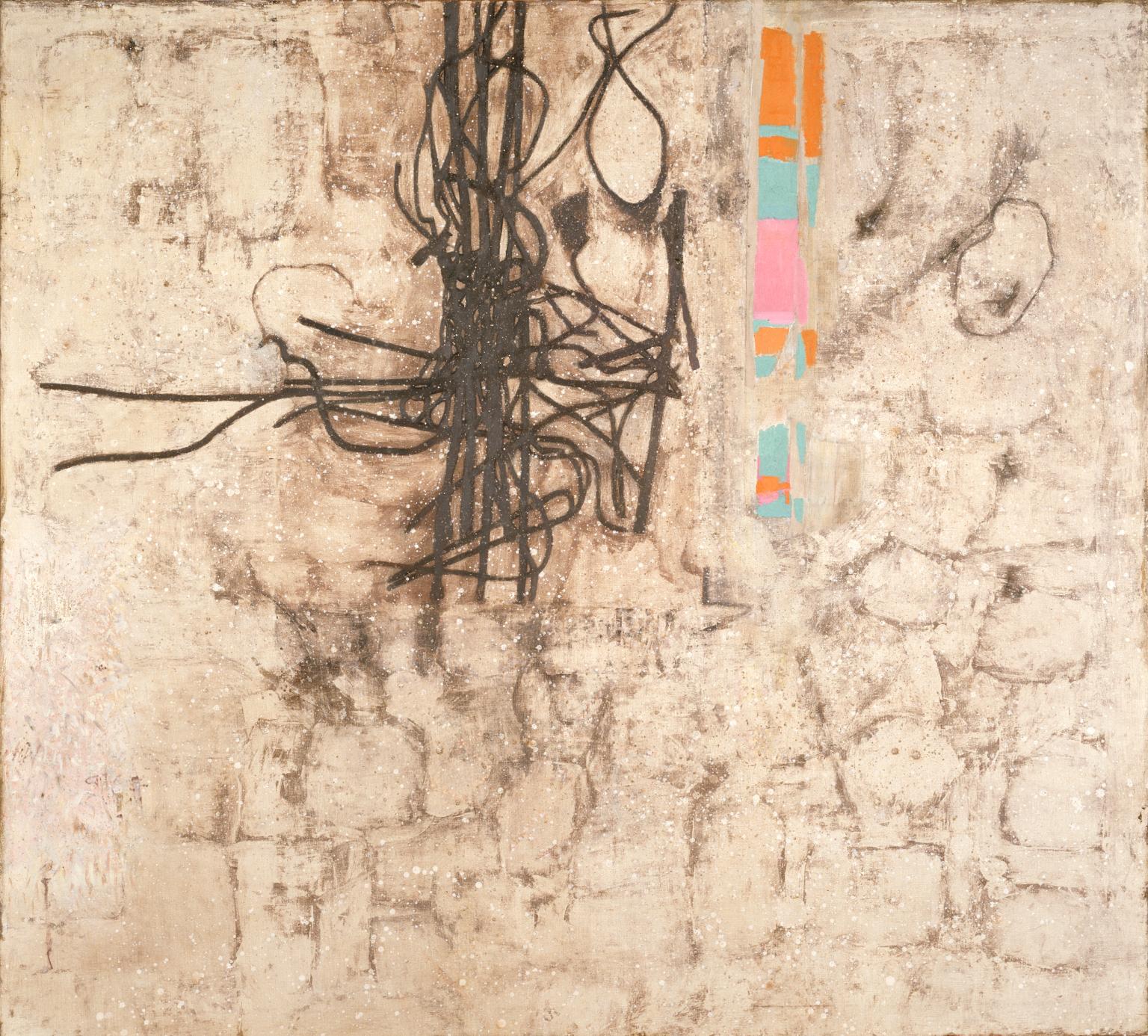
Prunella Clough, Wire and Demolition 1982
Clough’s paintings of urban and industrial scenes were often inspired by objects the artist noticed during walks around sites of interest. Here Clough references a piece of old wire discovered on a building site. Before studying art, Clough made maps for the US Office of War Information. The influence of this experience can be seen in her depiction of boundaries and fences in her paintings.
Gallery label, May 2019
9/13
artworks in Prunella Clough: Urbscapes
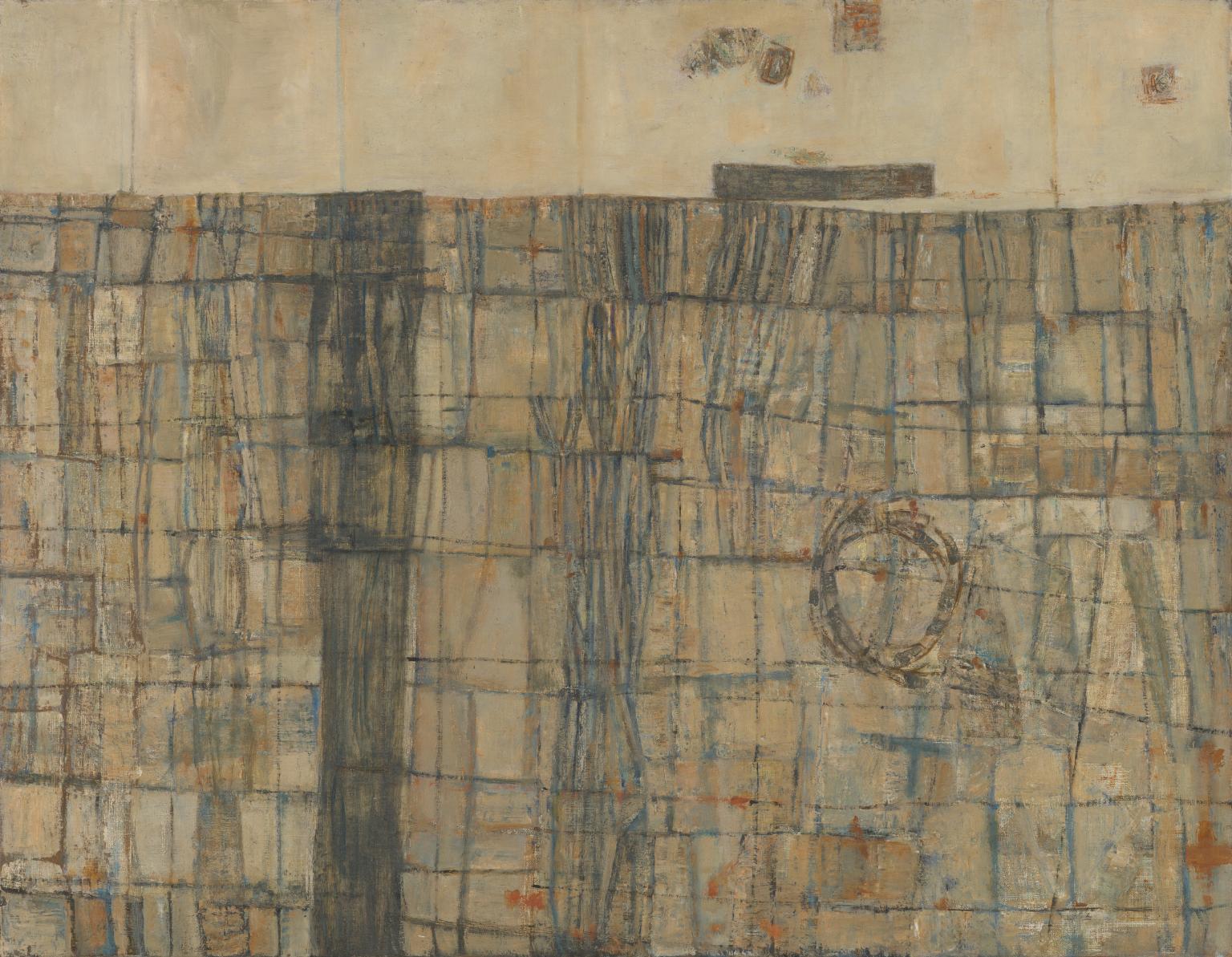
Prunella Clough, Paper Bales 1960
Paper Bales 1960 is a large rectangular oil painting on canvas that depicts geometrically abstract bales of paper in a non-descript and anonymous setting. Mostly rendered in Clough’s signature drab palette of greys, blues, creams and beiges, the canvas is punctuated by dabs of orange that serve to disrupt the painting’s graph-like wall of paper that dominates its foreground. The paper’s overlapping linear forms concertina, the concentration of their colouring reminiscent of an unruly barbed wire fence. The principal plane of the bales is interrupted by a circular swirl – presumably of string – in the mid-right side of the work. The swirl’s disruption of Clough’s graphic scheme serves to anchor four of the five small abstract shapes that float in the grim cream sky that frames the paper bales horizontally from above.
10/13
artworks in Prunella Clough: Urbscapes
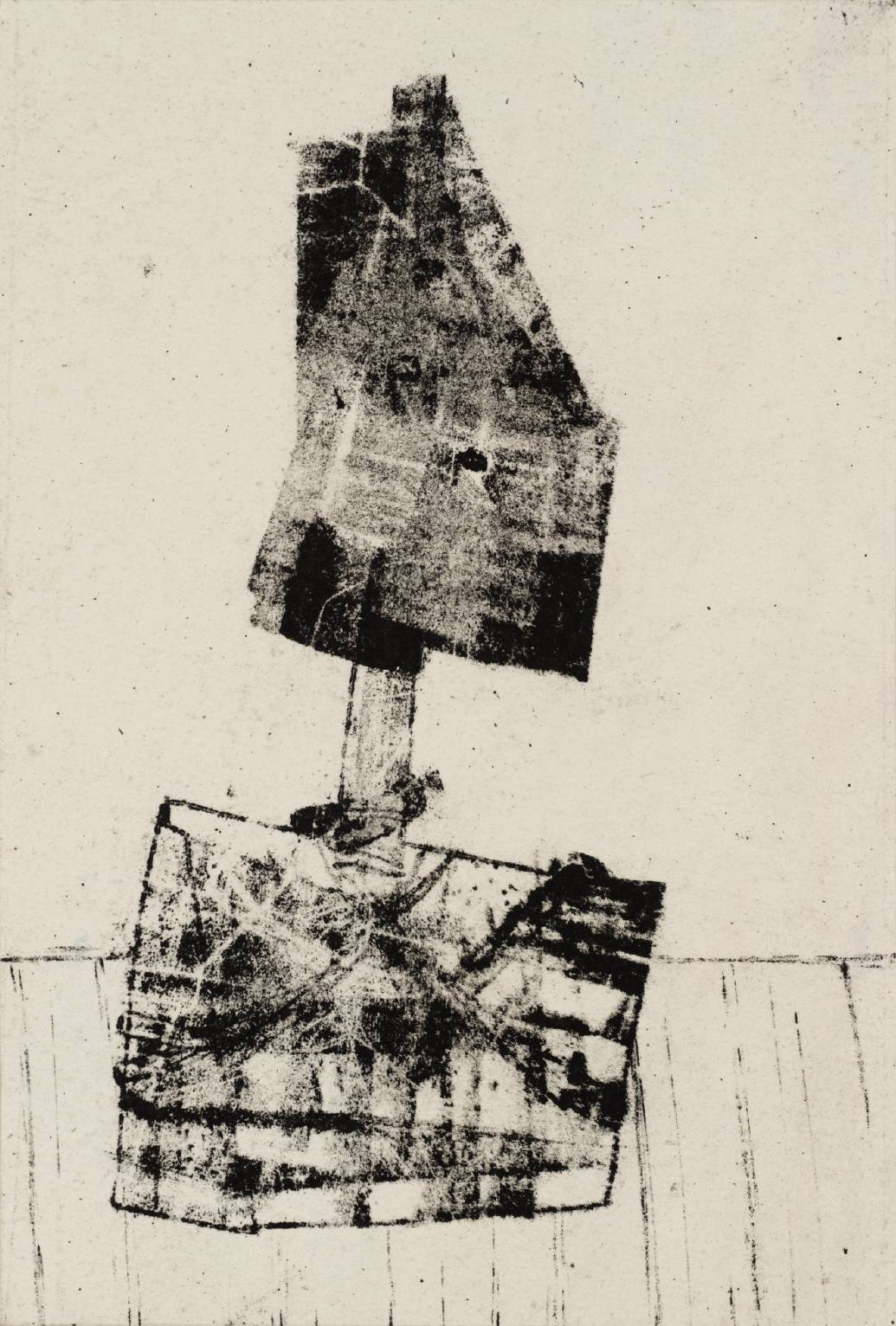
Prunella Clough, Float 1950
11/13
artworks in Prunella Clough: Urbscapes
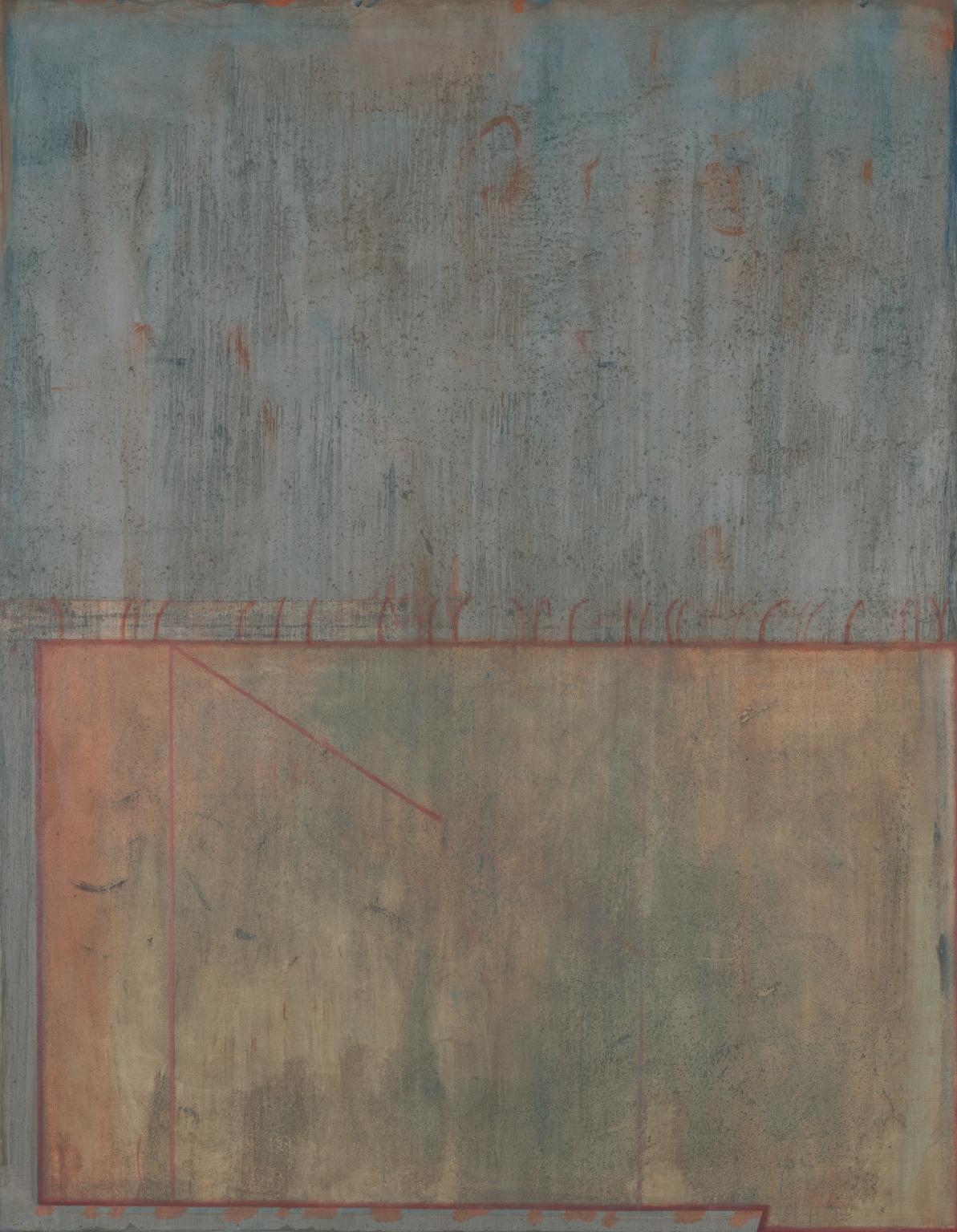
Prunella Clough, By the Canal 1976
Prunella Clough was born in London and studied at Chelsea School of Art. She had her first solo exhibition at the Leger Galleries in 1947 and three retrospective exhibitions at the Whitechapel Art Gallery, London in 1960, the Graves Art Gallery, Sheffield in 1972 and the Gallery of Modern Art, Edinburgh in 1976. Clough finds her subjects in the urban industrial landscape. Instead of making sketches on the spot she scrutinises particular motifs committing them to memory. Occasionally Clough takes photographs of aspects of the urban scene but these are not translated directly into paint. She likes to mix ash, sand or similar materials with her paints to give her pictures a sense of gritty strength.
Gallery label, September 2004
12/13
artworks in Prunella Clough: Urbscapes
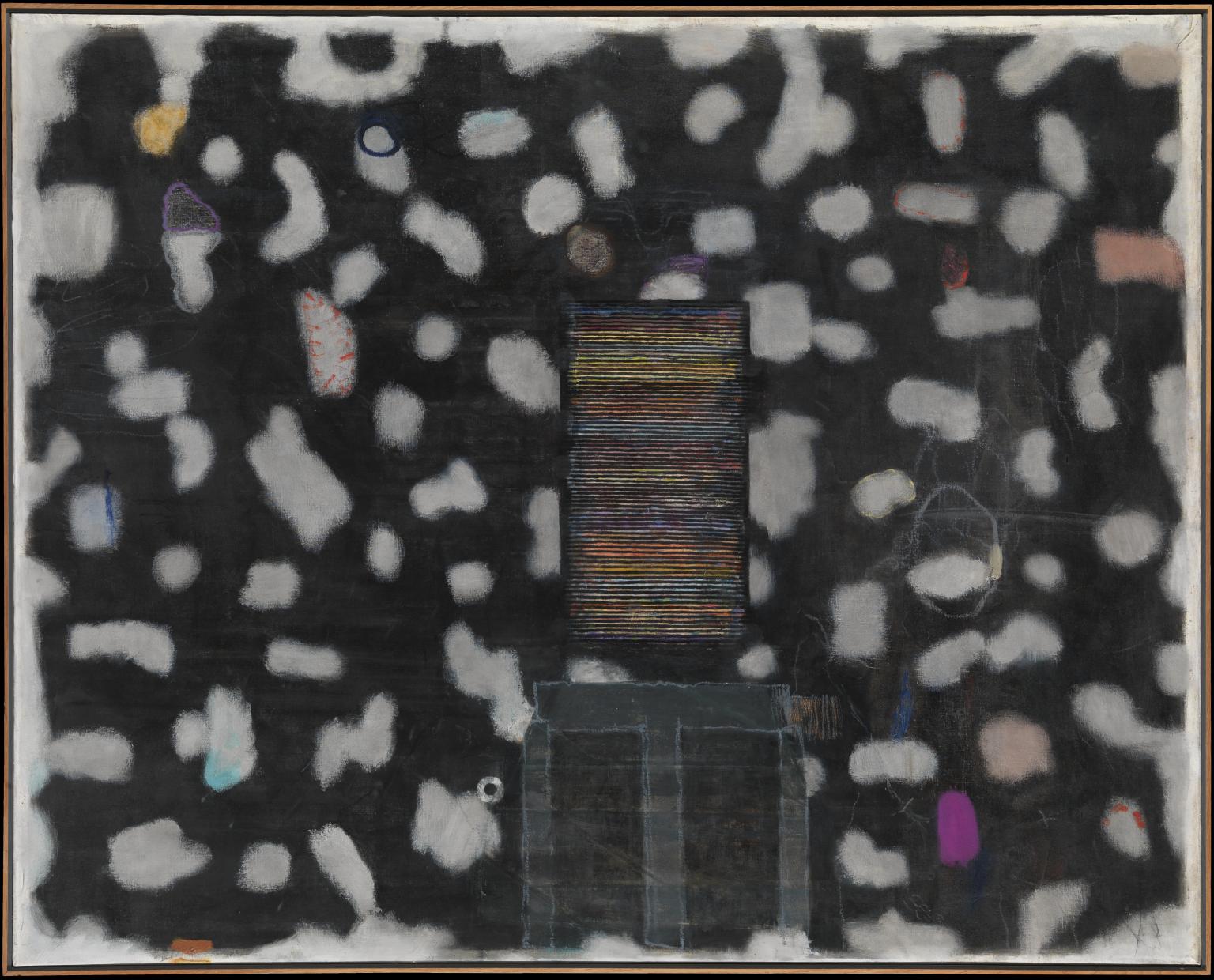
Prunella Clough, Stack 1993
13/13
artworks in Prunella Clough: Urbscapes
Art in this room
Prunella Clough
Rockery, 1963
1962–3
Prunella Clough
The White Root
1946
Prunella Clough
Marsh Plants
1954
Prunella Clough
Corrugated Fence
1955
Prunella Clough
Fence/Climbing Plant
1978
Prunella Clough
Cooling Tower II
1958
You've viewed 6/13 artworks
You've viewed 13/13 artworks