

Gerhard Richter, Cage (1) - (6) 2006. Lent from a private collection 2007. © 2006 Gerhard Richter.
14 rooms in Artist and Society
Look at Gerhard Richter's Cage paintings and consider the ways that abstract art can be political
Gerhard Richter’s Cage paintings are a suite of six canvases that form a single artwork. Richter made them using a scraper to drag thick layers of paint across the canvases. Ragged lines and discordant colours emerge from this intentionally unpredictable process.
The paintings are named after the US minimalist composer John Cage (1912–1992). Cage introduced elements of chance into his musical compositions, often using the I Ching (‘Book of Changes’), an ancient Chinese text, as a decision-making tool. This approach greatly interested Richter, whose own paintings explore the possibilities of an artwork that is subject to controlled chance.
Richter grew up in the former German Democratic Republic (GDR 1949–1990), where art was required to be representational and promote the politics and values of the socialist state. Upon seeing the abstract paintings of Jackson Pollock and Lucio Fontana at documenta II in Kassel, West Germany, in 1959, he recalled:
‘The sheer brazenness of it! That really fascinated me and impressed me. I might also say that those paintings were the real reason I left the GDR. I realised there was something wrong with my whole way of thinking.’
Throughout his career, Richter has experimented with both abstract and figurative painting. Either beginning with found images or working in complete abstraction, like the Cage paintings, his artworks explore not only the power of the image, but the limits of representation.
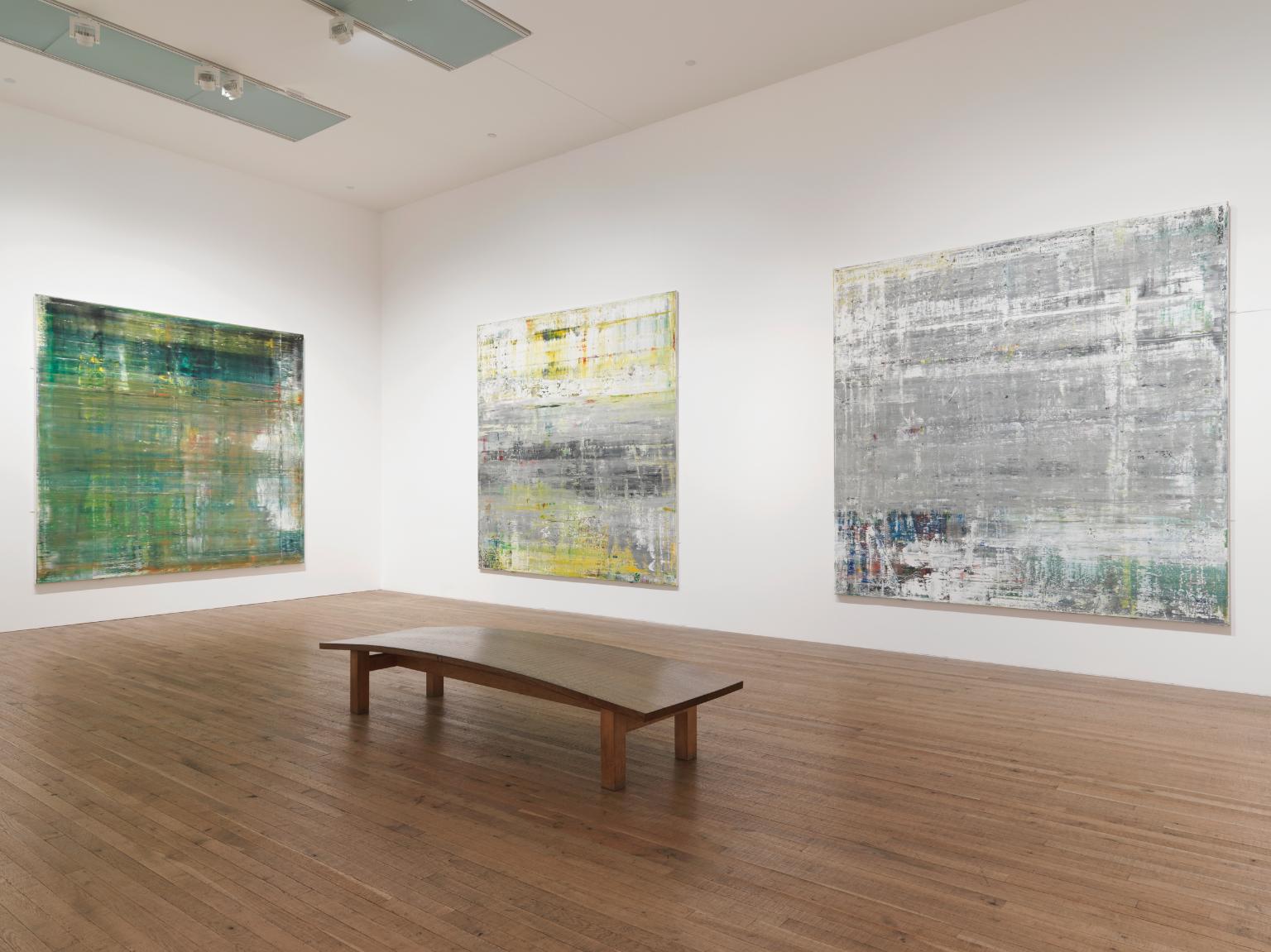
Gerhard Richter, Cage (1) - (6) 2006
Cage (1) – (6) 2006 is a group of six large, square abstract paintings by the German artist Gerhard Richter. Three of the canvases measure 2900 x 2900 mm, while the other three are slightly larger, at 3000 x 3000 mm each. The paintings all have a similar thickly painted surface that is rough and textured in appearance. They are composed of a progression of horizontal and vertical bands and a series of multi-directional scratches and indentations that are scraped into the painted surface. In specific areas of the paintings, the upper layers of paint have been removed and several sublayers of colour exposed. In each painting, the layers of colours and the composition of the bands and marks are different. Cage (1) is predominantly lime green in hue with a wide bottle green bar running horizontally across the upper quarter of the composition, and at the far right of the work is a wide vertical band composed mostly of white, but also containing yellow and green. Cage (2) is largely pale grey, white and lime green, with small exposed areas of bright red and charcoal grey. Cage (3) is composed of multiple scratch marks and indentations and is mostly light grey and white, with small patches of lime green, bottle green, dark grey, blue and red. Cage (4) has multiple sublayers of paint exposed, while Cage (5) is predominantly grey with white, red, pale yellow and a small amount of black. Cage (6) is the most varied in its range of exposed underlying colours, but it overall composition is mainly green, white, yellow, black and blue. The paintings are designed to be hung together in one large gallery space.
1/1
artworks in Gerhard Richter
Art in this room
Gerhard Richter
Cage (1) - (6)
2006