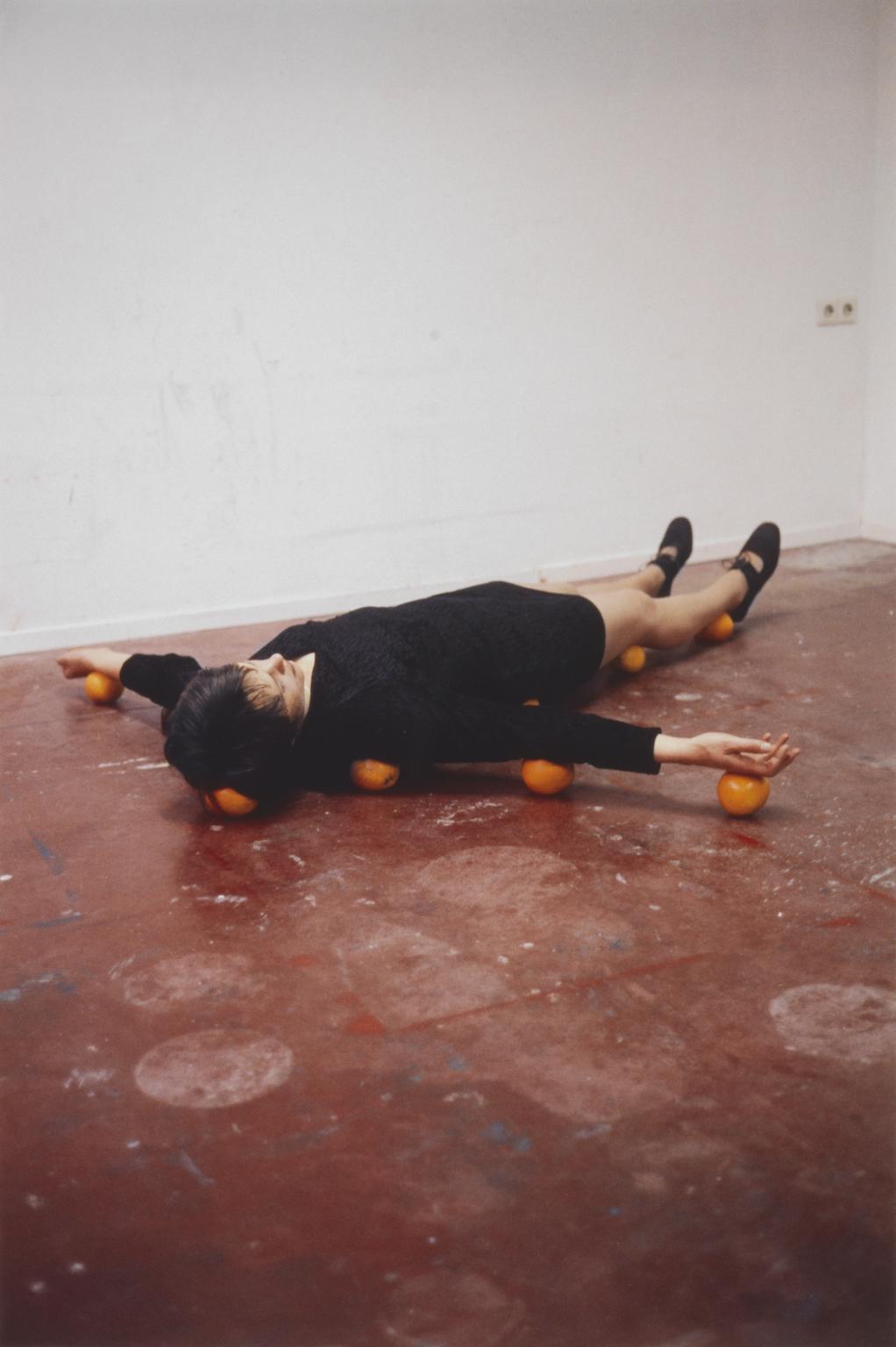
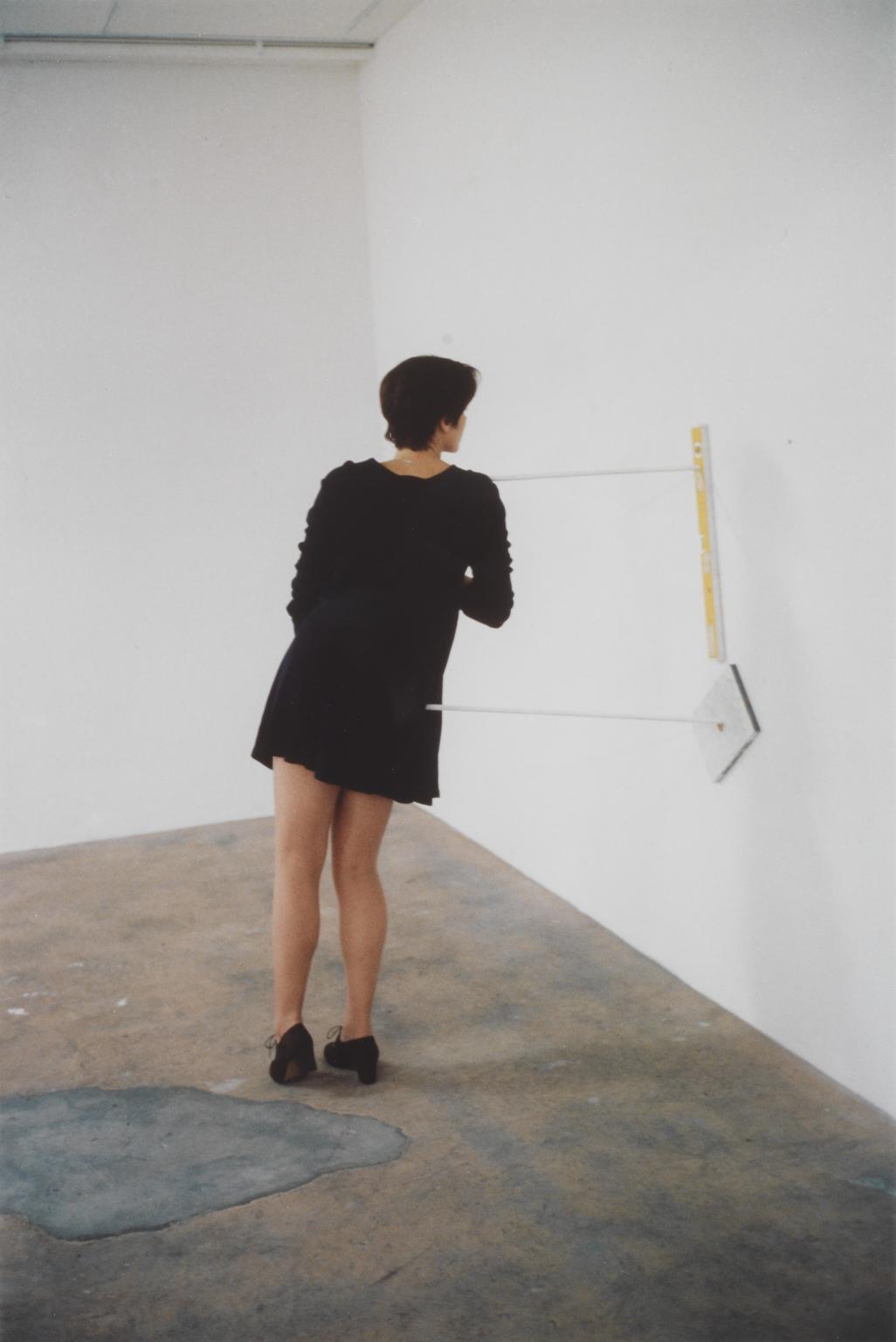
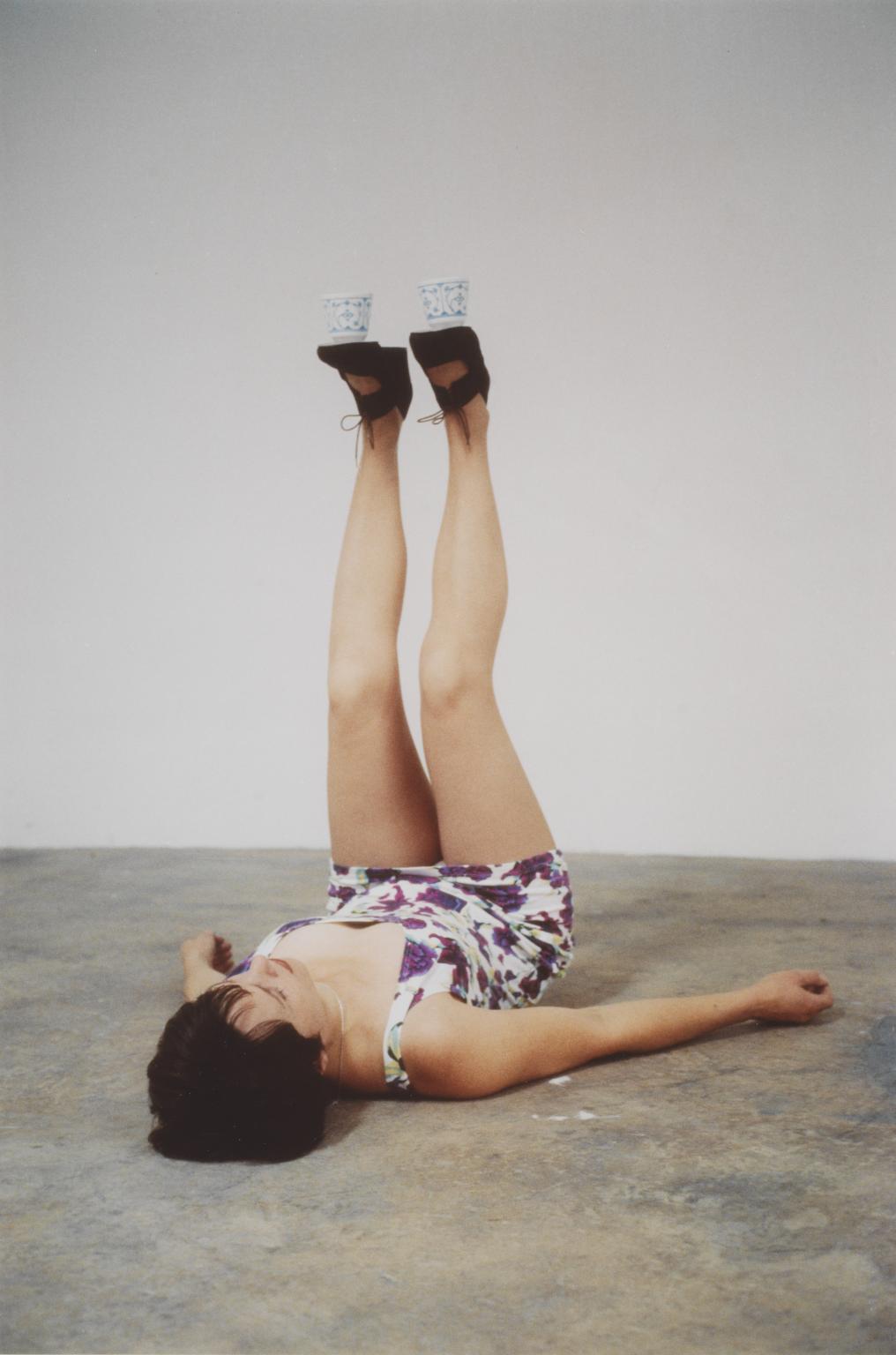
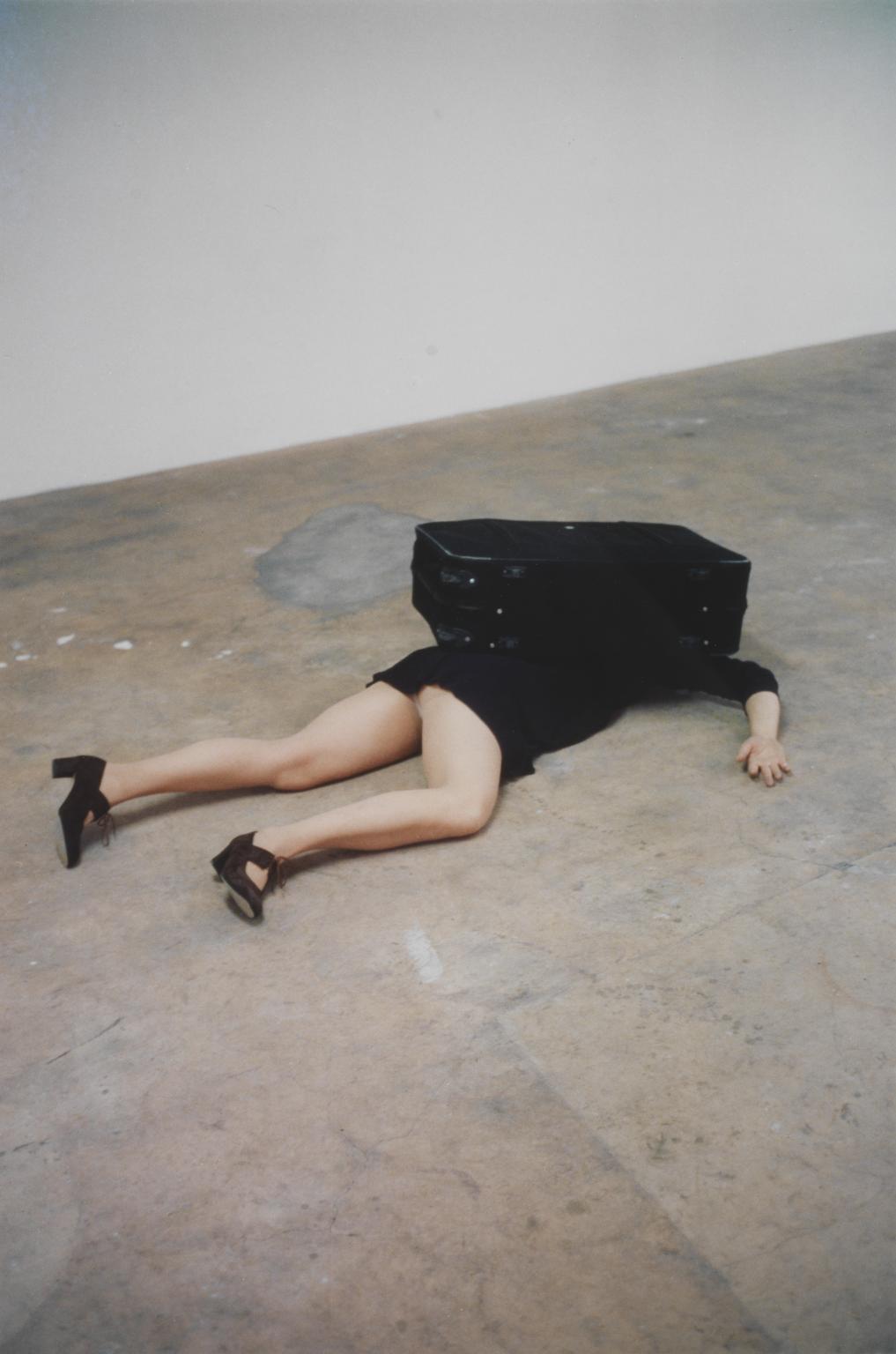
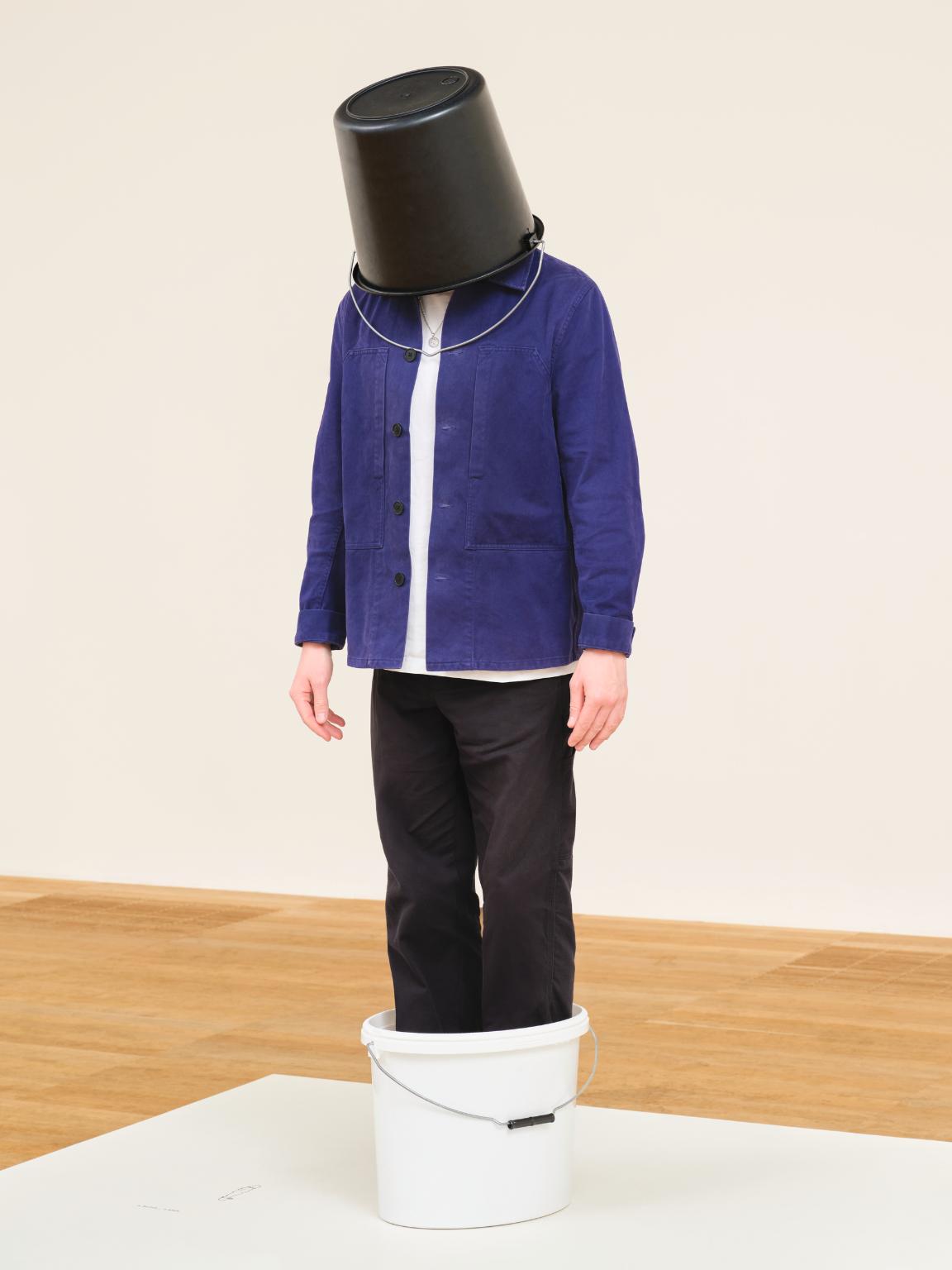
Erwin Wurm, One Minute Sculptures 1997. Tate. © Erwin Wurm.
Erwin Wurm
9 rooms in Performer and Participant
What happens when a sculpture is looked at as a performance?
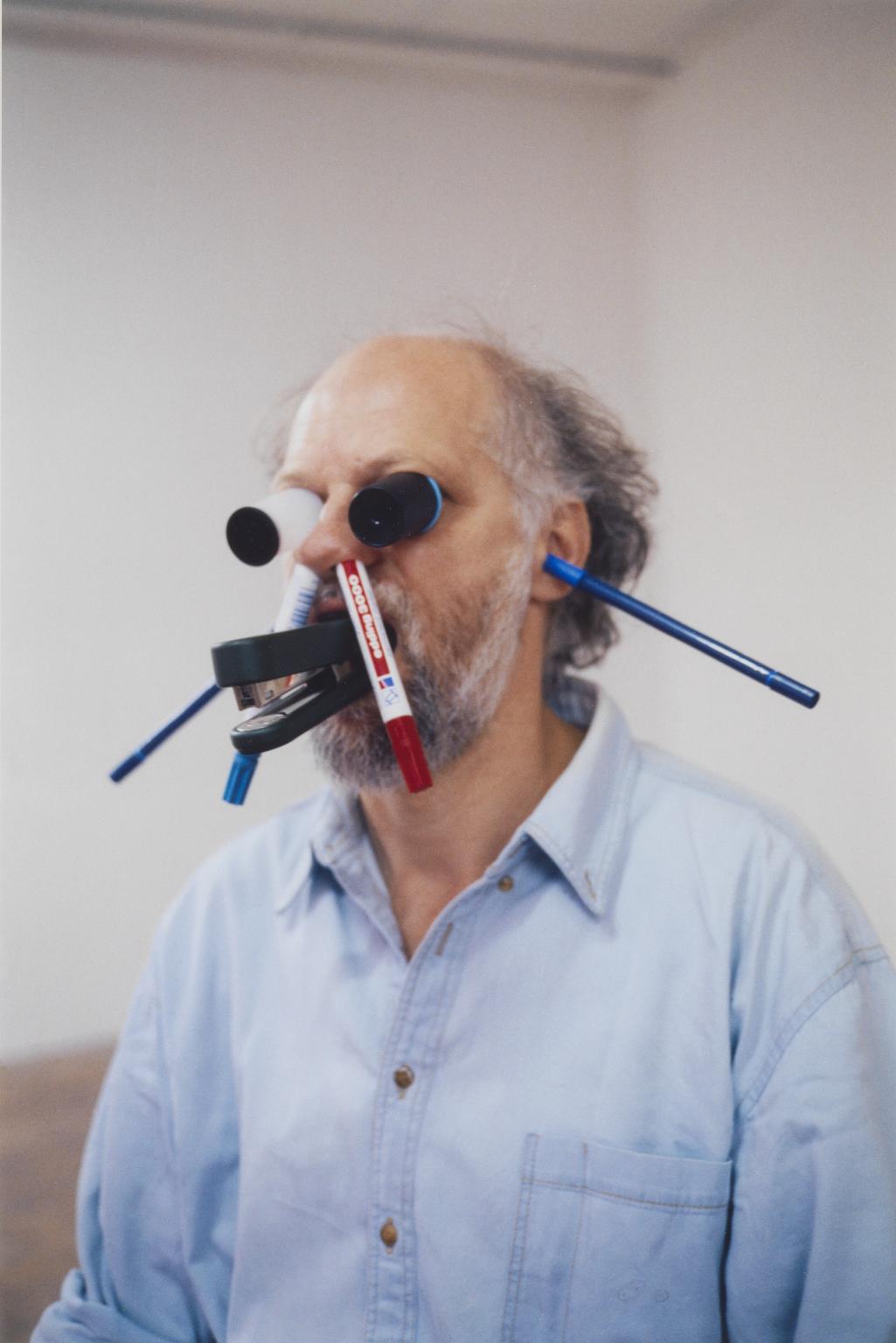
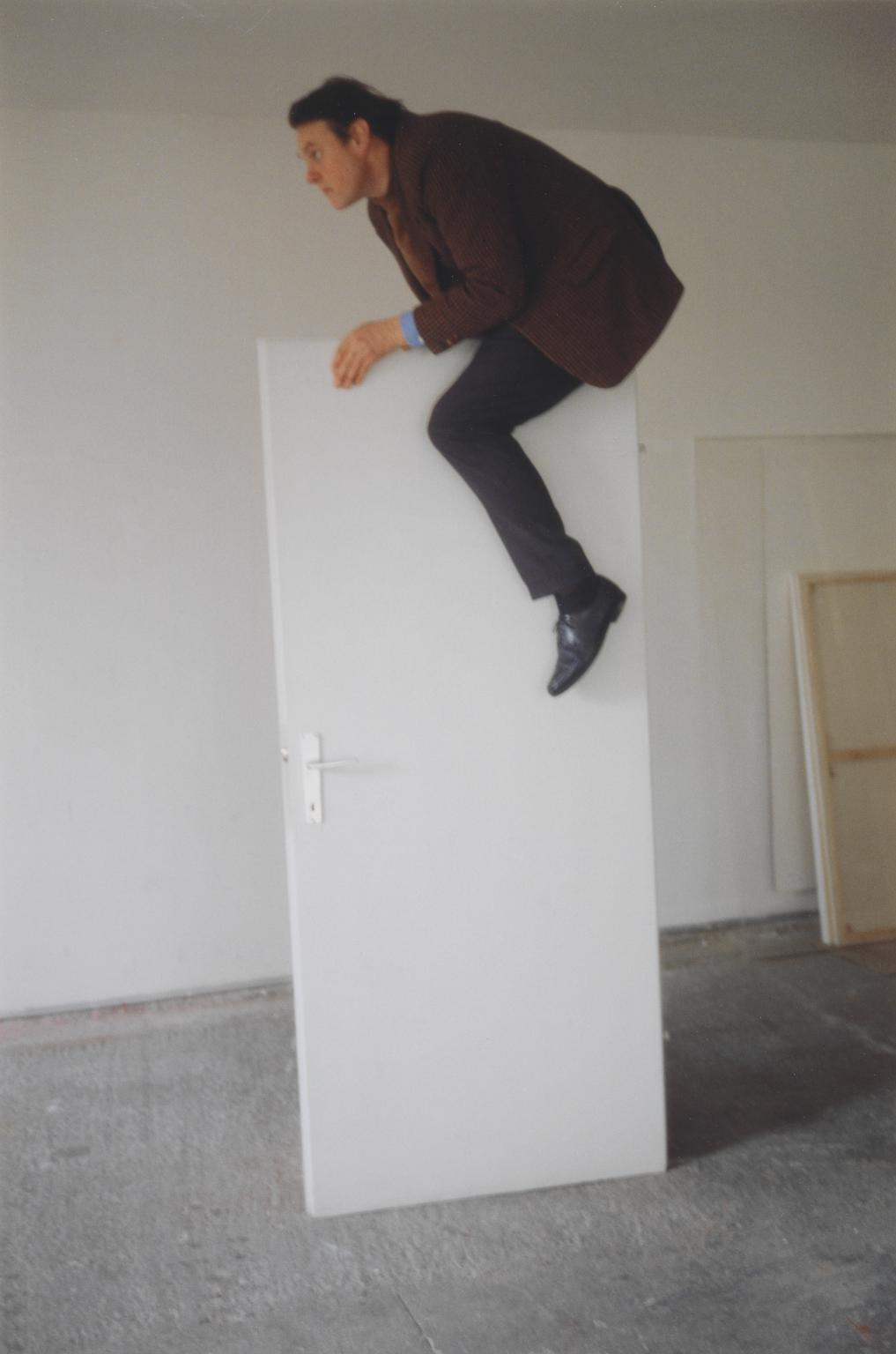
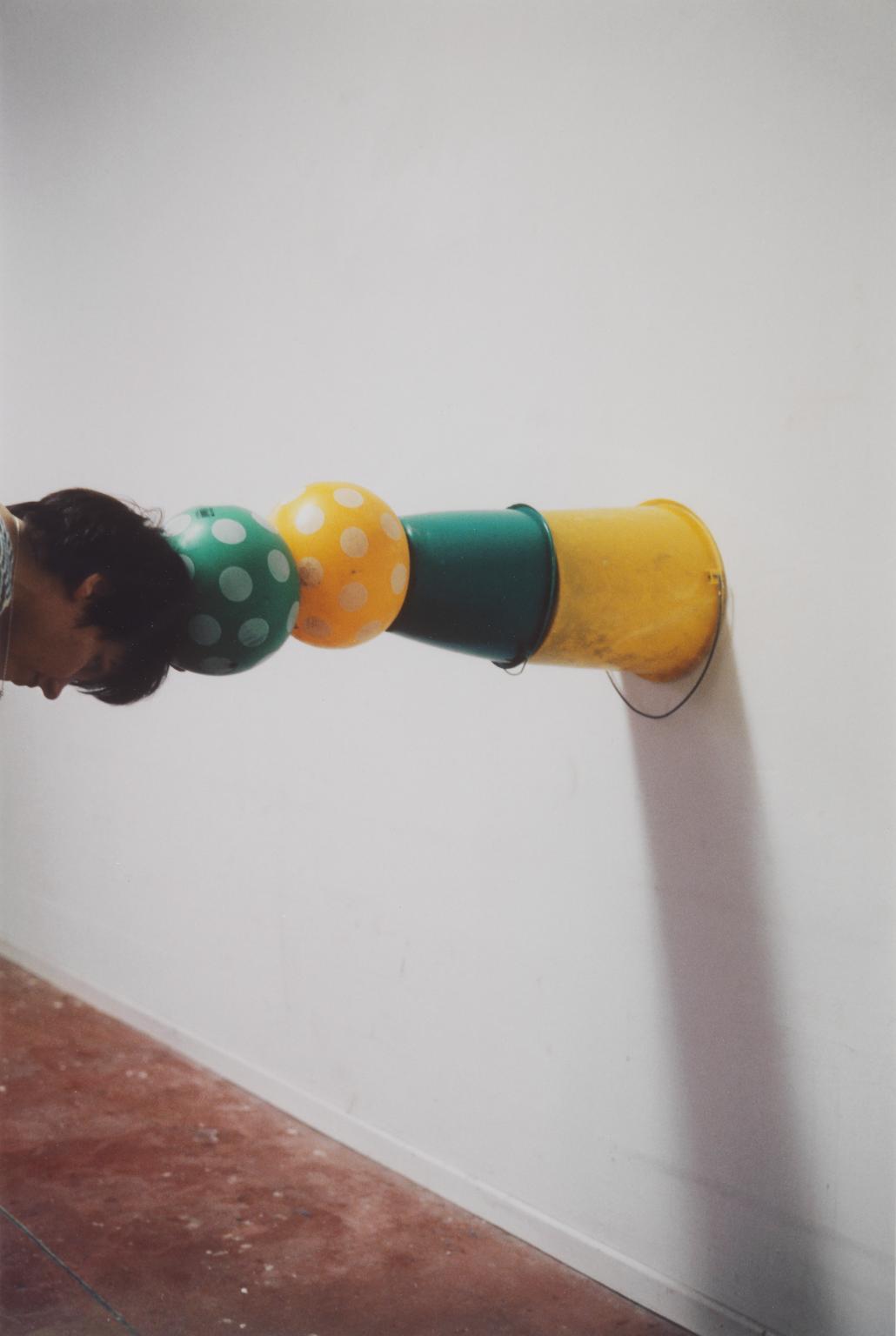
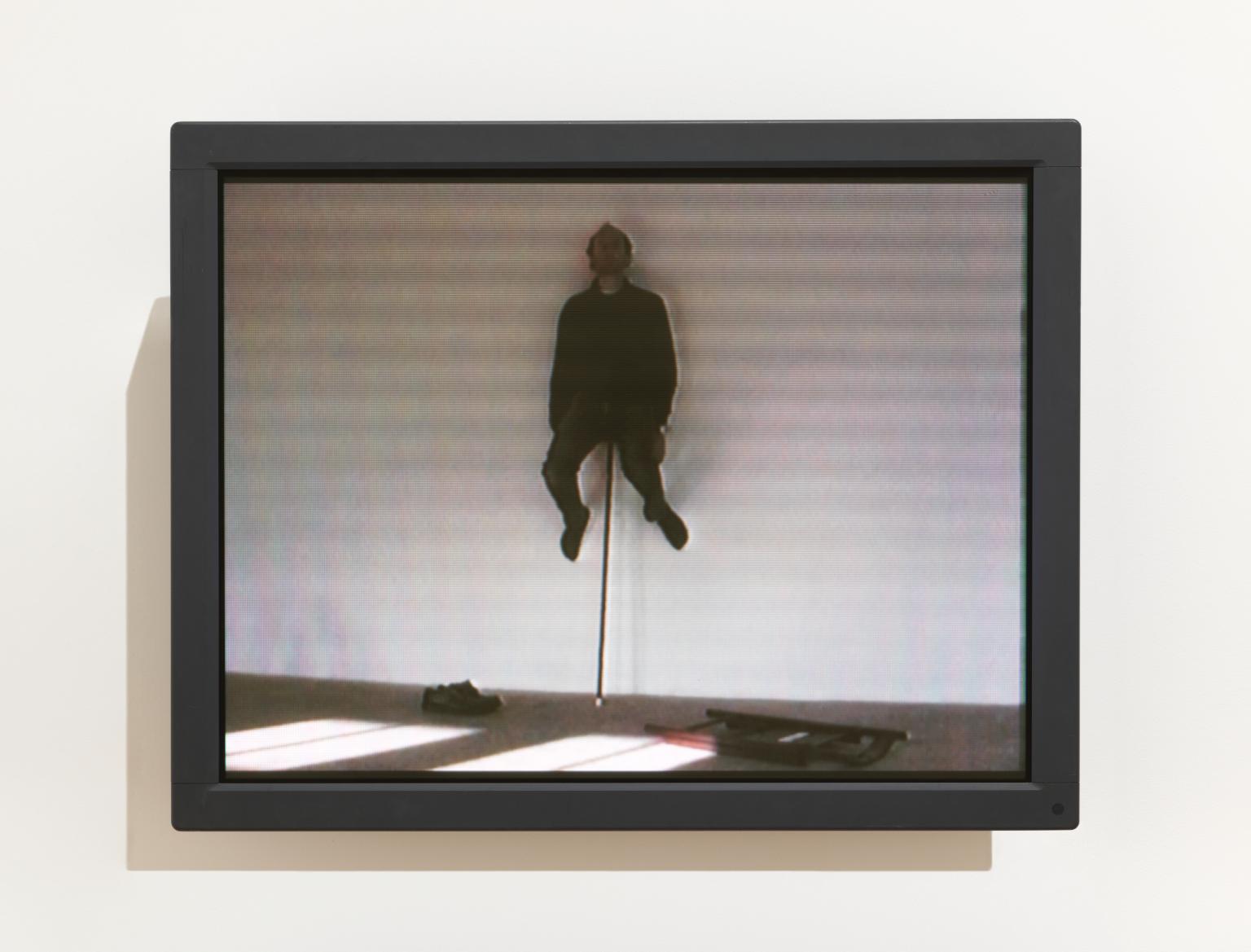
Erwin Wurm challenges the idea that a sculpture must be solid, long-lasting, or even physically present. In his ongoing series, One Minute Sculptures, anonymous people take on unusual and fleeting interactions with everyday objects, which are then photographed by the artist. Here, a selection of photographs capture participants in absurd poses, such as balancing on a door or pressing buckets against a wall. A video nearby also shows the precarious nature of the interactions. The works transform moments of play and awkwardness into reflections on time, form, and the body in art.
Wurm provides instructions on how to perform the sculptures, often as a simple drawing or a written phrase. The participant then tries to hold the pose for 60 seconds. In this short timeframe, the performer becomes both the subject and the material of Wurm’s sculptures. Through humour and absurdity, the artist’s instructions prompt reflection on the seriousness that is usually assigned to art and art galleries.
Double Bucket, Wurm’s performance piece involving two plastic buckets and a plinth, will also be in this room at regular intervals. You are welcome to take part and try out becoming the art when the buckets are on display.
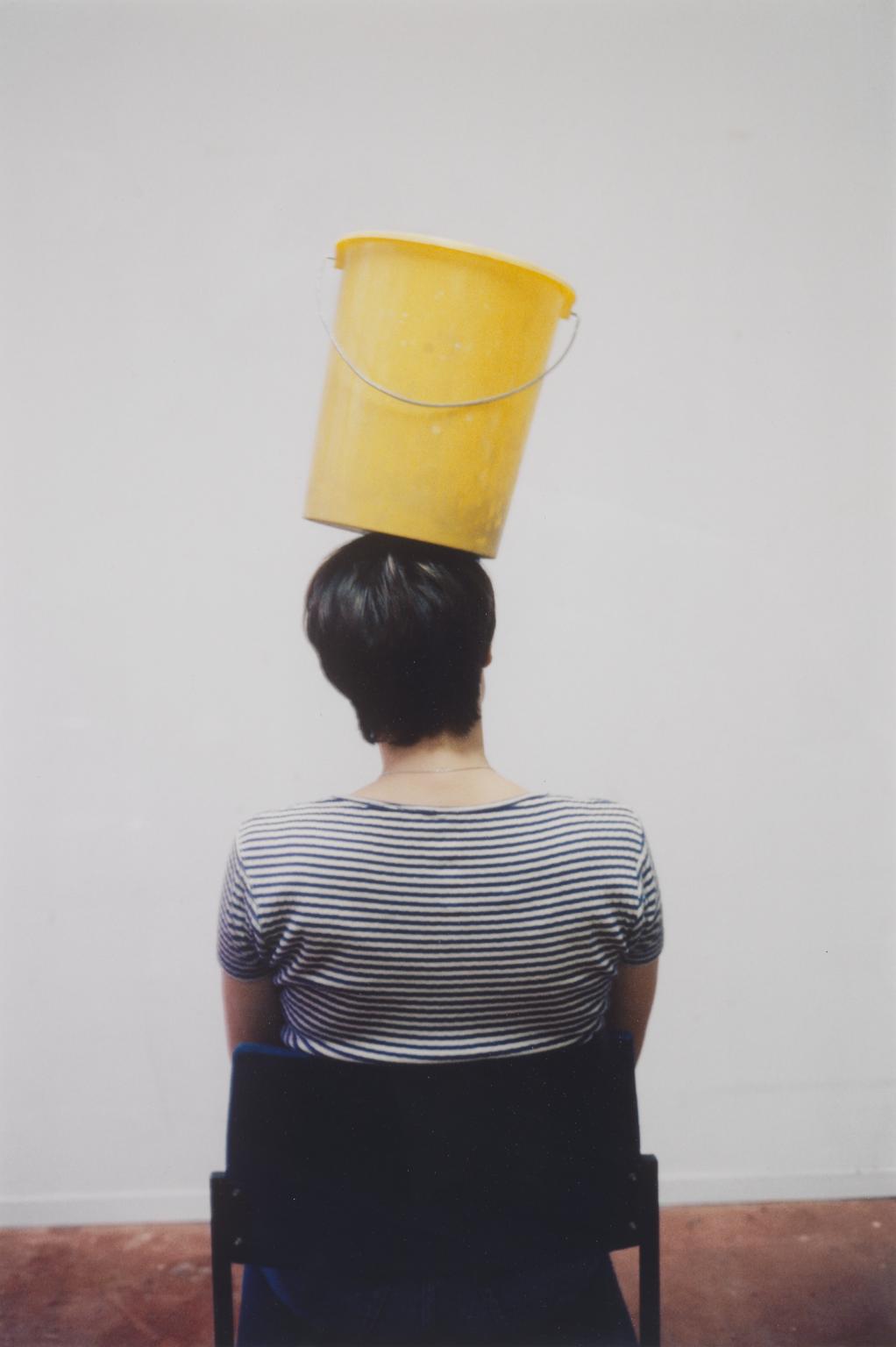
Erwin Wurm, One Minute Sculptures 1997
This colour photograph is one of a large number in Tate’s collection from Erwin Wurm’s series One Minute Sculptures (see Tate P14777–P14816 and Tate P82011–P82018). Wurm began his One Minute Sculptures in 1988, and has since been continuously contributing to the encyclopaedic series in myriad locations around the world. As well as photographs, the series comprises video (see One Minute Sculptures 1977, Tate T15047) and performance works (see Double Bucket 2009, Tate T15258, and Organisation of Love 2007, Tate T15257). The individual photographs feature images of people – anonymous participants, performers, curators, artists and even the artist himself – engaging in unconventional and sometimes physically challenging interactions with everyday objects such as clothing, buckets, balls, doorframes, bicycles and perishable goods. The resulting compositions feature unusual contortions – held for a minute – and illogical still-lives that are both humorous and provocative. While the photograph is the enduring record of each composition, the work comprises the entirety of the performative process, which begins with Wurm delivering instructions, both written and pictorial, to the subject of the ‘sculpture’. The participant subsequently enacts the determined formation or action and maintains it for a period of sixty seconds, during which time the pose is photographed. In a complex work that explores interaction, activation and the temporal, Wurm employs the photographic medium as a means of cataloguing his ephemeral studies.
1/22
artworks in Erwin Wurm
Erwin Wurm, One Minute Sculpture 1997
This colour photograph is one of a large number in Tate’s collection from Erwin Wurm’s series One Minute Sculptures (see Tate P14777–P14816 and Tate P82011–P82018). Wurm began his One Minute Sculptures in 1988, and has since been continuously contributing to the encyclopaedic series in myriad locations around the world. As well as photographs, the series comprises video (see One Minute Sculptures 1977, Tate T15047) and performance works (see Double Bucket 2009, Tate T15258, and Organisation of Love 2007, Tate T15257). The individual photographs feature images of people – anonymous participants, performers, curators, artists and even the artist himself – engaging in unconventional and sometimes physically challenging interactions with everyday objects such as clothing, buckets, balls, doorframes, bicycles and perishable goods. The resulting compositions feature unusual contortions – held for a minute – and illogical still-lives that are both humorous and provocative. While the photograph is the enduring record of each composition, the work comprises the entirety of the performative process, which begins with Wurm delivering instructions, both written and pictorial, to the subject of the ‘sculpture’. The participant subsequently enacts the determined formation or action and maintains it for a period of sixty seconds, during which time the pose is photographed. In a complex work that explores interaction, activation and the temporal, Wurm employs the photographic medium as a means of cataloguing his ephemeral studies.
2/22
artworks in Erwin Wurm
Erwin Wurm, One Minute Sculptures 1997–2005
This colour photograph is one of a large number in Tate’s collection from Erwin Wurm’s series One Minute Sculptures (see Tate P14777–P14816 and Tate P82011–P82018). Wurm began his One Minute Sculptures in 1988, and has since been continuously contributing to the encyclopaedic series in myriad locations around the world. As well as photographs, the series comprises video (see One Minute Sculptures 1977, Tate T15047) and performance works (see Double Bucket 2009, Tate T15258, and Organisation of Love 2007, Tate T15257). The individual photographs feature images of people – anonymous participants, performers, curators, artists and even the artist himself – engaging in unconventional and sometimes physically challenging interactions with everyday objects such as clothing, buckets, balls, doorframes, bicycles and perishable goods. The resulting compositions feature unusual contortions – held for a minute – and illogical still-lives that are both humorous and provocative. While the photograph is the enduring record of each composition, the work comprises the entirety of the performative process, which begins with Wurm delivering instructions, both written and pictorial, to the subject of the ‘sculpture’. The participant subsequently enacts the determined formation or action and maintains it for a period of sixty seconds, during which time the pose is photographed. In a complex work that explores interaction, activation and the temporal, Wurm employs the photographic medium as a means of cataloguing his ephemeral studies.
3/22
artworks in Erwin Wurm
Erwin Wurm, One Minute Sculptures 1997–2005
This colour photograph is one of a large number in Tate’s collection from Erwin Wurm’s series One Minute Sculptures (see Tate P14777–P14816 and Tate P82011–P82018). Wurm began his One Minute Sculptures in 1988, and has since been continuously contributing to the encyclopaedic series in myriad locations around the world. As well as photographs, the series comprises video (see One Minute Sculptures 1977, Tate T15047) and performance works (see Double Bucket 2009, Tate T15258, and Organisation of Love 2007, Tate T15257). The individual photographs feature images of people – anonymous participants, performers, curators, artists and even the artist himself – engaging in unconventional and sometimes physically challenging interactions with everyday objects such as clothing, buckets, balls, doorframes, bicycles and perishable goods. The resulting compositions feature unusual contortions – held for a minute – and illogical still-lives that are both humorous and provocative. While the photograph is the enduring record of each composition, the work comprises the entirety of the performative process, which begins with Wurm delivering instructions, both written and pictorial, to the subject of the ‘sculpture’. The participant subsequently enacts the determined formation or action and maintains it for a period of sixty seconds, during which time the pose is photographed. In a complex work that explores interaction, activation and the temporal, Wurm employs the photographic medium as a means of cataloguing his ephemeral studies.
4/22
artworks in Erwin Wurm
Erwin Wurm, One Minute Sculptures 1997–2005
This colour photograph is one of a large number in Tate’s collection from Erwin Wurm’s series One Minute Sculptures (see Tate P14777–P14816 and Tate P82011–P82018). Wurm began his One Minute Sculptures in 1988, and has since been continuously contributing to the encyclopaedic series in myriad locations around the world. As well as photographs, the series comprises video (see One Minute Sculptures 1977, Tate T15047) and performance works (see Double Bucket 2009, Tate T15258, and Organisation of Love 2007, Tate T15257). The individual photographs feature images of people – anonymous participants, performers, curators, artists and even the artist himself – engaging in unconventional and sometimes physically challenging interactions with everyday objects such as clothing, buckets, balls, doorframes, bicycles and perishable goods. The resulting compositions feature unusual contortions – held for a minute – and illogical still-lives that are both humorous and provocative. While the photograph is the enduring record of each composition, the work comprises the entirety of the performative process, which begins with Wurm delivering instructions, both written and pictorial, to the subject of the ‘sculpture’. The participant subsequently enacts the determined formation or action and maintains it for a period of sixty seconds, during which time the pose is photographed. In a complex work that explores interaction, activation and the temporal, Wurm employs the photographic medium as a means of cataloguing his ephemeral studies.
5/22
artworks in Erwin Wurm
Erwin Wurm, One Minute Sculptures 1997–2005
This colour photograph is one of a large number in Tate’s collection from Erwin Wurm’s series One Minute Sculptures (see Tate P14777–P14816 and Tate P82011–P82018). Wurm began his One Minute Sculptures in 1988, and has since been continuously contributing to the encyclopaedic series in myriad locations around the world. As well as photographs, the series comprises video (see One Minute Sculptures 1977, Tate T15047) and performance works (see Double Bucket 2009, Tate T15258, and Organisation of Love 2007, Tate T15257). The individual photographs feature images of people – anonymous participants, performers, curators, artists and even the artist himself – engaging in unconventional and sometimes physically challenging interactions with everyday objects such as clothing, buckets, balls, doorframes, bicycles and perishable goods. The resulting compositions feature unusual contortions – held for a minute – and illogical still-lives that are both humorous and provocative. While the photograph is the enduring record of each composition, the work comprises the entirety of the performative process, which begins with Wurm delivering instructions, both written and pictorial, to the subject of the ‘sculpture’. The participant subsequently enacts the determined formation or action and maintains it for a period of sixty seconds, during which time the pose is photographed. In a complex work that explores interaction, activation and the temporal, Wurm employs the photographic medium as a means of cataloguing his ephemeral studies.
6/22
artworks in Erwin Wurm
Erwin Wurm, One Minute Sculptures 1997–2005
This colour photograph is one of a large number in Tate’s collection from Erwin Wurm’s series One Minute Sculptures (see Tate P14777–P14816 and Tate P82011–P82018). Wurm began his One Minute Sculptures in 1988, and has since been continuously contributing to the encyclopaedic series in myriad locations around the world. As well as photographs, the series comprises video (see One Minute Sculptures 1977, Tate T15047) and performance works (see Double Bucket 2009, Tate T15258, and Organisation of Love 2007, Tate T15257). The individual photographs feature images of people – anonymous participants, performers, curators, artists and even the artist himself – engaging in unconventional and sometimes physically challenging interactions with everyday objects such as clothing, buckets, balls, doorframes, bicycles and perishable goods. The resulting compositions feature unusual contortions – held for a minute – and illogical still-lives that are both humorous and provocative. While the photograph is the enduring record of each composition, the work comprises the entirety of the performative process, which begins with Wurm delivering instructions, both written and pictorial, to the subject of the ‘sculpture’. The participant subsequently enacts the determined formation or action and maintains it for a period of sixty seconds, during which time the pose is photographed. In a complex work that explores interaction, activation and the temporal, Wurm employs the photographic medium as a means of cataloguing his ephemeral studies.
7/22
artworks in Erwin Wurm
Erwin Wurm, One Minute Sculptures 1997–2005
This colour photograph is one of a large number in Tate’s collection from Erwin Wurm’s series One Minute Sculptures (see Tate P14777–P14816 and Tate P82011–P82018). Wurm began his One Minute Sculptures in 1988, and has since been continuously contributing to the encyclopaedic series in myriad locations around the world. As well as photographs, the series comprises video (see One Minute Sculptures 1977, Tate T15047) and performance works (see Double Bucket 2009, Tate T15258, and Organisation of Love 2007, Tate T15257). The individual photographs feature images of people – anonymous participants, performers, curators, artists and even the artist himself – engaging in unconventional and sometimes physically challenging interactions with everyday objects such as clothing, buckets, balls, doorframes, bicycles and perishable goods. The resulting compositions feature unusual contortions – held for a minute – and illogical still-lives that are both humorous and provocative. While the photograph is the enduring record of each composition, the work comprises the entirety of the performative process, which begins with Wurm delivering instructions, both written and pictorial, to the subject of the ‘sculpture’. The participant subsequently enacts the determined formation or action and maintains it for a period of sixty seconds, during which time the pose is photographed. In a complex work that explores interaction, activation and the temporal, Wurm employs the photographic medium as a means of cataloguing his ephemeral studies.
8/22
artworks in Erwin Wurm
Erwin Wurm, One Minute Sculptures 1997–2005
This colour photograph is one of a large number in Tate’s collection from Erwin Wurm’s series One Minute Sculptures (see Tate P14777–P14816 and Tate P82011–P82018). Wurm began his One Minute Sculptures in 1988, and has since been continuously contributing to the encyclopaedic series in myriad locations around the world. As well as photographs, the series comprises video (see One Minute Sculptures 1977, Tate T15047) and performance works (see Double Bucket 2009, Tate T15258, and Organisation of Love 2007, Tate T15257). The individual photographs feature images of people – anonymous participants, performers, curators, artists and even the artist himself – engaging in unconventional and sometimes physically challenging interactions with everyday objects such as clothing, buckets, balls, doorframes, bicycles and perishable goods. The resulting compositions feature unusual contortions – held for a minute – and illogical still-lives that are both humorous and provocative. While the photograph is the enduring record of each composition, the work comprises the entirety of the performative process, which begins with Wurm delivering instructions, both written and pictorial, to the subject of the ‘sculpture’. The participant subsequently enacts the determined formation or action and maintains it for a period of sixty seconds, during which time the pose is photographed. In a complex work that explores interaction, activation and the temporal, Wurm employs the photographic medium as a means of cataloguing his ephemeral studies.
9/22
artworks in Erwin Wurm
Erwin Wurm, One Minute Sculptures 1997–2005
This colour photograph is one of a large number in Tate’s collection from Erwin Wurm’s series One Minute Sculptures (see Tate P14777–P14816 and Tate P82011–P82018). Wurm began his One Minute Sculptures in 1988, and has since been continuously contributing to the encyclopaedic series in myriad locations around the world. As well as photographs, the series comprises video (see One Minute Sculptures 1977, Tate T15047) and performance works (see Double Bucket 2009, Tate T15258, and Organisation of Love 2007, Tate T15257). The individual photographs feature images of people – anonymous participants, performers, curators, artists and even the artist himself – engaging in unconventional and sometimes physically challenging interactions with everyday objects such as clothing, buckets, balls, doorframes, bicycles and perishable goods. The resulting compositions feature unusual contortions – held for a minute – and illogical still-lives that are both humorous and provocative. While the photograph is the enduring record of each composition, the work comprises the entirety of the performative process, which begins with Wurm delivering instructions, both written and pictorial, to the subject of the ‘sculpture’. The participant subsequently enacts the determined formation or action and maintains it for a period of sixty seconds, during which time the pose is photographed. In a complex work that explores interaction, activation and the temporal, Wurm employs the photographic medium as a means of cataloguing his ephemeral studies.
10/22
artworks in Erwin Wurm
Erwin Wurm, One Minute Sculptures 1997
This colour photograph is one of a large number in Tate’s collection from Erwin Wurm’s series One Minute Sculptures (see Tate P14777–P14816 and Tate P82011–P82018). Wurm began his One Minute Sculptures in 1988, and has since been continuously contributing to the encyclopaedic series in myriad locations around the world. As well as photographs, the series comprises video (see One Minute Sculptures 1977, Tate T15047) and performance works (see Double Bucket 2009, Tate T15258, and Organisation of Love 2007, Tate T15257). The individual photographs feature images of people – anonymous participants, performers, curators, artists and even the artist himself – engaging in unconventional and sometimes physically challenging interactions with everyday objects such as clothing, buckets, balls, doorframes, bicycles and perishable goods. The resulting compositions feature unusual contortions – held for a minute – and illogical still-lives that are both humorous and provocative. While the photograph is the enduring record of each composition, the work comprises the entirety of the performative process, which begins with Wurm delivering instructions, both written and pictorial, to the subject of the ‘sculpture’. The participant subsequently enacts the determined formation or action and maintains it for a period of sixty seconds, during which time the pose is photographed. In a complex work that explores interaction, activation and the temporal, Wurm employs the photographic medium as a means of cataloguing his ephemeral studies.
11/22
artworks in Erwin Wurm
Erwin Wurm, One Minute Sculptures 1997
This colour photograph is one of a large number in Tate’s collection from Erwin Wurm’s series One Minute Sculptures (see Tate P14777–P14816 and Tate P82011–P82018). Wurm began his One Minute Sculptures in 1988, and has since been continuously contributing to the encyclopaedic series in myriad locations around the world. As well as photographs, the series comprises video (see One Minute Sculptures 1977, Tate T15047) and performance works (see Double Bucket 2009, Tate T15258, and Organisation of Love 2007, Tate T15257). The individual photographs feature images of people – anonymous participants, performers, curators, artists and even the artist himself – engaging in unconventional and sometimes physically challenging interactions with everyday objects such as clothing, buckets, balls, doorframes, bicycles and perishable goods. The resulting compositions feature unusual contortions – held for a minute – and illogical still-lives that are both humorous and provocative. While the photograph is the enduring record of each composition, the work comprises the entirety of the performative process, which begins with Wurm delivering instructions, both written and pictorial, to the subject of the ‘sculpture’. The participant subsequently enacts the determined formation or action and maintains it for a period of sixty seconds, during which time the pose is photographed. In a complex work that explores interaction, activation and the temporal, Wurm employs the photographic medium as a means of cataloguing his ephemeral studies.
12/22
artworks in Erwin Wurm
Erwin Wurm, One Minute Sculptures 1997
This colour photograph is one of a large number in Tate’s collection from Erwin Wurm’s series One Minute Sculptures (see Tate P14777–P14816 and Tate P82011–P82018). Wurm began his One Minute Sculptures in 1988, and has since been continuously contributing to the encyclopaedic series in myriad locations around the world. As well as photographs, the series comprises video (see One Minute Sculptures 1977, Tate T15047) and performance works (see Double Bucket 2009, Tate T15258, and Organisation of Love 2007, Tate T15257). The individual photographs feature images of people – anonymous participants, performers, curators, artists and even the artist himself – engaging in unconventional and sometimes physically challenging interactions with everyday objects such as clothing, buckets, balls, doorframes, bicycles and perishable goods. The resulting compositions feature unusual contortions – held for a minute – and illogical still-lives that are both humorous and provocative. While the photograph is the enduring record of each composition, the work comprises the entirety of the performative process, which begins with Wurm delivering instructions, both written and pictorial, to the subject of the ‘sculpture’. The participant subsequently enacts the determined formation or action and maintains it for a period of sixty seconds, during which time the pose is photographed. In a complex work that explores interaction, activation and the temporal, Wurm employs the photographic medium as a means of cataloguing his ephemeral studies.
13/22
artworks in Erwin Wurm
Erwin Wurm, One Minute Sculptures 1997
This colour photograph is one of a large number in Tate’s collection from Erwin Wurm’s series One Minute Sculptures (see Tate P14777–P14816 and Tate P82011–P82018). Wurm began his One Minute Sculptures in 1988, and has since been continuously contributing to the encyclopaedic series in myriad locations around the world. As well as photographs, the series comprises video (see One Minute Sculptures 1977, Tate T15047) and performance works (see Double Bucket 2009, Tate T15258, and Organisation of Love 2007, Tate T15257). The individual photographs feature images of people – anonymous participants, performers, curators, artists and even the artist himself – engaging in unconventional and sometimes physically challenging interactions with everyday objects such as clothing, buckets, balls, doorframes, bicycles and perishable goods. The resulting compositions feature unusual contortions – held for a minute – and illogical still-lives that are both humorous and provocative. While the photograph is the enduring record of each composition, the work comprises the entirety of the performative process, which begins with Wurm delivering instructions, both written and pictorial, to the subject of the ‘sculpture’. The participant subsequently enacts the determined formation or action and maintains it for a period of sixty seconds, during which time the pose is photographed. In a complex work that explores interaction, activation and the temporal, Wurm employs the photographic medium as a means of cataloguing his ephemeral studies.
14/22
artworks in Erwin Wurm
Erwin Wurm, One Minute Sculptures 1997
This video with sound is shown on a monitor and lasts nearly forty-eight minutes. It is one of a large number of works, mainly photographs, in Tate’s collection that form part of Erwin Wurm’s series One Minute Sculptures (see Tate P14777–P14816 and Tate P82011–P82016). Wurm began his One Minute Sculptures in 1988, and has since been continuously contributing to the encyclopaedic series in myriad locations around the world. The individual photographs feature images of people – anonymous participants, performers, curators, artists and even the artist himself – engaging in unconventional and sometimes physically challenging interactions with everyday objects such as clothing, buckets, balls, doorframes, bicycles and perishable goods. The resulting compositions feature unusual contortions – held for a minute – and illogical still-lives that are both humorous and provocative. While the photograph is the enduring record of each composition, the work comprises the entirety of the performative process, which begins with Wurm delivering instructions, both written and pictorial, to the subject of the ‘sculpture’. The participant subsequently enacts the determined formation or action and maintains it for a period of sixty seconds, during which time the pose is photographed. In a complex work that explores interaction, activation and the temporal, Wurm employs the photographic medium as a means of cataloguing his ephemeral studies.
15/22
artworks in Erwin Wurm
Erwin Wurm, One Minute Sculptures 1997
This colour photograph is one of a large number in Tate’s collection from Erwin Wurm’s series One Minute Sculptures (see Tate P14777–P14816 and Tate P82011–P82018). Wurm began his One Minute Sculptures in 1988, and has since been continuously contributing to the encyclopaedic series in myriad locations around the world. As well as photographs, the series comprises video (see One Minute Sculptures 1977, Tate T15047) and performance works (see Double Bucket 2009, Tate T15258, and Organisation of Love 2007, Tate T15257). The individual photographs feature images of people – anonymous participants, performers, curators, artists and even the artist himself – engaging in unconventional and sometimes physically challenging interactions with everyday objects such as clothing, buckets, balls, doorframes, bicycles and perishable goods. The resulting compositions feature unusual contortions – held for a minute – and illogical still-lives that are both humorous and provocative. While the photograph is the enduring record of each composition, the work comprises the entirety of the performative process, which begins with Wurm delivering instructions, both written and pictorial, to the subject of the ‘sculpture’. The participant subsequently enacts the determined formation or action and maintains it for a period of sixty seconds, during which time the pose is photographed. In a complex work that explores interaction, activation and the temporal, Wurm employs the photographic medium as a means of cataloguing his ephemeral studies.
16/22
artworks in Erwin Wurm
Erwin Wurm, One Minute Sculptures 1997–2005
This colour photograph is one of a large number in Tate’s collection from Erwin Wurm’s series One Minute Sculptures (see Tate P14777–P14816 and Tate P82011–P82018). Wurm began his One Minute Sculptures in 1988, and has since been continuously contributing to the encyclopaedic series in myriad locations around the world. As well as photographs, the series comprises video (see One Minute Sculptures 1977, Tate T15047) and performance works (see Double Bucket 2009, Tate T15258, and Organisation of Love 2007, Tate T15257). The individual photographs feature images of people – anonymous participants, performers, curators, artists and even the artist himself – engaging in unconventional and sometimes physically challenging interactions with everyday objects such as clothing, buckets, balls, doorframes, bicycles and perishable goods. The resulting compositions feature unusual contortions – held for a minute – and illogical still-lives that are both humorous and provocative. While the photograph is the enduring record of each composition, the work comprises the entirety of the performative process, which begins with Wurm delivering instructions, both written and pictorial, to the subject of the ‘sculpture’. The participant subsequently enacts the determined formation or action and maintains it for a period of sixty seconds, during which time the pose is photographed. In a complex work that explores interaction, activation and the temporal, Wurm employs the photographic medium as a means of cataloguing his ephemeral studies.
17/22
artworks in Erwin Wurm
Erwin Wurm, One Minute Sculptures 1997–2005
This colour photograph is one of a large number in Tate’s collection from Erwin Wurm’s series One Minute Sculptures (see Tate P14777–P14816 and Tate P82011–P82018). Wurm began his One Minute Sculptures in 1988, and has since been continuously contributing to the encyclopaedic series in myriad locations around the world. As well as photographs, the series comprises video (see One Minute Sculptures 1977, Tate T15047) and performance works (see Double Bucket 2009, Tate T15258, and Organisation of Love 2007, Tate T15257). The individual photographs feature images of people – anonymous participants, performers, curators, artists and even the artist himself – engaging in unconventional and sometimes physically challenging interactions with everyday objects such as clothing, buckets, balls, doorframes, bicycles and perishable goods. The resulting compositions feature unusual contortions – held for a minute – and illogical still-lives that are both humorous and provocative. While the photograph is the enduring record of each composition, the work comprises the entirety of the performative process, which begins with Wurm delivering instructions, both written and pictorial, to the subject of the ‘sculpture’. The participant subsequently enacts the determined formation or action and maintains it for a period of sixty seconds, during which time the pose is photographed. In a complex work that explores interaction, activation and the temporal, Wurm employs the photographic medium as a means of cataloguing his ephemeral studies.
18/22
artworks in Erwin Wurm
Erwin Wurm, One Minute Sculptures 1997–2005
This colour photograph is one of a large number in Tate’s collection from Erwin Wurm’s series One Minute Sculptures (see Tate P14777–P14816 and Tate P82011–P82018). Wurm began his One Minute Sculptures in 1988, and has since been continuously contributing to the encyclopaedic series in myriad locations around the world. As well as photographs, the series comprises video (see One Minute Sculptures 1977, Tate T15047) and performance works (see Double Bucket 2009, Tate T15258, and Organisation of Love 2007, Tate T15257). The individual photographs feature images of people – anonymous participants, performers, curators, artists and even the artist himself – engaging in unconventional and sometimes physically challenging interactions with everyday objects such as clothing, buckets, balls, doorframes, bicycles and perishable goods. The resulting compositions feature unusual contortions – held for a minute – and illogical still-lives that are both humorous and provocative. While the photograph is the enduring record of each composition, the work comprises the entirety of the performative process, which begins with Wurm delivering instructions, both written and pictorial, to the subject of the ‘sculpture’. The participant subsequently enacts the determined formation or action and maintains it for a period of sixty seconds, during which time the pose is photographed. In a complex work that explores interaction, activation and the temporal, Wurm employs the photographic medium as a means of cataloguing his ephemeral studies.
19/22
artworks in Erwin Wurm
Erwin Wurm, One Minute Sculptures 1997–2005
This colour photograph is one of a large number in Tate’s collection from Erwin Wurm’s series One Minute Sculptures (see Tate P14777–P14816 and Tate P82011–P82018). Wurm began his One Minute Sculptures in 1988, and has since been continuously contributing to the encyclopaedic series in myriad locations around the world. As well as photographs, the series comprises video (see One Minute Sculptures 1977, Tate T15047) and performance works (see Double Bucket 2009, Tate T15258, and Organisation of Love 2007, Tate T15257). The individual photographs feature images of people – anonymous participants, performers, curators, artists and even the artist himself – engaging in unconventional and sometimes physically challenging interactions with everyday objects such as clothing, buckets, balls, doorframes, bicycles and perishable goods. The resulting compositions feature unusual contortions – held for a minute – and illogical still-lives that are both humorous and provocative. While the photograph is the enduring record of each composition, the work comprises the entirety of the performative process, which begins with Wurm delivering instructions, both written and pictorial, to the subject of the ‘sculpture’. The participant subsequently enacts the determined formation or action and maintains it for a period of sixty seconds, during which time the pose is photographed. In a complex work that explores interaction, activation and the temporal, Wurm employs the photographic medium as a means of cataloguing his ephemeral studies.
20/22
artworks in Erwin Wurm
Erwin Wurm, One Minute Sculptures 1997
This colour photograph is one of a large number in Tate’s collection from Erwin Wurm’s series One Minute Sculptures (see Tate P14777–P14816 and Tate P82011–P82018). Wurm began his One Minute Sculptures in 1988, and has since been continuously contributing to the encyclopaedic series in myriad locations around the world. As well as photographs, the series comprises video (see One Minute Sculptures 1977, Tate T15047) and performance works (see Double Bucket 2009, Tate T15258, and Organisation of Love 2007, Tate T15257). The individual photographs feature images of people – anonymous participants, performers, curators, artists and even the artist himself – engaging in unconventional and sometimes physically challenging interactions with everyday objects such as clothing, buckets, balls, doorframes, bicycles and perishable goods. The resulting compositions feature unusual contortions – held for a minute – and illogical still-lives that are both humorous and provocative. While the photograph is the enduring record of each composition, the work comprises the entirety of the performative process, which begins with Wurm delivering instructions, both written and pictorial, to the subject of the ‘sculpture’. The participant subsequently enacts the determined formation or action and maintains it for a period of sixty seconds, during which time the pose is photographed. In a complex work that explores interaction, activation and the temporal, Wurm employs the photographic medium as a means of cataloguing his ephemeral studies.
21/22
artworks in Erwin Wurm
Erwin Wurm, One Minute Sculptures 1997–2005
This colour photograph is one of a large number in Tate’s collection from Erwin Wurm’s series One Minute Sculptures (see Tate P14777–P14816 and Tate P82011–P82018). Wurm began his One Minute Sculptures in 1988, and has since been continuously contributing to the encyclopaedic series in myriad locations around the world. As well as photographs, the series comprises video (see One Minute Sculptures 1977, Tate T15047) and performance works (see Double Bucket 2009, Tate T15258, and Organisation of Love 2007, Tate T15257). The individual photographs feature images of people – anonymous participants, performers, curators, artists and even the artist himself – engaging in unconventional and sometimes physically challenging interactions with everyday objects such as clothing, buckets, balls, doorframes, bicycles and perishable goods. The resulting compositions feature unusual contortions – held for a minute – and illogical still-lives that are both humorous and provocative. While the photograph is the enduring record of each composition, the work comprises the entirety of the performative process, which begins with Wurm delivering instructions, both written and pictorial, to the subject of the ‘sculpture’. The participant subsequently enacts the determined formation or action and maintains it for a period of sixty seconds, during which time the pose is photographed. In a complex work that explores interaction, activation and the temporal, Wurm employs the photographic medium as a means of cataloguing his ephemeral studies.
22/22
artworks in Erwin Wurm
Art in this room
Sorry, no image available
You've viewed 6/22 artworks
You've viewed 22/22 artworks