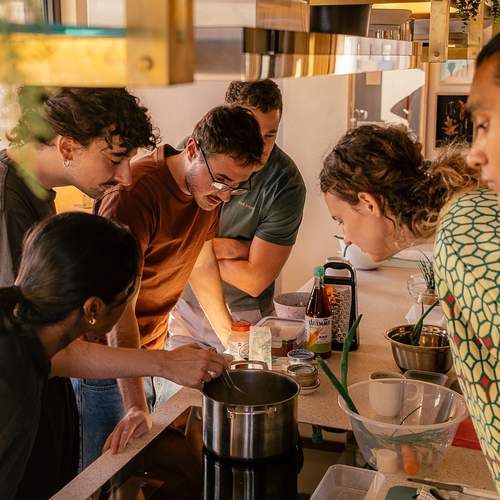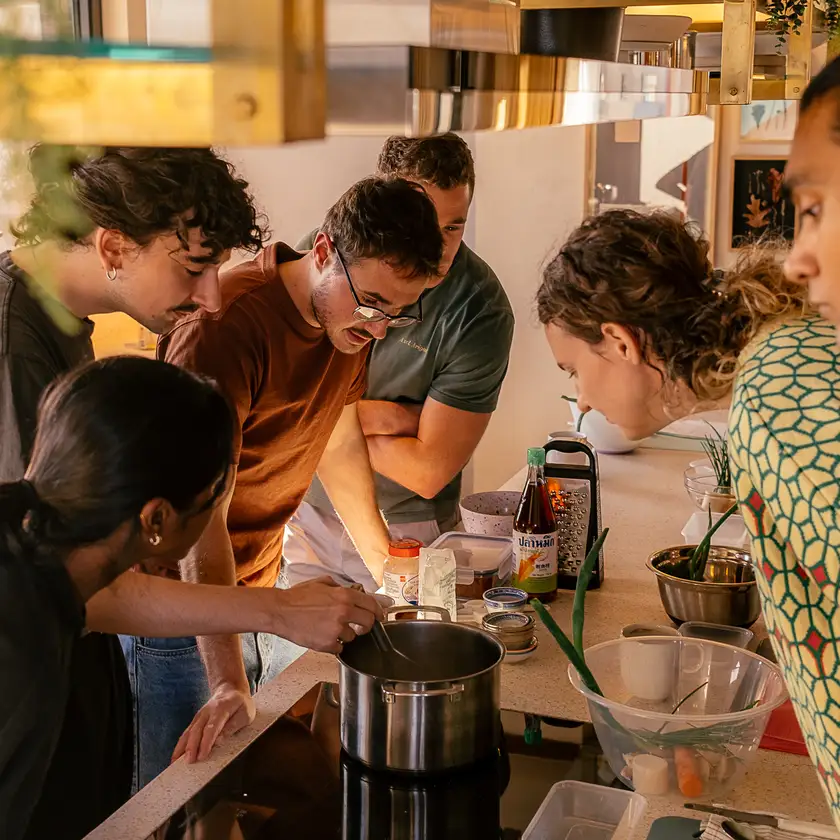
Under Stefan’s guidance, you’ll create your own sauerkraut and fermented hot sauce to take home. Learn the science, history, and techniques that turn everyday vegetables into flavour-packed staples.
Why ferment?
Fermentation transforms simple ingredients into bold, complex flavours while preserving nutrients naturally. Sauerkraut, or ‘sour cabbage’, has been a European staple for centuries, famously helping sailors avoid scurvy. Fermented hot sauce brings chillies to life with depth and tanginess, far beyond what vinegar alone can achieve.
What you will learn
- The basics of lacto-fermentation: how lactic acid bacteria turn cabbage and chillies into delicious ferments
- Hands-on guidance in making classic sauerkraut and fermented hot sauce from scratch
- Tips for flavour experimentation: spices, fruits, and vegetables in your ferments
- Troubleshooting common fermentation issues, from kahm yeast to mould
- How temperature, salinity, and time influence taste and texture
"Hey, My name is Stefan Russo of Russo's Kitchen.
My background is in biomedical science, where I am currently a post-doctoral researcher in Cell Biology & Immunology at Queen Mary University of London. My passion has always been cooking and after my doctorate, this passion led me pursue a career in the kitchen where I became chef de partie at the well-known London restaurant, Rochelle Canteen. Beside cooking, fermentation has always been a hobby of mine, a mix of both microbial science, human health and cooking. A hobby that was kickstarted from my time in South Korea where Kimchi was a daily staple. Since then, I have diversified into kombucha, pickles, sauerkraut, kefir, kvass, lactofermentation and sourdough. In these workshops I aim to help people understand how to safely and easily do these things at home and to teach you the benefits these foods can have on you and your daily lives."
All Tate Modern entrances are step-free. You can enter via the Turbine Hall and into the Natalie Bell Building on Holland Street, or into the Blavatnik Building on Sumner Street. There are lifts to every floor of the Blavatnik and Natalie Bell buildings. Alternatively you can take the stairs.
- Fully accessible toilets are located on every floor on the concourses
- A quiet room is available to use in the Natalie Bell Building on Level 4
- Ear defenders can be borrowed from the Ticket desks
To help plan your visit to Tate Modern, have a look at our visual story. It includes photographs and information about what you can expect from a visit to the gallery.
For more information before your visit:
- Email hello@tate.org.uk
- Call +44 (0)20 7887 8888 (daily 10.00–17.00)