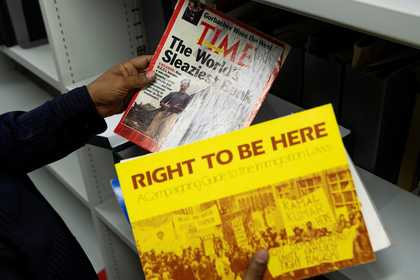
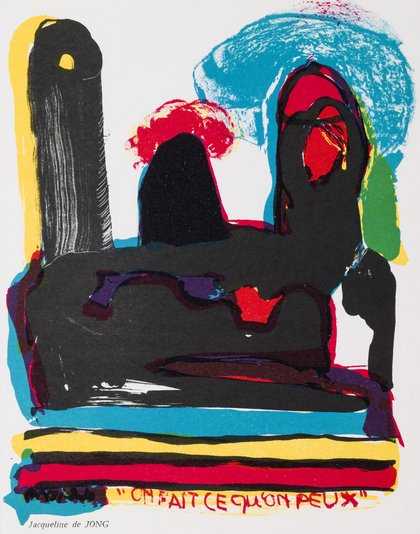
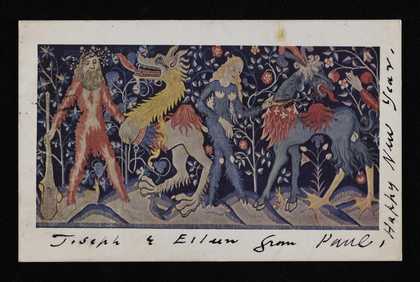
For South Asian Heritage Month, Tate's Library and Archive are putting on a Show and Share displaying highlights from the Panchayat Collection, alongside material relating to South Asian art and artists from Tate Library and Archive extensive collections.
Selected by Archivist Adrian Glew Archivist and Library Collections & Engagement Manager Gustavo Grandal Montero .
The Panchayat Collection, formerly Panchayat Arts Education Resource Unit (PAERU), consists of ephemera, information files, exhibition catalogues, books, journals, slides and videos relating to cultural activities and activism in Britain, mainland Europe, North America and South Asia between the 1980s and 2003. The Panchayat Collection is of central importance to the practice and exhibition histories of artists with South Asian, Caribbean and African heritage, living and working in Britain during this period.
Between 1997 and 2015 the collection was housed at the University of Westminster. In 2015, Shaheen Merali and Dr. Janice Cheddie, custodians of the Panchayat Collection, agreed to the transfer of the material to Tate Library as a Special Collection. Since then, it has attracted newer audiences and a wide range of researchers exploring topics including diasporic connections and the role of women of colour in the visual arts. The Panchayat Collection was the focus of a case study for the Provisional Semantics research project in 2020-2022.
Panchayat was founded in London in 1988 by Shaheen Merali and Allan de Souza, in consultation with Bhajan Hunjan, Symrath Patti and Shanti Thomas, as a response to the need for the representation of Southern world and first nation artists. Panchayat was first imagined by the group as an arts organisation whose focus was to create an archive of work by contemporary artists who would produce issue-based work, with a particular focus on cultural identity and the intersection between race, class, gender, policed sexualities, and (dis)ability. As the organisation developed it was involved in publishing, conferences, exhibitions and workshops.
The Panchayat Collection, formerly Panchayat Arts Education Resource Unit (PAERU), consists of ephemera, information files, exhibition catalogues, books, journals, slides and videos relating to cultural activities and activism in Britain, mainland Europe, North America and South Asia between the 1980s and 2003. The Panchayat Collection is of central importance to the practice and exhibition histories of artists with South Asian, Caribbean and African heritage, living and working in Britain during this period.
Between 1997 and 2015 the collection was housed at the University of Westminster. In 2015, Shaheen Merali and Dr. Janice Cheddie, custodians of the Panchayat Collection, agreed to the transfer of the material to Tate Library as a Special Collection. Since then, it has attracted newer audiences and a wide range of researchers exploring topics including diasporic connections and the role of women of colour in the visual arts. The Panchayat Collection was the focus of a case study for the Provisional Semantics research project in 2020-2022.
Tate Britain's step-free entrance is on Atterbury Street. It has automatic sliding doors and there is a ramp down to the entrance with central handrails.
There is a lift between the Lower and Main floors. Alternatively you can take the stairs.
- Accessible and standard toilets are located on the Lower floor.
- A Changing Places toilet is not currently available.
- Ear defenders can be borrowed from the ticket desk on the Lower floor.
To help plan your visit to Tate Britain, have a look at our visual story. It includes photographs and information about what you can expect from a visit to the gallery.
For more information before your visit:
Email hello@tate.org.uk
Call +44 (0)20 7887 8888 – option 1 (daily 09.45–18.00)